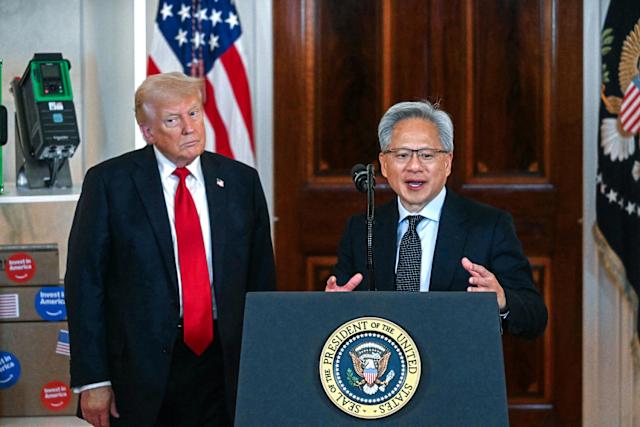
U.S. President Donald Trump announced Monday that his administration will allow chipmaker Nvidia to sell its advanced H200 artificial intelligence (AI) processors to “approved customers” in China, partially lifting a high-stakes export ban that had become a focal point of U.S.-China technological competition.
“We will protect National Security, create American Jobs, and keep America’s lead in AI,” Trump wrote in a social media post.
The policy shift, which also applies to other U.S. semiconductor firms like AMD, follows extensive lobbying by Nvidia CEO Jensen Huang and includes a requirement that Nvidia pay a share of its Chinese revenues to the U.S. government—reportedly 25%.
The H200 chip is one generation behind Nvidia’s latest Blackwell architecture but remains a high-performance AI accelerator. In a statement, Nvidia welcomed the decision as “a thoughtful balance that is great for America” and will support jobs and manufacturing in the United States.
The move reflects a strategic recalibration. Analysts suggest it may help the U.S. secure access to Chinese-controlled rare earth minerals essential for electronics manufacturing, while delaying a full-scale technological decoupling.
However, national security experts warn that supplying advanced AI chips could still accelerate China’s military AI capabilities.
“By making it easier for the Chinese to access these high-quality AI chips, you enable China to more easily use and deploy AI systems for military applications,” said Cole McFaul of Georgetown University’s Center for Security and Emerging Technology.
Despite the opening, Beijing has previously directed domestic tech firms to prioritize locally produced semiconductors over older Nvidia models, signaling its long-term drive for self-sufficiency.
Shares in Nvidia edged higher on the news, which marks a significant—and contentious—step in the ongoing geopolitics of AI.
By James Kisoo