By Andrew Kariuki
The Trump administration has signaled a dramatic new turn in its immigration crackdown, announcing a sweeping review of citizenship cases involving Americans of Somali origin, a move that could result in some citizens losing their U.S. nationality.
Homeland Security officials confirmed that the government is auditing past naturalization files to identify cases where citizenship may have been obtained through fraud.
If wrongdoing is established, authorities say the law allows for denaturalization, a rare and legally complex process that strips an individual of U.S. citizenship.
“Under U.S. law, citizenship obtained through fraud can be revoked,” said Homeland Security Assistant Secretary Tricia McLaughlin, in remarks shared by conservative media outlets and later amplified by the White House.
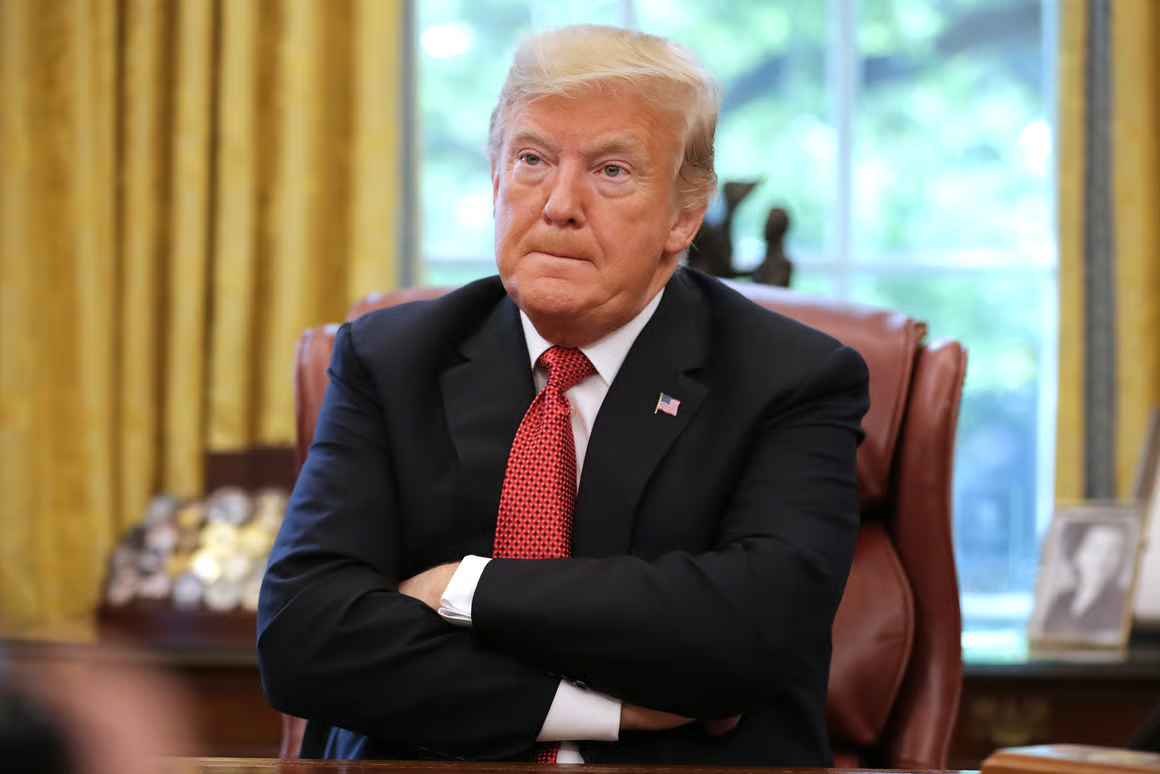
While denaturalization has historically been uncommon, averaging roughly a dozen cases annually over several decades, the announcement fits into President Donald Trump’s broader hardline immigration agenda since returning to office in January.
His administration has intensified deportations, canceled visas and green cards, expanded vetting of immigrants’ online activity and reopened long-dormant enforcement tools.
The latest focus on Somali Americans has drawn particular attention in Minnesota, home to the largest Somali community in the United States.
Federal authorities have recently described the state as a center of large-scale fraud involving government-funded social programs, claims that immigrant-rights groups say are being used to justify sweeping scrutiny of an entire community.
FBI Director Kash Patel disclosed that federal investigators and resources have been heavily deployed to Minnesota as part of ongoing fraud probes, many of which have intersected with Somali-run organizations.
Civil liberties advocates warn that the investigations risk blurring the line between targeted enforcement and ethnic profiling.
Tensions escalated further after the U.S. Department of Health and Human Services announced it was freezing all child care payments to Minnesota.
The agency said future disbursements nationwide will require detailed justification and proof of spending before funds are released.
Minnesota Governor Tim Walz pushed back strongly, accusing the administration of exploiting fraud concerns for political ends.
He said the state has already taken aggressive action against fraud and warned that federal actions could undermine essential services for vulnerable families.
Human rights organizations have condemned the administration’s approach, arguing it threatens due process and disproportionately impacts immigrant communities.
Trump officials, however, maintain that the measures are necessary to protect public funds and strengthen national security.
As investigations expand, the possibility that naturalized citizens could face the loss of their citizenship has sparked unease among Somali Americans and raised fresh questions about how far the administration is willing to go in redefining the boundaries of immigration enforcement.