BBC – A series of text exchanges between Donald Trump and European leaders about ownership of Greenland have sensationally been released.
The US president has pledged to tell European leaders at this week’s forum in Davos, Switzerland, that “we will have to have” Greenland.
Diplomacy has traditionally been seen as synonymous with discretion and most of it continues to be behind closed doors.
The latest revelations, however, fall in a different category.
Here are the messages in full and what experts told the BBC one should read into them:
Text exchange between Trump and Norwegian Prime Minister Jonas Støre
Released by the office of Støre following a freedom of information request by the BBC, 18 January at 15:48 (14:48 GMT)
Gahr Støre:
Dear Mr President, dear Donald – on the contact across the Atlantic – on Greenland, Gaza, Ukraine – and your tariff announcement yesterday.
You know our position on these issues. But we believe we all should work to take this down and de-escalate – so much is happening around us where we need to stand together.
We are proposing a call with you later today – with both of us or separately – give us a hint of what you prefer! Best – Alex [on behalf of Finnish Prime Minister Alexander Stubb] and Jonas
Trump’s response, 18 January 16:15 (15:15 GMT):
Dear Jonas: Considering your Country decided not to give me the Nobel Peace Prize for having stopped 8 Wars PLUS, I no longer feel an obligation to think purely of Peace, although it will always be predominant, but can now think about what is good and proper for the United States of America.
Denmark cannot protect that land from Russia or China, and why do they have a “right of ownership” anyway?
There are no written documents, it’s only that a boat landed there hundreds of years ago, but we had boats landing there, also. I have done more for NATO than any other person since its founding, and now, NATO should do something for the United States.
The World is not secure unless we have Complete and Total Control of Greenland. Thank you! President DJT
This is evidence that “diplomatic norms have been changing for a while and it’s not just President Trump”, the former Nato spokesperson, Oana Lungescu, told the BBC.
“It’s rather unusual for private messages between leaders to be made public, but it’s part of President Trump’s propensity of conducting diplomacy in public. You could say it’s the ultimate megaphone diplomacy.”
Mark Weller, professor at Cambridge University who has advised governments and international organisations, agrees.
“Exchanges between governments at a high level are ordinarily carefully scripted. This avoids misunderstanding and accidents when responding on important points without due reflection,” Weller says.
“This is not a problem for President Trump, who thrives on disrupting expectations.”
But he notes that it is unusual “for the cool Norwegians to retaliate in kind – clearly there is a sense that one must fight fire with fire, in addition to personal frustration about the loss of all diplomatic form”.
Message from French President Emmanuel Macron to Trump
Posted on Truth Social by Trump, 19 January, 17:01 (12:01 GMT):
From president Macron to President Trump
My friend,
We are totally in line on Syria
We can do great things on Iran
I do not understand what you are doing on Greenland
Let us try to build great things :
1) I can set up a G7 meeting after Davos in Paris on Thursday afternoon. I can invite the Ukrainians, the Danish, the Syrians and the Russians in the margins
2) Let us have a dinner together in Paris together on Thursday before you go back to the US
Emmanuel
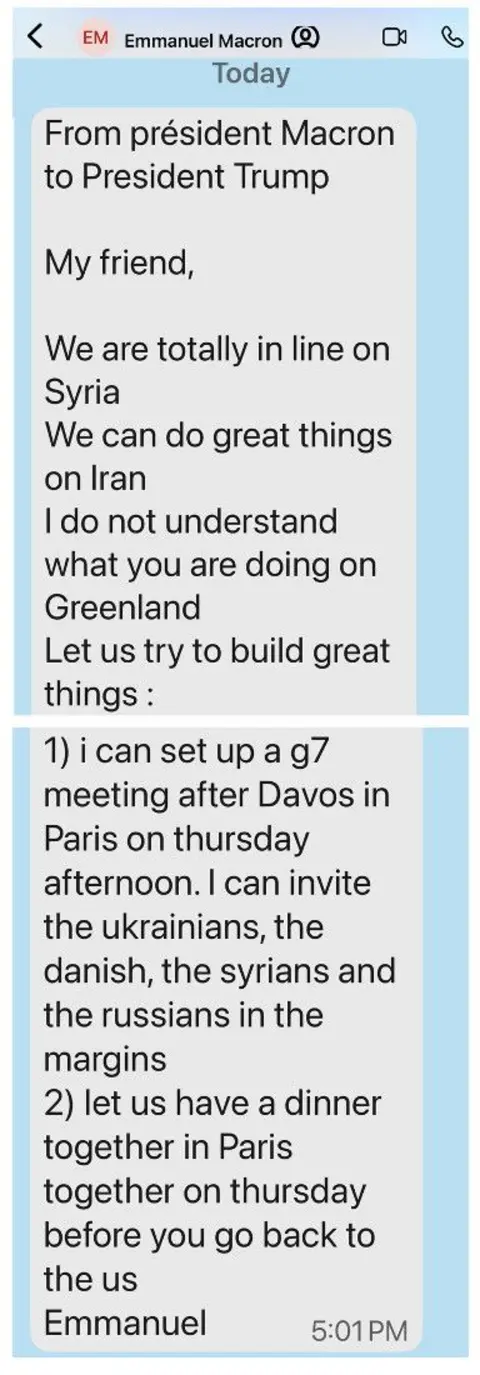
Macron’s texts being exposed could be “embarrassing” for the president, said former French diplomat Francios-Joseph Schichan, as some parts were “exposing”.
“At the beginning of the text, Macron clearly acknowledges something he didn’t acknowledge in public, which is he didn’t understand Trump’s behaviour with Greenland,” Schichan said.
“I think that’s damaging because you don’t want to be exposed like that, so that’s pretty embarrassing.”
However, Schichan noted Macron’s invitation to Trump with a meeting at the G7 [group of most industrialised countries] “isn’t embarrassing, that’s something he precisely needs to do”.
The texts further show how “Macron is trying to engage with classic diplomacy”, he said, warning, “that doesn’t work with Trump because he puts it on Truth Social and the plan blows up”.
“That’s another element of global diplomacy that’s crumbling. You used to be able to have a one-on-one conversation in private, but now you don’t know if it’ll end up on social media.”
Message from Nato Secretary General Mark Rutte to Trump
Posted on Truth Social by Trump, 20 January, 01:53 (06:53 GMT) :
Mr. President, dear Donald – what you accomplished in Syria today is incredible. I will use my media engagements in Davos to highlight your work there, in Gaza, and in Ukraine.
I am committed to finding a way forward on Greenland. Can’t wait to see you.
Yours, Mark
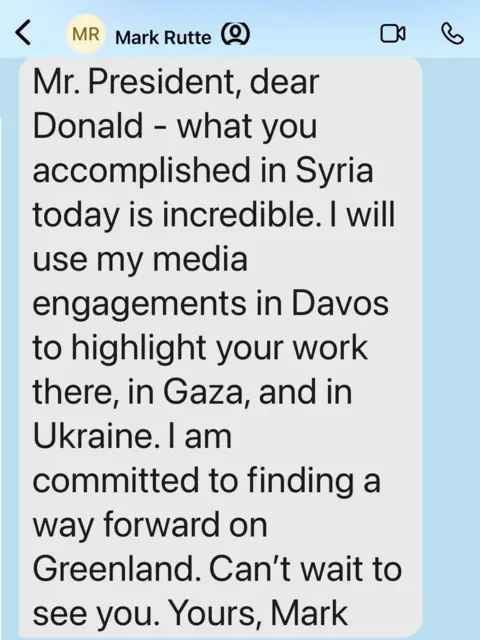
Similar to Macron, Rutte’s private message to Trump being exposed is “unusual”, says Lungescu – the longest-serving of Nato spokespeople and now a senior fellow at Royal United Services Institute (Rusi) defence think tank.
Lungescu said Rutte’s message was “consistent in what he says publicly and privately” – whilst other leaders “may appear stronger in public and more conciliatory in private”.
“So there’s been a lot of risks that what was private is no longer so,” she said, adding that “if people are tempted to appear powerful on social media, that risks leading to more rhetorical escalation rather than working behind the scenes to find win-win solutions.”
“The space for diplomacy will have a focus on more phone calls and more face-to-face encounters. In that case, that may bring us back to traditional diplomacy,” Lungescu said.
Marc Weller, who is also a programme director for international law at Chatham House think tank as well as a former UN senior mediation expert, cautions that “the tendency to publish as it happens really makes any serious, confidential-crisis diplomacy impossible where rapid and confidential action and dialogue is in fact required”.