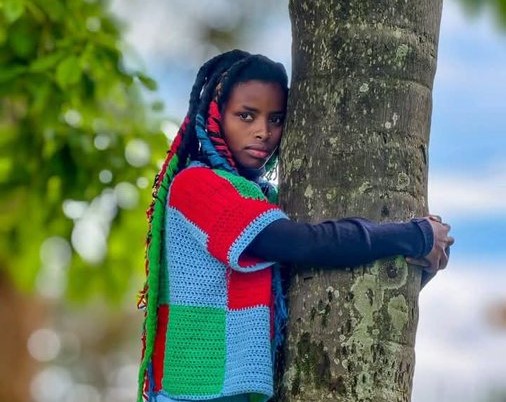
Kenyan environmental activist Truphena Muthoni has etched her name into the global record books after Guinness World Records officially confirmed her marathon 72-hour tree-hugging feat, a remarkable endurance challenge undertaken to draw attention to forest conservation, climate action, and mental well-being.
At just 22 years old, Muthoni completed the continuous three-day embrace of an indigenous tree outside the Nyeri County Governor’s office between December 8 and 11, 2025, enduring rain, cold, hunger, and fatigue without food, water, or breaks — a testament to her physical and psychological resolve.
The official recognition from Guinness World Records confirms that her effort — which surpassed her own earlier 48-hour record — now stands as the longest marathon tree-hugging challenge ever verified.
Beyond the physical feat, Muthoni has made clear that her act of hugging a tree for three days was never just a stunt. To her, it was a peaceful protest and symbolic call to protect Kenya’s forests against deforestation, safeguard indigenous trees, and elevate public discourse on environmental stewardship and mental health.

Muthoni’s achievement blends performance with activism, leveraging the global platform of Guinness World Records to amplify her message. Unlike traditional campaigns that rely on reports and speeches, her physical challenge captured the public imagination and drew widespread local and international attention to issues like climate change, biodiversity loss, and the intrinsic connection between humans and nature.
Environmentalists and public figures have lauded her courage. Among them, Nairobi Woman Representative Esther Passaris praised her “audacity to speak for the environment without even saying a word,” highlighting how the act alone — silent but sustained — can shift public engagement with ecological issues.
Her recognition comes at a time when Kenya is grappling with environmental challenges similar to those confronting the rest of the world: rising temperatures, shrinking forests, and the urgent need for sustainable land management. By placing her body and stamina at the center of the narrative, Muthoni has reframed environmental advocacy as something deeply personal and urgent.
Muthoni’s record has already begun to ripple through Kenyan society. Her story has sparked national pride, placing the country prominently in global conversations about climate activism. Citizen engagement has surged, with local communities, schools, and youths citing her accomplishment as an inspiration to get involved in environmental protection and grassroots conservation efforts.
Indeed, other Kenyans have taken up related challenges or begun their own initiatives drawing inspiration from her example, including extended tree-hugging efforts in Nanyuki aimed at promoting peace and environmental awareness.
For young Kenyans, her achievement embodies a new model of creative, courageous activism — showing that even symbolic gestures, when executed with passion and discipline, can spark conversations that transcend borders and demographics.
Not everyone has embraced the symbolic nature of her activism without question. Some commentators argue that physical challenges alone do not directly halt deforestation or enact policy change, and caution against equating symbolic acts with long-term environmental solutions. These voices reflect a broader debate within the climate movement over form versus substance in activism.
Yet even among critics, there is recognition that the dialogue itself has value. By generating conversation and media coverage on ecological issues — topics often overshadowed by immediate economic or political concerns — Muthoni’s record achievement has helped elevate the national discourse around environmental responsibility.
Muthoni’s success underscores a larger narrative in Kenyan environmental history — one that connects symbolic protest with deeper movements for ecological preservation. Her feat evokes the legacy of figures like Wangari Maathai, whose decades of tree-planting and civic activism reshaped Kenya’s environmental policy and global reputation. While methods differ, Muthoni’s record highlights how individual acts of courage and visibility can influence collective consciousness.
With the Guinness World Record now formally recognising her 72-hour tree-hugging marathon, Truphena Muthoni’s name will be remembered not only for endurance but for bringing attention to Kenya’s forests, inspiring environmental activism, and showcasing the power of symbolic action on the world stage.