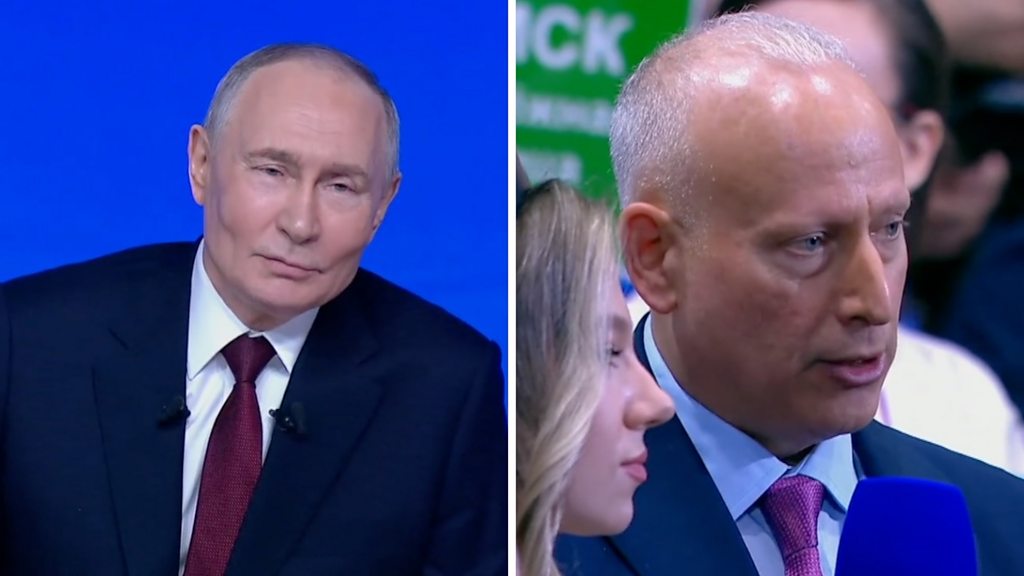
Reporters ask world leaders questions every day. But what is it like to pose one to Vladimir Putin—the president who ordered the full-scale invasion of Ukraine and whose country stands accused of “the export of chaos”—live on television, with millions watching?
“It’s a big responsibility. You don’t want to mess up.”
The question I chose cut to the core: “What kind of future are you planning for your country and your people?” I listed possibilities: a future where dissent is punishable, the hunt for enemies accelerates, internet outages become routine, and new “special military operations” are launched.
As I spoke, Putin took notes. His reply defended Russia’s repressive “foreign agent” law by pointing to Western precedents. “We didn’t invent it,” he argued.
The microphone was taken from me before I could counter that Russia’s version is uniquely draconian, stripping critics of their professions, finances, and freedom. The moderator swiftly changed the subject to the BBC’s own legal troubles, eliciting Putin’s agreement with President Trump: “I think President Trump is right.”
Then, he returned to my question with the line that made headlines: “There won’t be [new operations], if you treat us with respect… Unless you cheat us, like you did with Nato’s eastward expansion.”
The exchange laid bare the driving force of Putin’s worldview: a deep-seated, bitter resentment of the West. He accuses Western leaders of years of disrespect, deception, and lies—including the “rubbish” claim that Russia plans to attack Europe.
Yet, given the denialism before the Ukraine invasion and recent acts of aerial and cyber aggression, European trust is absent.
So, was his final statement—”We’re ready to cease hostilities immediately provided that Russia’s medium- and long-term security is ensured”—a genuine olive branch? The answer hinges on Moscow’s next move.
If “long-term security” remains code for the annexation of Ukrainian territory and the dismantling of its sovereignty, European leaders will view any offer not as peace, but as a demand for surrender.
By James Kisoo