Stacy Boit,

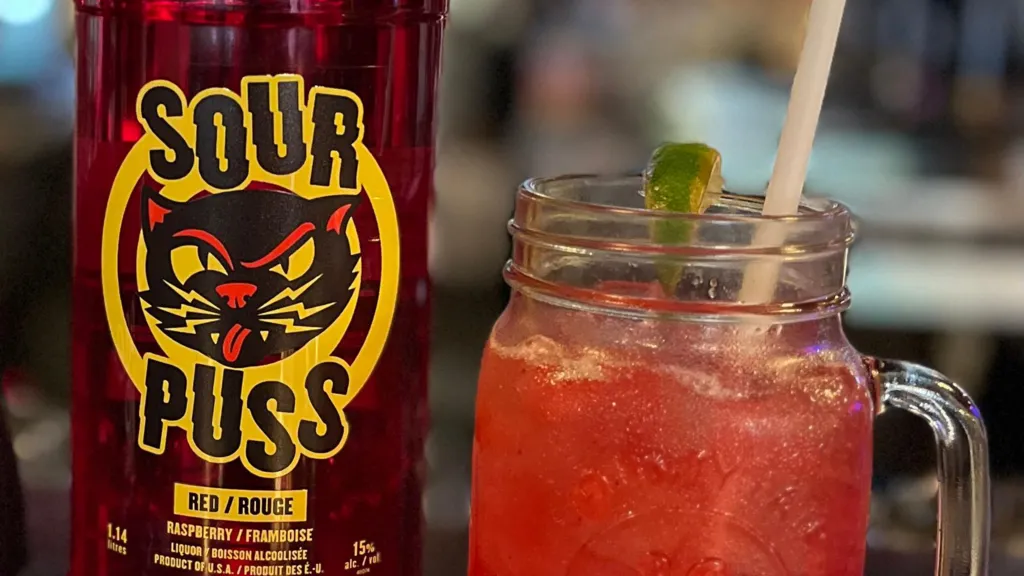
Stephanie Intrevado has a bit of a collection. Ever since taking her first sip of Sour Puss at the age of 18 – the legal drinking age in her home province of Quebec – she has been on the hunt to try every flavour of the brightly coloured, fruity liqueurs.
From passionfruit, to coconut and watermelon, the 35-year-old counts herself “very lucky” to have acquired some hard-to-find bottles and merch.
So when she learned that Sour Puss, a popular drink with Canadian university students, was actually American-made, she was shocked – and concerned about where she would get her next bottle. Most Canadian provinces have been boycotting American-made liquor since Spring 2025, as retaliation for US President Donald Trump’s tariffs against the country.
The boycott put Phillips Distilling, the family-owned maker of Sour Puss based in Minnesota, into a tight spot.
They lost 70% of their Canadian business as a result, which CEO Andy England referred to as “a disaster”. Sales of Sour Puss were the hardest hit, as Canada is by far its largest consumer.
It forced Phillips Distilling to do something they have never done before: move some production north of the border. The shift worked, with their products back on sale in stores across Canada.
“We’re in a different place now,” England told the BBC.
“We produce and sell in Canada,” he said. “We have, I think, convinced all of the provinces to take back some of our products, and we’re on the road to recovery.”
US-based liquor producers have all taken a financial hit since the trade war between the two countries heated up. But Phillips Distilling is one of the only ones yet to shift some production to Canada.
A trade deal between the two countries remains elusive, still. The US has flagged the liquor sales ban as a main irritant amid ongoing negotiations, while Prime Minister Mark Carney has said that provinces may be willing to sell American alcohol again if tariffs on key Canadian sectors like automotives, metals and lumber are lowered or lifted.
Provinces first made the decision to ban the sale of US liquor in March of last year, starting with Ontario, whose liquor board is one of largest wholesale purchasers of alcohol in the world, and whose automotive sector has been hard hit by Trump’s tariffs.
Other major provinces soon followed, including Quebec and British Columbia. As of May 2026, only two provinces out of 10 are still selling American alcohol: Alberta and Saskatchewan.
In Canada, alcohol sales are largely controlled by provincial governments, which operate boards that manage the import and sale of most wine and spirits, giving them broad authority over what is sold. Alberta and Saskatchewan have a fully privatised liquor retail system.
For Phillips Distilling, the impact of the provincial liquor boycott was felt almost immediately due to the popularity Sour Puss in Canada.
“If we sold 1,000 cases of Sour Puss in the US, I’d be surprised,” England said, adding that he saw it as “very much a Canadian brand” due to how Canadians embraced it over the years.
Because of its popularity, England said the company started exploring moving some of its production to Canada just weeks after provincial liquor boards began halting their orders.
By October – as both Trump’s tariffs and the provincial liquor ban showed no signs of ending – the company signed an agreement with a Montreal-based alcohol manufacturer named Station 22 to start production.
Canadian distributors across the country were excited “and very appreciative” that the company made the move, England added. But getting their products back on shelves took some time. Quebec agreed first, which he said helped facilitate conversations with other provinces.
The return of Sour Puss was celebrated by Intrevado with an Instagram post. “Guess who’s back?” she captioned an image of four bottles of the raspberry flavour. “Oh how I’ve missed you.”
Both England and Meredith Lilly, a professor of international economic policy at Carleton University in Ottawa, noted that it is easier for Phillips Distilling to shift production north than other companies whose products are tied to a certain geographic area, like Kentucky bourbon or California wine.
Lilly added that, because a big chunk of their business is Canadian, they risk “no reputational penalty in the US” for deciding to move their production.
The decision to pull American liquor off the shelves by some premiers was “a heat of the moment” response, she said, that in this case brought an accidental positive – bringing more production to Canada.
“I don’t think it was envisioned that (the boycott) would be in place as long as it has been,” Lilly said.
But whether the boycott will help Canada at the negotiating table is unclear.
US commerce secretary Howard Lutnick called it “outrageous”, “insulting” and “disrespectful”.
Lilly also cautioned that the decision to return US alcohol back on the shelves ultimately rests with the provinces, not the Carney government, making it an unpredictable bargaining chip.
Canada’s federal government has retaliated against US liquor in the past during Trump’s first term, when former Prime Minister Justin Trudeau imposed tariffs on Kentucky bourbon as a way to put pressure on Republican states after Trump slapped levies on Canadian steel.
Those tariffs were lifted less than a year later after both countries reached a deal.
This time, however, the tariff dispute between Canada and the US has endured, with the two sides appearing no closer to reaching a deal. For England, what happens next may not matter much, he said, as the last year has forced his company to rethink the way it does business, likely for the long term.