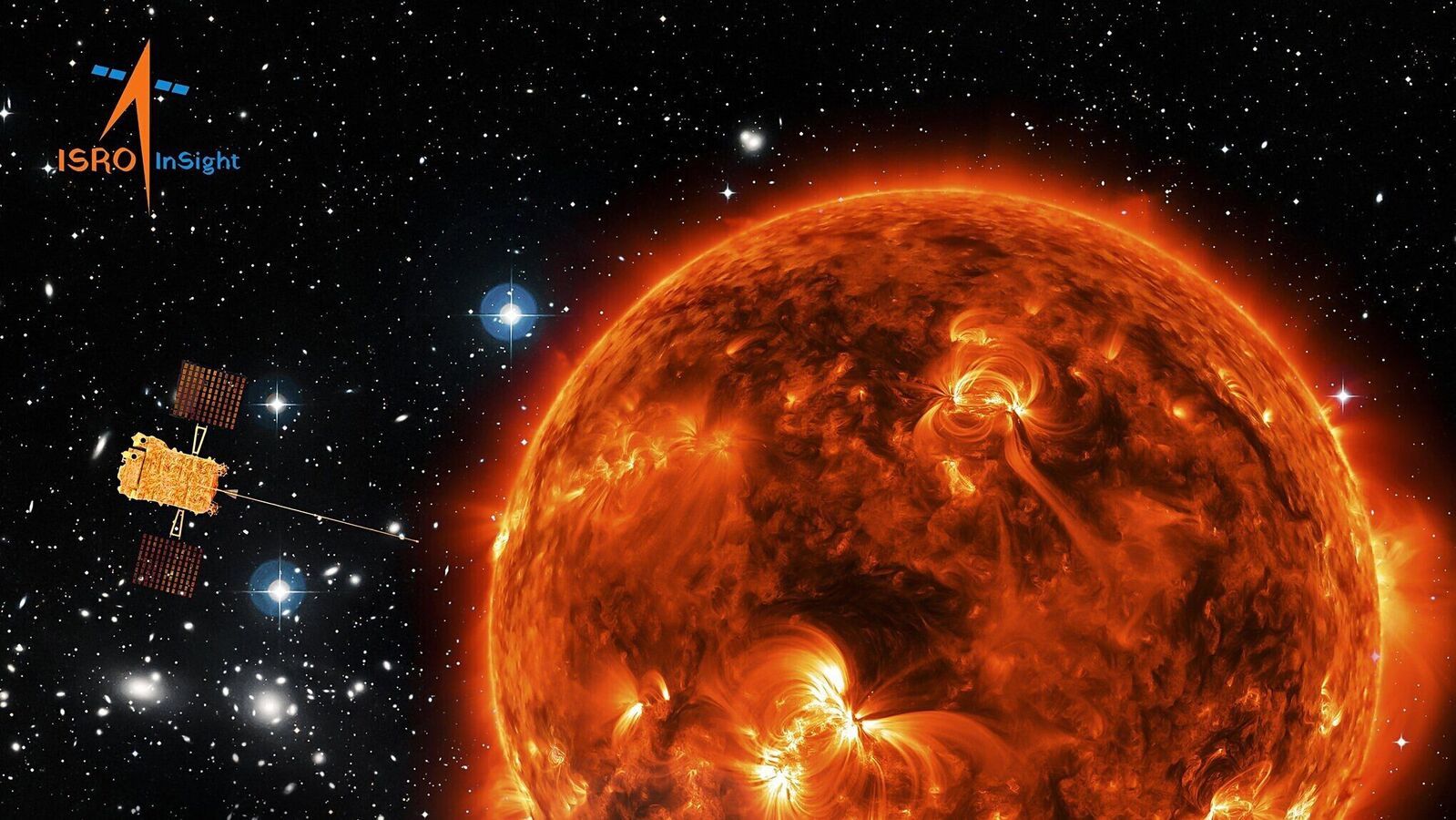
Launched last year, the spacecraft will for the first time witness the Sun at the peak of its activity cycle—a period of dramatic transformation that occurs roughly every 11 years, when the star’s magnetic poles flip. During this “solar maximum,” the Sun shifts from calm to intensely stormy, unleashing a surge in solar storms and coronal mass ejections (CMEs).
CMEs are colossal bubbles of fire erupting from the Sun’s outer atmosphere, or corona. Weighing up to a trillion kilograms and accelerating to 3,000 kilometers per second, they can shoot in any direction—including toward Earth. At top speed, one could cover the 150-million-kilometer journey in just 15 hours.
“During quiet periods, the Sun launches two to three CMEs per day,” says Professor R Ramesh of the Indian Institute of Astrophysics. “Next year, we expect 10 or more daily.”
Professor Ramesh is the principal investigator for Aditya-L1’s most important instrument—the Visible Emission Line Coronagraph, or Velc—and leads the analysis of its data. Studying these eruptions, he explains, is central to the mission’s goals: not only to better understand our star, but also to safeguard the technology modern life depends on.
While CMEs rarely endanger human life directly, they trigger geomagnetic storms that can wreak havoc on satellites, power grids, and communication systems. The dazzling auroras they produce are a visible sign of charged particles traveling from the Sun to Earth—but the same particles can fry satellite electronics, knock out electrical networks, and disrupt weather and navigation satellites.
History offers stark warnings: the Carrington Event of 1859 disabled telegraph networks worldwide. In 1989, a solar storm left six million people in Quebec without power for nine hours. More recently, in 2022, a single CME destroyed 38 commercial satellites.
“If we can observe the corona in real time, track a CME’s origin, temperature, and path, we gain crucial hours to warn satellite operators and grid managers,” says Prof. Ramesh.
Aditya-L1 holds a unique advantage in this watch. Unlike other solar missions, its coronagraph is precisely sized to mimic the Moon, blocking the Sun’s bright face to provide an uninterrupted, 24/7 view of the faint corona—even during eclipses. It is also the only mission capable of studying eruptions in visible light, allowing scientists to measure a CME’s temperature and energy—key indicators of its potential strength if aimed at Earth.
To prepare for 2026’s solar peak, Professor Ramesh’s team recently collaborated with NASA to analyze one of the largest CMEs recorded by Aditya-L1 so far. On September 13, 2024, the observatory captured an eruption with a mass of 270 million tonnes—180 times that of the iceberg that sank the Titanic. At its origin, it registered 1.8 million degrees Celsius and carried energy equivalent to 2.2 million megatons of TNT.
Yet, remarkably, Professor Ramesh describes this as a “medium-sized” event. During solar maximum, CMEs could release energy exceeding that of the asteroid that wiped out the dinosaurs.
“This CME occurred during the Sun’s normal phase,” he says. “It sets a benchmark for what we can expect at maximum activity. What we learn will not only help protect satellites and infrastructure—it will deepen our understanding of space itself.”
As the Sun stirs toward its stormy peak, India’s first solar mission is poised to witness cosmic violence at an unprecedented scale—and in doing so, help shield our increasingly connected world from the star that gives it life.
By James Kisoo