If you have lived outside India for many decades, as in my case, landing again on Indian soil can be striking. The airports are modern, efficient, and impressive. Wow, Bharat Mata ki Jai!
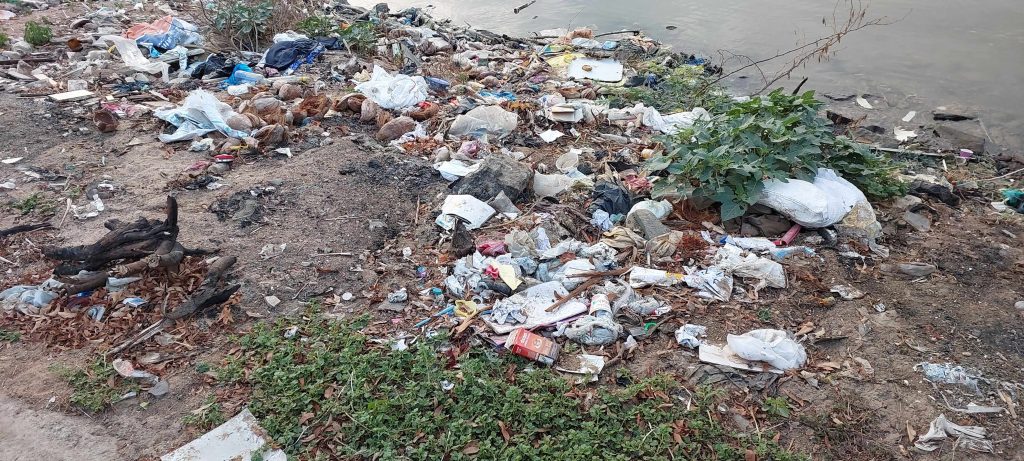
As you drive outside the airport, however, two things hit you hard even as you admire the expanding infrastructure. They hit you very hard, undeniably hard: noise and dirt. India is noisy. India is still dirty.
The discomfort turns into embarrassment when travelling with foreign guests. The shame hits an epic-peak when the guest happens to be a German, as I realised in February 2026. We travelled from Trivandrum to Kanyakumari to Chennai to Delhi.
Kanyakumari district is simply dirty. One could blame it on the tourists. But cities such as Chennai and Delhi present a more complex picture. There are pockets of order and cleanliness, and then, quite abruptly, areas that appear neglected, disorderly, with heaps and heaps of rubbish. These are middleclass residential areas.
As one walks from the drop-off point to the entrance of the Taj Mahal in Agra, the surroundings are familiarly filthy. The stench and the dirt assert themselves. The bollards lining the pathway are stained red with paan spittle.
Weeks later, I am on transit in Mumbai. Much of the city appears, visually, like an extended informal settlement. My Indian friends quickly respond: “Visit Navi Mumbai. It is beautiful.” I give them the benefit of the doubt. Which only strengthens the argument. It is possible to keep an Indian city clean, after all.
So why is most of India still dirty?
Oh, it is the population. India is too large, too dense, too complex. How then, China manages its urban cleanliness more efficiently. According to the World Bank’s What a Waste 2.0 (2018), China generates over 200 million tonnes of municipal solid waste annually, while India generates about 150 million tonnes. The problem is not volume alone. It is management.
On the Environmental Performance Index produced by the Yale Center for Environmental Law & Policy, India scores significantly lower than China on waste treatment, air quality, and environmental health indicators. The gap is substantial, often on the order of twenty percentile points.
So, what is not working in India?
Is dirt part of our culture? That is an easy claim, and an unhelpful one. Culture alone cannot explain why private homes in India are often meticulously clean while public spaces are neglected. Nor does it explain why planned areas function better than unplanned ones in the Indian cities.
What we are dealing with is not culture, but systems.
Also in February 2026, my friends from Nairobi were shocked as we drove around Chennai: people just drink water and throw the empty bottle just there; they open a pack of their favourite snack and throw the wrapper just there; they clear their throat and spit just there!
These are behaviours, certainly. But they are also responses to inadequate systems. Dust bins, if any, aren’t easily accessible. And rubbish collection points aren’t cleared! So, what is the problem if I throw the rubbish just there! Anywhere!
Enough of my ranting in frustration!
Let me join the bestselling author and historian, Yuval Noah Harari, in giving credit to India – the land of my birth. Harari, in his book Nexus, hails Prime Minister Narendra Modi for launching the Swachh Bharat Abhiyan – the Clean India Campaign. Between 2014 and 2020, his government could mobilise ten billion dollars to build 100 million new latrines. Congratulations, Mr Prime Minister!
I am more interested in Harari’s concluding statement to that narrative, “Sewage isn’t the stuff of epic poems, but it is a test of a well-functioning state.” Herein lies the clue to the cause of dirt in India: our local governments are not well-functioning. At least, not yet!
A well-functioning state is not one that occasionally delivers grand projects. It is one that performs ordinary tasks reliably, day after day, without fail, like cleaning our streets!