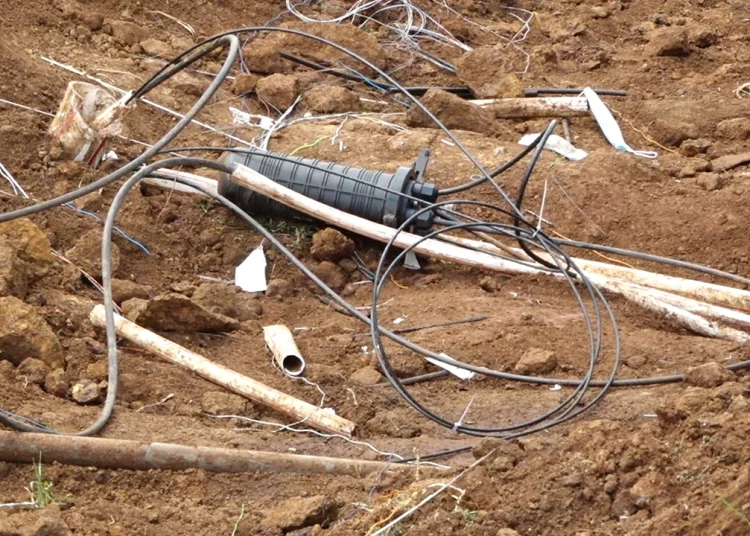
The fiber-to-the-home (FTTH) sector in Kenya is growing with new players and new subscribers. However, this positive growth has a negative aspect, with the cables on poles and trenches becoming an eyesore across the country.
Now, the Communications Authority of Kenya (CA), the regulatory agency for the ICT sector in Kenya with responsibilities in telecommunications, is moving in to arrest the mess.
As part of its mandate, the authority has published draft guidelines to establish standards for cable installation and maintenance.
CA claims, “When installations are poorly done, the result is slow speeds, frequent outages, and even safety risks.” That’s why new guidelines have been proposed.”
According to the document, the majority of internet service providers in Kenya ignore manufacturer recommendations when laying their cable infrastructure.
“Whereas there exist cable installation and maintenance guidelines from cable manufacturers to be adhered to for ensuring the networks are fit for purpose, the Authority has noted the proliferation of cables not only installed with disregard for the manufacturer standards but also poorly maintained,” the guidelines state.
Cable Installation Guidelines
The guidelines establish specific technical standards for both aerial and underground cable installations.
| Aerial Cable Installations |
| All telecommunication poles must maintain a minimum vertical ground clearance of 23 feet |
| Maximum distance between poles limited to 100 feet |
| A maximum of ten(10) different providers of telecommunication cables shall share one pole |
| Minimum vertical clearance between adjacent cables on a pole set at one foot |
| The lowest ground clearance for a telecommunication cable running parallel to roads, railway line and crossing footpaths shall be 10 feet |
| The lowest ground clearance for telecommunication cables crossing an entry into estate gates shall be a minimum of 13 feet. |
| Cable sag restricted to no more than 2% of the cable span length |
| All slack loops shall be fixed on poles and supported with brackets or trays |
| A pole shall have only one slack; therefore, sharing service providers shall have to alternate their slacks |
Guidelines From the CA’s Technical and Procedural Guidelines for Installation and Maintenance of Cable Telecommunication Infrastructure, 2026
| Underground Cable Installations |
| Excavation depth must be at least three feet |
| Minimum trench width of 2.5 feet to accommodate at least four 100mm diameter ducts |
| Horizontal separation between ducts set at a minimum 50mm |
| Marking tape must be placed at maximum two feet from the top of the trench |
| Cable markers spaced at one-kilometer intervals along the entire route |
| Manholes to be positioned at almost 1,000-foot intervals |
| Fiber cables crossing rivers or lakes, an underwater ground continuous length cable should be used to avoid underwater joints, with the gradient of the cable route down the riverbed or lakeshore made as gentle as possible to avoid the fiber moving within the cable |
| Excavations crossing roads, railways and other underground utility infrastructure shall be done as guided by the respective utility providers. |
Guidelines From the CA’s Technical and Procedural Guidelines for Installation and Maintenance of Cable Telecommunication Infrastructure, 2026
Every 300 feet, cables must be marked with permanent labels that clearly identify the service provider in bold or capital letters.
These labels must also specify the internal fiber count (such as 24F or 48F); the cable type, distinguishing between Singlemode (SM) and Multimode (MM); and the date the cable was installed.
To maintain high service quality, all fiber connections must use fusion splicing to minimize signal loss, with every joint enclosure marked by a permanent, weather-resistant label identifying the service provider.
During pulling and installation, cables must never exceed the manufacturer’s bending stress limits.
Specifically, the minimum bending diameter must be maintained at 40 times the cable’s outer diameter during installation and 20 to 30 times the diameter once fixed, while microduct cables must follow specific manufacturer guidance.
Infrastructure Sharing, Licensing, and Approval
The guidelines require all trenches to have at least four ducts installed to facilitate sharing among service providers. This aligns with the authority’s broader infrastructure-sharing regulatory framework and supports the “Dig Once” policy principle to reduce costs and avoid duplication.
Service providers wishing to install and operate telecommunications infrastructure must obtain a Network Facility Provider (NFP) license under the Authority’s technology- and service-neutral licensing regime.
Contractors and technical personnel working on behalf of service providers require separate licenses.
Different agencies are tasked with cable installation approvals. Service providers must seek the county governments’ approval for excavation permits and wayleave acquisition.
They must also seek relevant road authorities’ approvals (KeNHA, KURA, and KeRRA) for cable infrastructure crossing roads or road reserves.
Where public land is to be used, approval is given by the Ministry of Lands and Physical Planning for public lands. The National Environment Management Authority (NEMA) is the agency to be sought where environmental assessments are required.
Kenya Power (KPLC) for pole-sharing arrangements, water and sewerage agencies for installations near their pipelines, and Kenya Railways Corporation for infrastructure running within 15 feet of railway networks.
Compliance Framework and Transition
Upon completion of installation, service providers must notify the regulator and submit a self-test report using equipment such as optical time-domain reflectometers, accompanied by photographic evidence of continuity tests, insulation resistance measurements, loop resistance, signal quality tests, and end-to-end optical power measurements.
CA will then conduct certification exercises within 14 days of receiving notification to verify compliance before allowing service providers to provision services on the installed infrastructure.
Service providers who currently have actively deployed cable infrastructure will be given 6 months after the regulations come into force to ensure they comply.
The document is still in draft form and subject to stakeholder consultation; hence, the effective date for the guidelines remains to be determined.