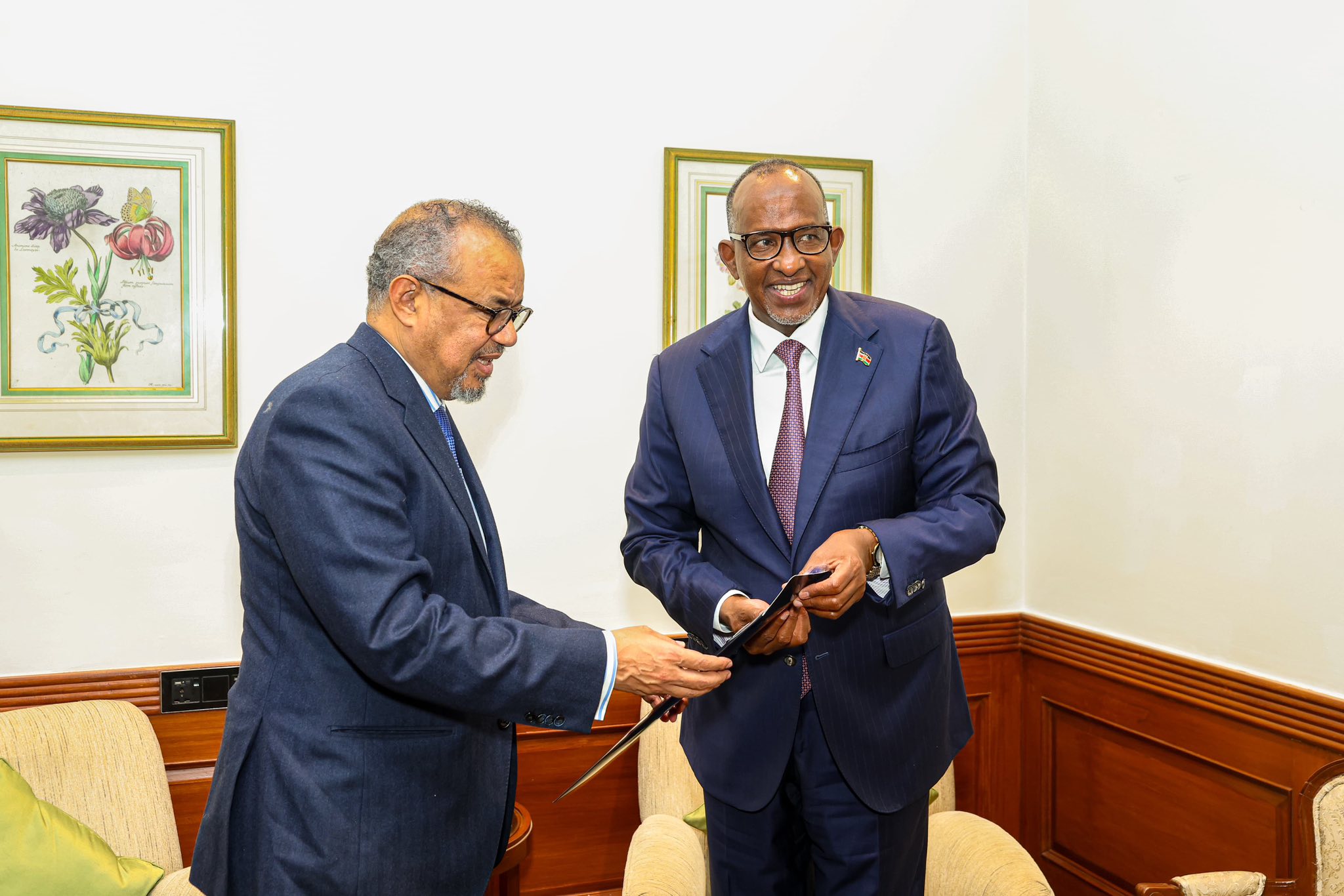
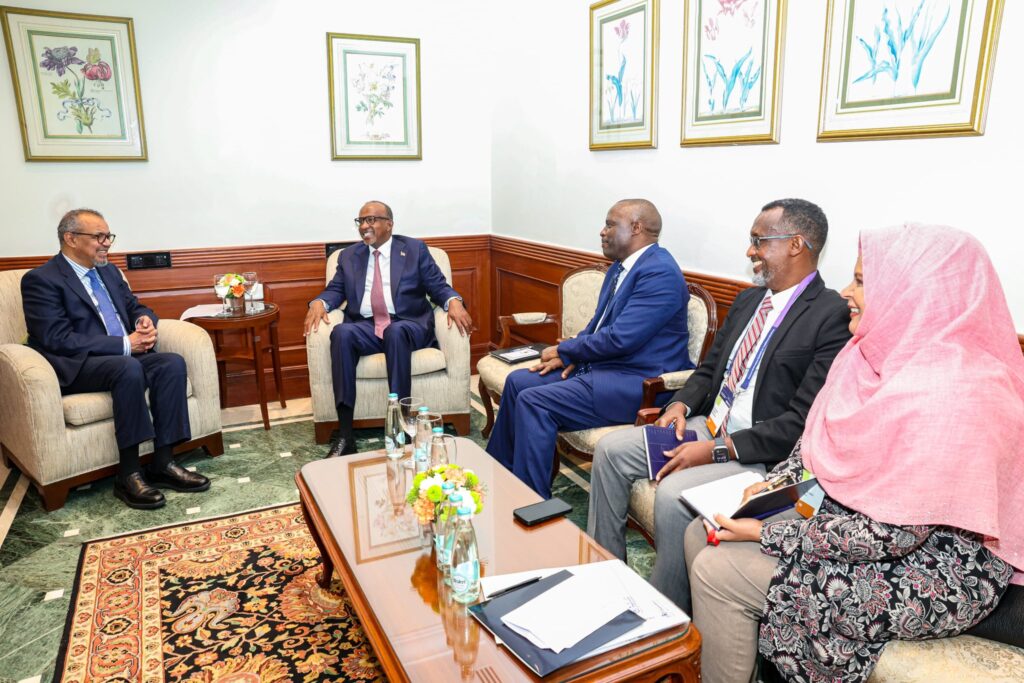
Health Cabinet Secretary Hon. Aden Duale on Friday held a strategic bilateral engagement with the Director-General of the World Health Organization (WHO), Dr Tedros Adhanom Ghebreyesus, on the sidelines of the ongoing 2nd WHO Global Summit on Traditional Medicine in India.
Reflecting on his recent consultations with the WHO Regional Director for Africa, Hon. Duale commended WHO’s sustained technical and political support to H.E. the President during early high-level engagements, noting that this support has strengthened confidence at the highest levels of Government in WHO as a reliable and strategic partner.
The Cabinet Secretary reaffirmed Kenya’s deep appreciation for WHO’s longstanding collaboration in health, science, and innovation, while underscoring the country’s intention to elevate the partnership beyond conventional assistance models.
“Our priority is to advance technology transfer, industrial collaboration, and sustainable systems strengthening—an approach fully aligned with H.E. the President’s role as African Union Champion for Local Manufacturing, aimed at reducing dependency and strengthening Africa’s capacity to produce essential health commodities,” Hon. Duale stated.

He noted that this transition is already underway through targeted regulatory and investment reforms, including an accelerated six-month evaluation timeline and reduced regulatory fees for locally manufactured products, measures that have attracted 13 new pharmaceutical manufacturers.
Hon. Duale further outlined Kenya’s progress towards attaining WHO Maturity Level 3 by 2026 through the implementation of Institutional Development Plans. An updated progress report is expected by January 2026, with a re-benchmarking mission anticipated from March 2026.
The Cabinet Secretary called for continued WHO technical assistance, particularly in training and capacity building across critical regulatory functions for medicines and vaccines. He also emphasised the need to strengthen emergency preparedness and response in the face of escalating global risks, including climate change, with a focus on surveillance systems, early warning mechanisms, rapid response capacity, and workforce readiness to enhance both national and regional resilience.
As global negotiations on the Pandemic Agreement advance, Kenya intends to continue engaging closely with WHO to secure equitable outcomes that safeguard national interests while advancing global solidarity.
Additionally, Hon. Duale sought WHO’s normative and technical support in strengthening health systems, expanding primary healthcare, and deepening collaboration in research, knowledge exchange, and implementation science through key national institutions, including the Pharmacy and Poisons Board (PPB), Kenya Biovax Institute, the National Public Health Institute (NPHI), and the Kenya Medical Research Institute (KEMRI).
He reaffirmed Kenya’s readiness to lead with strong political commitment and a clear implementation roadmap, and expressed confidence that the partnership with WHO will translate into tangible and measurable benefits for Kenyans and the global community.