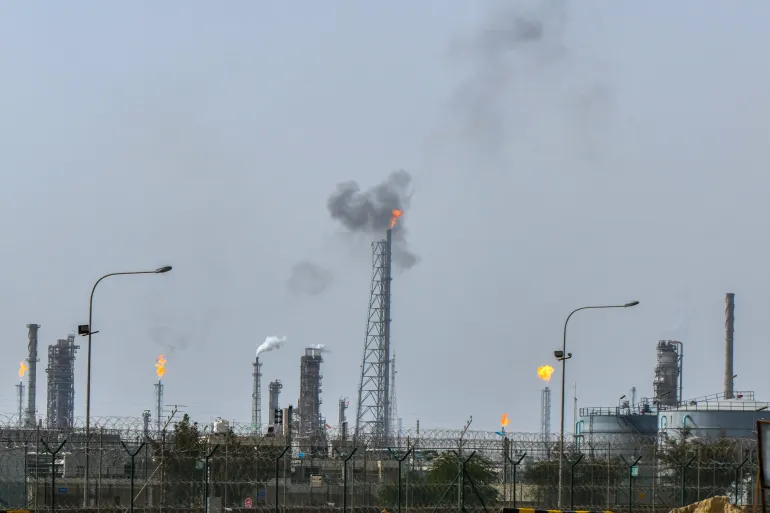
Drones have struck Kuwait’s largest oil refinery for the second day as Iran launched a sweeping assault on energy infrastructure across the Gulf, while explosions boomed over Tehran from Israeli attacks as the country marked the Persian New Year.
Fires broke out across multiple units at the Mina al-Ahmadi refinery, which processes about 730,000 barrels of oil per day, early on Friday morning, as Kuwaitis marked Eid al-Fitr, the celebration ending the holy month of Ramadan.
Kuwait’s national oil company said several units had been shut down, though there were no casualties.
The country’s military said its air defences were actively intercepting incoming missile and drone threats.
The strikes form part of a broadening Iranian campaign against Gulf Arab states, launched in retaliation for an Israeli strike earlier this week on Iran’s South Pars gasfield, the country’s largest, supplying about 80 percent of its domestic natural gas needs.
Iran’s Islamic Revolutionary Guard Corps (IRGC) said they had also hit United States forces at the UAE’s al-Dhafra airbase, as well as sites inside Israel.
The UAE reported incoming missile and drone threats, while Bahrain said shrapnel from what it called “Iranian aggression” sparked a warehouse fire. Saudi Arabia said its forces had intercepted and destroyed more than a dozen drones within the space of two hours.
Iranian Foreign Minister Abbas Araghchi warned this week that the strikes on Gulf infrastructure represented “a fraction” of the country’s capabilities, and threatened “zero restraint” should Iran’s own energy facilities come under attack again.
Israeli Prime Minister Benjamin Netanyahu, meanwhile, said Israel had acted alone in striking South Pars and would hold off further attacks on energy infrastructure at the request of US President Donald Trump, who had distanced himself from the strike.
Get instant alerts and updates based on your interests. Be the first to know when big stories happen.Yes, keep me updated
Qatar’s Ras Laffan, the world’s largest liquefied natural gas (LNG) terminal, sustained severe damage in Iranian attacks, wiping out roughly 17 percent of global LNG supply and costing an estimated $20bn in annual revenue.
QatarEnergy chief Saad al-Kaabi said repairs could take between three and five years, and that the scale of destruction had set the region back “10 to 20 years”.
Iran has also closed the Strait of Hormuz, through which about a fifth of the world’s oil and LNG passes, sending energy prices surging and squeezing supplies of everything from computer chips to fertiliser.
Governments across Asia are already rationing electricity and cutting office hours.
Mujtaba Rahman, managing director at political risk consultancy Eurasia Group, told Al Jazeera the conflict appeared to be entering “an escalatory phase”, warning that Asia and Europe faced the heaviest exposure depending on “how long the war continues”.
Al Jazeera’s correspondent in Dubai, Zein Basravi, said Gulf leaders were “trying to maintain some kind of poise as these attacks escalate”, but it was becoming increasingly hard to see how the situation could continue “without some kind of breaking point”.
Israel launched further attacks on Iran overnight. The sound of explosions was heard in Tehran as Iranians marked Nowruz, the Persian New Year. No further details were immediately available.
Meanwhile, sirens sounded on Friday morning in central Israel, including in the capital of Tel Aviv, due to a second Iranian missile barrage within an hour, the Israeli army said.
Air defence systems were trying to intercept the missiles, the army said in a statement.
Israel’s foreign ministry also slammed Iran for what it called an “attack on the holy sites” of Jerusalem following an impact near the walls of the Old City.
It was unclear whether a missile or an interception caused the impact.
According to the AFP news agency, the impacted site was by the Zion Gate, close to the holy sites of the Al-Aqsa Mosque, the Western Wall and the Church of the Holy Sepulchre.
But the spokesman for Iran’s paramilitary IRGC insisted on Friday that Tehran was still building missiles, seeking to counter a claim by Netanyahu that it no longer could.
Ali Mohammad Naeini also said the Iran war would go on. A short time later, Iranian state television reported Naeini was killed in an air strike.
“These people expect the war to continue until the enemy is completely exhausted,” the general said of the Iranian public. “This war must end when the shadow of war is lifted from the country.”
On Friday, Israel also broadened its attacks to Syria, saying it hit infrastructure there in response to attacks on the minority Druze population in southern Suwayda province. Syria’s state-run SANA news agency did not immediately acknowledge the attack.
Israel, which has a significant Druze population, has previously intervened in defence of the Druze in Syria, launching dozens of air attacks on convoys of government fighters and even striking the Syrian Ministry of Defence headquarters in central Damascus.
More than 1,300 people in Iran have been killed during the war. Israeli strikes against the Hezbollah group in Lebanon have displaced more than 1 million people, according to the Lebanese government, which says more than 1,000 people have been killed. Israel says it has killed more than 500 Hezbollah fighters.
In Israel, 15 people have been killed by Iranian missile fire. Four people were also killed in the occupied West Bank by an Iranian missile strike.
At least 13 US military members have been killed.