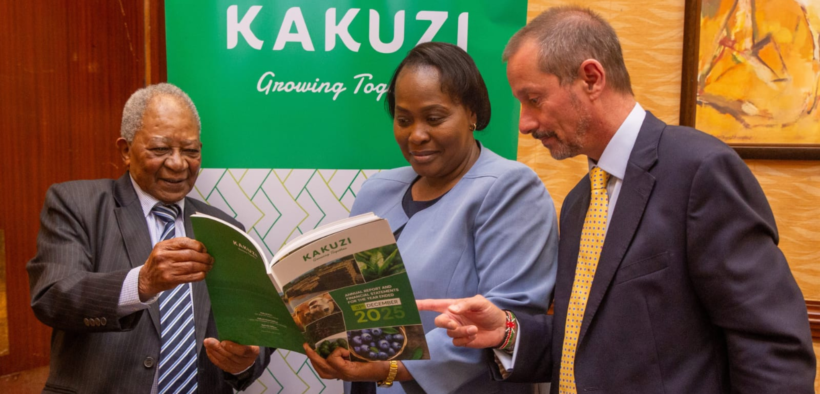
Listed agribusiness and superfoods producer Kakuzi Plc has acknowledged the growing international market risks facing the firm and Kenyan export agriculture, necessitating strategic diversification of products and markets.
Speaking at the Nairobi Securities Exchange (NSE) listed firm’s 98th Annual General Meeting (AGM), Kakuzi Plc Chairman, Mr Nicholas Ng’ang’a, said agribusiness firms globally are facing contemporary operating risks, further compounded by unrest in the Middle East.
To mitigate risks, he noted that the firm is pursuing further diversification across products and markets, as well as actively exploring income streams from non-agricultural enterprises.
Mr Ng’ang’a said that the blueberry expansion is well underway, marking the transition from an experimental crop to a key contributor to the Company’s long-term growth, expanding our revenue streams, strengthening resilience, and positioning Kakuzi to lead East Africa in superfood production.
As part of its product diversification strategy, Kakuzi is also exploring export opportunities for avocado products, including long-life avocado, frozen avocado pulp, and crude avocado oil, to extend shelf life and capture new value streams.
While dismissing concerns that avocado exports are not sustainable, Kakuzi Plc Managing Director Mr Chris Flowers explained that the firm had maintained a growth trajectory with production rising by 23%, and 525 containers exported last year, up from 446 the previous year.
“The fact is, the business is challenging, but exporting fresh avocados remains viable as long as we produce quality fruit,” Mr Flowers said.
He added, “We believe growth must be deliberate, purposeful, prudent, and asset-preserving. We are not just farmers; we are builders of our economic development.”
During the AGM, Kakuzi shareholders approved the payment of a first and final dividend of Ksh 16.00 per ordinary share for the Financial Year ended 31 December 2025, up from the Ksh 8.00 payout the previous year.
Last year, Kakuzi’s avocado profit nearly doubled to Ksh 709 million in 2025, up from Ksh 361 million in 2024.
Kakuzi Macadamia business posted better profits, closing at Ksh 365 million, up from Ksh 69 million the previous year.
Demand for macadamia, Flowers said, continues to recover, with increased sales volumes and improved prices.
“However, to maintain sustainable demand, the product needs to expand the opportunities for how consumers can experience quality macadamia kernels,” he said.
The Kakuzi Blueberry operation recovered to a Ksh 5 million profit, up from a Ksh 19 million loss the previous year.
Production volumes also increased to 90 tons, up from 53 tons.
To preserve shareholder value, the Kakuzi Board of Directors assured investors that the firm intends to maximise the potential of its land holdings and would resist efforts by unscrupulous persons to acquire its land irregularly.
“Kakuzi’s land is not for sale, and neither are we giving it away. It is the bedrock of our future, the source of our strength, and an investment inheritance we are safeguarding for generations to come,” the listed firm’s officials assured.