By Andrew Kariuki
Prime Cabinet Secretary and Cabinet Secretary for Foreign and Diaspora Affairs Musalia Mudavadi has urged nations of the Global South to strengthen cooperation and defend multilateralism, warning that growing geopolitical tensions and shifting international alliances are reshaping the global order.
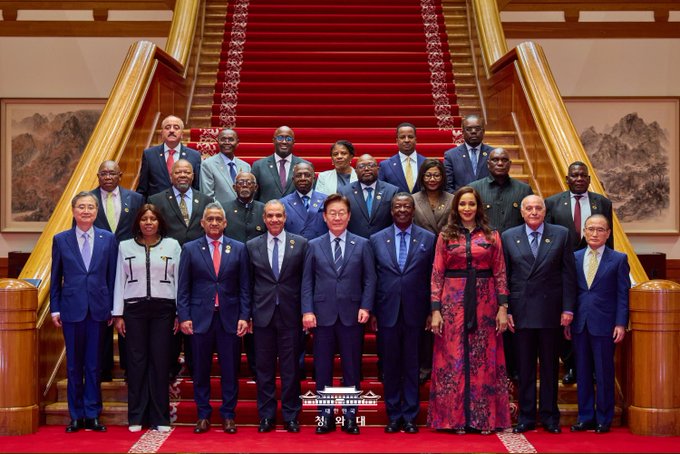
Speaking at Sungkyunkwan University in Seoul, South Korea, during an address themed “From Regional Anchor to Global Influence: Kenya’s Strategic Foreign Policy Outlook in an Evolving World Order,” Mudavadi outlined Kenya’s diplomatic ambitions while calling for deeper partnerships between Africa and Asia.
The lecture, delivered at the invitation of university leadership and political science scholars, focused on Kenya’s positioning in a rapidly changing international environment marked by economic uncertainty, conflict, and rising global competition.
Mudavadi argued that the international system is increasingly under pressure due to renewed unilateralism, intensifying sanctions, trade tensions and expanding military rivalries, developments he warned carry serious consequences for both economic stability and global security.
According to the Prime CS, diplomacy is gradually losing ground to transactional politics, where state interests are pursued with diminishing regard for collective global cooperation.
He cautioned that such trends risk weakening institutions built to sustain international order, adding that countries in Africa must respond strategically by strengthening regional cooperation, diversifying partnerships and investing in innovation.
Mudavadi cited major disruptions, including the lingering economic effects of the COVID-19 pandemic, the Russia-Ukraine conflict and tensions in the Middle East involving the United States, Israel and Iran, saying their ripple effects continue to deepen economic vulnerabilities across African economies.
“These global disruptions have reinforced the urgency for African states to rethink economic resilience through trade, science, technology and stronger partnerships,” he noted.
He also pointed to humanitarian emergencies in Sudan and South Sudan, where conflict and climate-related challenges continue to displace populations and disrupt education systems.
Against this backdrop, Mudavadi said African governments must move away from overreliance on aid and instead pursue policies centred on trade, investment and economic self-sufficiency.
He described the African Continental Free Trade Area (AfCFTA) as a major opportunity to strengthen regional economies through manufacturing, industrialisation and value addition.
According to him, the trade bloc presents an avenue for African nations to build stronger supply chains across sectors such as agriculture, pharmaceuticals and manufacturing while reducing external dependence.
Mudavadi further advocated reforms within global governance institutions, particularly the United Nations, arguing that multilateral systems should be strengthened rather than abandoned.
With the election of a new UN Secretary-General expected later this year, he called for leadership committed to equitable development, scientific advancement and fair representation for developing nations.
Turning to Kenya’s relationship with South Korea, Mudavadi highlighted growing bilateral cooperation in technology, education, healthcare and industrial development.
He pointed to South Korea’s role in supporting flagship projects such as Konza Technopolis and the Kenya Advanced Institute of Science and Technology (Kenya-AIST), initiatives aimed at strengthening research, digital innovation and industrial competitiveness.
Describing Kenya as Africa’s “Silicon Savannah,” Mudavadi cited the country’s achievements in financial technology, telecommunications and digital entrepreneurship, including the global success of mobile money services.
He also positioned Kenya as a gateway to East and Central Africa, noting that the country offers access to a market of more than 1.5 billion consumers through continental trade arrangements.
Nairobi’s growing diplomatic importance was also highlighted, with Mudavadi noting that the city hosts key international agencies, including the United Nations Office at Nairobi, UNEP and UN-Habitat, alongside regional offices of major financial institutions.
“In a world increasingly driven by transactional interests, Kenya remains committed to dialogue, partnership and principled cooperation,” he said.
Mudavadi concluded by encouraging stronger academic, economic and cultural collaboration between Kenya and South Korea, inviting investors, scholars and tourists to deepen engagement with the country.
He expressed optimism that stronger Africa-Korea partnerships could contribute not only to shared prosperity but also to greater global stability.