Sponsored Ad

Ad 1
Ad 2
Ad 3
Ad 4
Ad 5
Ad 6
27.3 C
Kenya
Saturday, May 9, 2026
Home Blog Page 255

Ruto, Kindiki offices spent Ksh.298M on fuel in six months – Audit Report

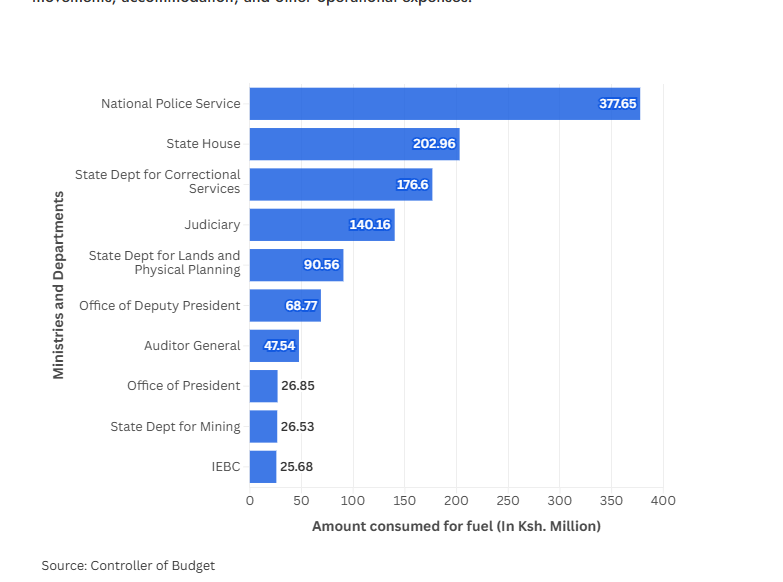
Months after President William Ruto pledged to implement austerity measures to curb government spending, a new audit report has revealed that State House and the offices of the President and his deputy spent Ksh.298.58 million on fuel for their vehicles within the first six months of the 2025/26 Financial Year.

According to the Office of the Controller of Budget, State House alone consumed Ksh.202.96 million on fuel, the second highest expenditure among government entities, coming only after the National Police Service, which spent Ksh.377.65 million.

If the current trend continues, State House could record even higher fuel expenditure by the end of the 2025/26 financial year.
Government officials often travel with large entourages during official engagements such as project launches, meetings, and public events. When the President or Deputy President travels, logistical costs typically extend beyond vehicles to include security details, staff movements, accommodation, and other operational expenses.

Since President Ruto assumed office in September 2022, State House has utilised Ksh.1.092 billion on fuel, raising questions about the austerity pledge made by the Kenya Kwanza administration.

For instance, State House spent Ksh.481.39 million on fuel in the 2024/25 financial year, a notable increase from Ksh.407.92 million recorded in the 2023/24 financial year.

Further, the Office of the Deputy President of Kenya used Ksh.68.77 million on fuel during the first half of the 2025/26 financial year, placing it among the top government spenders in this category. 

The office holder, Prof. Kithure Kindiki, whose nationwide empowerment programmes and frequent political engagements have seen him travel extensively across the country.

Kindiki has also been actively campaigning for candidates of the United Democratic Alliance (UDA) in recent mini-polls.

During this period, the once soft-spoken politician has increasingly adopted a combative political tone, popularising slogans such as “Fire si Fire” and “Wewe Goliathi”. Critics argue the shift reflects the high-stakes political environment surrounding his role in government and party mobilisation.

Likewise, President Ruto’s office recorded Ksh.26.85 million in fuel expenditure during the same six-month period. While lower than State House spending, the figure still contributes to the combined fuel bill incurred by the Presidency.

To put it into perspective, the vehicles consumed an average of 1.7 million litres of fuel, covering approximately 14 million kilometres during the period.

Overall, in FY 2025/26, the gross allocation to ministerial recurrent expenditure stands at Ksh.1.80 trillion, compared to Ksh.1.77 trillion allocated in FY 2024/25. 

In the first six months of FY 2025/26, expenditure stood at Ksh.899.74 billion, including Ksh.881.50 billion representing 50 per cent of the annual gross recurrent estimates. This is markedly higher compared to the 24 per cent, equivalent to Ksh.433.89 billion, recorded during the same period in FY 2024/25.

The revelations come at a time when State House is set to spend Ksh.17 billion by the end of the current financial year, nearly double the Ksh.8.5 billion initially allocated at the beginning of the year.

Further, State House has requested Ksh.20 billion for the next financial year starting July 1, citing the addition of four new State lodges as a key factor driving the anticipated rise in expenditure.

The requests have raised fresh questions about government spending priorities, particularly at a time when many Kenyans continue to grapple with the high cost of living, increased taxation, and economic pressures.

The figures, however, are expected to increase, especially as the country approaches the 2027 General Election, where political activities increase, meaning fuel expenditure could rise further as leaders traverse the country for political mobilisation and campaign activities.

MP Ndindi Nyoro claims Turkana oil project has been ‘personalised’

Kiharu Member of Parliament Ndindi Nyoro has called on leaders to put the interests of Kenya and its citizens above personal gain, warning against alleged attempts to personalise the Turkana oil development project.

Speaking while launching three laboratories at Karemaini Secondary School, Nyoro claimed that some leaders were treating the Turkana oil venture as a personal project instead of a national resource meant to benefit all Kenyans.

He cautioned that the oil project must be managed in a manner that ensures its benefits are shared broadly across the country rather than serving the interests of a few individuals.

“It is very wrong and diabolical that instead of Kenya benefiting from Turkana oil, a section of elected leaders have become selfish and are now claiming that the oil from Turkana does not belong to Kenya but to an individual. Someone should be very ashamed for putting their personal ambitions in such a national issue,” Nyoro said.

“The oil from Turkana and Boma must benefit the people of Turkana and all Kenyans. Leaders associating themselves with the oil should put aside greed and put Kenya first so that the resource benefits the nation and not an individual.”

Nyoro also raised concerns over plans to construct a railway line to transport oil from Turkana to the Coast, saying the project should first prioritise the needs and welfare of Turkana residents rather than private interests.

“They plan to construct a railway to transport oil from Turkana to Mombasa using public funds, while the oil belongs to an individual. Let us first build infrastructure that helps the people of Turkana travel to Nairobi and Mombasa before using public resources to construct a railway that benefits a private individual,” he stated.

The broader oil development plan includes a proposed 825-kilometre pipeline to Lamu that is expected to transport an estimated 560 million barrels of recoverable crude oil.

Production from the fields is projected to reach about 120,000 barrels per day by 2032.

Court of Appeal suspends ruling declaring Ruto advisors’ offices unconstitutional

The Court of Appeal has temporarily halted the implementation of a High Court judgment that declared the creation of several advisory positions in the Office of the President unconstitutional.

In a ruling delivered on Friday afternoon, the Appellate court granted an order staying the execution of the judgment pending the hearing and determination of an intended appeal filed by the government.

The judges noted that it was not disputed that the intended appeal raises arguable issues that deserve consideration by the court.

The key question for determination, they said, was whether failure to grant a stay would render the appeal nugatory if it ultimately succeeds.

The High Court had earlier issued orders declaring that the establishment of offices held by the 3rd to 23rd respondents, who serve as advisors to the President, was unconstitutional.

In determining whether to suspend the decision, the Court of Appeal considered whether the effects of the High Court judgment would be reversible if the appeal later succeeded, or whether damages would adequately compensate the affected parties.

The court also observed that applications for stay must be considered based on the specific facts and circumstances of each case.

Judges noted that the matter involves competing public interest considerations, requiring a proportionality assessment before deciding whether to grant the orders sought.

Lawyers for the applicant and supporting respondents argued that failing to suspend the judgment would paralyse Executive functions and cause administrative disruption within the Office of the President.

They also warned that the immediate removal of the advisors could create instability and constitutional uncertainty, particularly because formal handover processes had not taken place.

However, the first respondent opposed the application, arguing that allowing the stay would permit the continuation of unconstitutional actions despite the High Court’s findings.

The court examined earlier Appellate court decisions involving the now-defunct position of Chief Administrative Secretary (CAS), which had also been declared unconstitutional.

In one case, the Court of Appeal declined to suspend the ruling, reasoning that allowing individuals to serve in offices created in violation of the Constitution could not be justified even if services were rendered to the public.

“Service rendered in violation of the Constitution is no service at all in the eyes of the law,” the court had held in that earlier decision.

However, the judges said the current case differs from that situation because the advisors were already in office and performing their duties when the High Court issued its judgment.

The court noted that removing them immediately could disrupt the functioning of the Office of the President.

The judges further stated that concerns raised about possible duplication of roles would be addressed during the substantive hearing of the appeal.

“In the circumstances, we are convinced that the applicant has satisfied the two limbs for the grant of the order sought,” the court ruled.

The judges therefore issued an order staying the execution of the High Court judgment until the appeal is heard and determined.

Given the public interest nature of the dispute, the Court of Appeal recommended that the President of the court prioritise the hearing of the intended appeal.

The court also directed that the costs of the application will be determined based on the outcome of the appeal.

‘Snake under the bed!’ EACC boss Oginde warns on normalising corruption

Ethics and Anti-Corruption Commission (EACC) Chairperson David Oginde has warned that corruption in society should never be accepted as normal, likening it to “a snake under the bed” that threatens the safety of the entire house.

Speaking during the Kenya Leadership Integrity Forum (KLIF) Campus Edition at Pan Africa Christian University on Wednesday, Oginde cautioned against growing tendencies to view corruption as a necessary evil in society.

“The idea that corruption is a necessary evil comes from a concept known as the ‘grease the wheels’ argument,” he said, noting that some economists argue that corruption can speed up bureaucratic processes.

However, the EACC boss added that modern research shows the opposite, saying; “Rather than ‘greasing the wheels,’ corruption adds sand to the system by rewarding influence instead of competence.”

The event, held at PAC University’s main campus in Nairobi, brought together university leaders, students and anti-corruption stakeholders to discuss the theme: Can we really tame corruption or is it a necessary evil in today’s society?

Using a vivid metaphor, Oginde described corruption as a hidden danger within institutions, warning that accepting corruption as inevitable is similar to allowing a snake to remain in a house simply because it might eat rats.

“From where I sit, corruption is a snake under our bed. You may not see it, but once you know it is there, the entire room becomes unsafe,” he said. 

“It may sound clever, but no responsible household accepts a snake as part of the furniture.”

The EACC Chairperson noted that corruption often operates quietly through procurement decisions, licensing approvals and regulatory processes while institutions outwardly appear stable, adding that the biggest casualty of corruption is trust.

“When citizens begin to believe that justice can be bought, that opportunities depend on connections rather than merit, and that laws apply only to the powerless, then the legitimacy of institutions begins to erode,” he said.

Oginde further stressed that leadership plays a decisive role in shaping the ethical tone of a nation, underscoring that responsibility does not lie with leaders alone and that corruption also persists through citizen participation.

“The ethical tone of a nation is often set by those who lead its institutions. When leaders tolerate corruption, corruption multiplies. When leaders excuse wrongdoing, integrity becomes optional,” he noted.

“A bribe requires two actors: one who demands it and one who offers it,” he said, pointing to everyday compromises such as bribing traffic officers, cheating in exams and falsifying documents as contributors to broader national corruption.

Quoting anti-corruption advocate John Githongo, the anti-corruption watchdog chief cautioned that corruption becomes even more dangerous when societies begin to normalise it and thrives when citizens lose their sense of outrage.

He linked corruption to wider economic and social challenges facing the country.“A society that learns to live with corruption is like a household that learns to live with snakes under the bed,” Oginde said.

“The pain of corruption is all around us – tough economic times, unemployment, floods, and many such anomalies in our nation. These are snake bites,” he added.

Consequently, the anti-graft boss explained that eliminating corruption requires a coordinated effort from leadership, institutions and citizens, thus urging the society to “smoke out the serpent,” since it will not disappear on its own.

“Corruption must first be exposed through transparency and investigative scrutiny. It must then be confronted through accountability and enforcement. Finally, institutions must be strengthened so that corruption cannot easily return,” he said.

“The snake enjoying the warmth of your house will not just slither away on its own – it must be forcefully removed.”

While highlighting the progress made by the commission over the past three years, Oginde said the commission has filed 133 asset recovery suits valued at approximately Ksh.25.71 billion, recovered Ksh.7.4 billion from illegally acquired assets and secured 72 convictions in corruption-related cases.

He said the agency has also safeguarded Ksh.10.74 billion in public funds through disruption interventions, conducted 41 systems reviews across ministries, departments and agencies, and supported 17 county governments through corruption risk assessments.

Clerk Nyegenye Underscores Strategic Role of Supply Chain in Parliamentary Service

The Clerk of the Senate, Mr. Jeremiah Nyegenye, has emphasized that the Supply Chain function remains one of the most critical enablers of PSC service delivery.

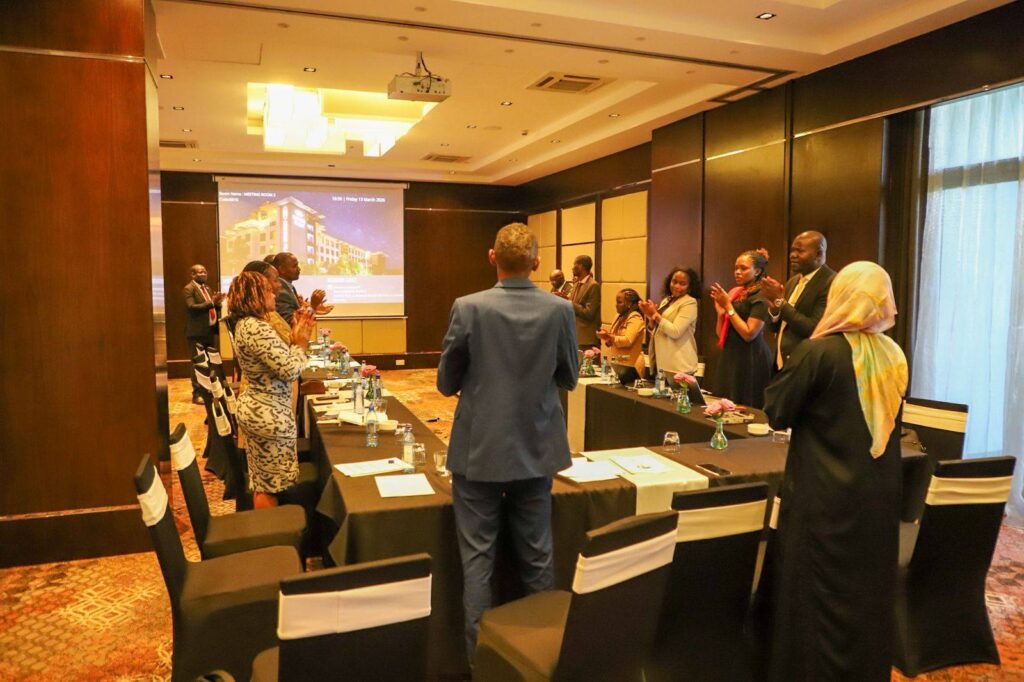
Speaking during the inaugural performance review retreat for the Supply Chain Department in Machakos County, the Clerk noted that the Commission’s ability to deliver on its mandate depends significantly on the efficiency, integrity, and professionalism of its supply chain officers.

The Clerk, who also serves as the Secretary to the Parliamentary Service Commission (PSC), identified the department as a vital “custodian of public resources”.

He noted that their work directly supports the effective functioning of the PSC by ensuring that procurement processes, transport services, and air ticketing operations are conducted transparently and in strict compliance with relevant laws and regulations.

The retreat provides a timely opportunity to review departmental performance for the 2024/2025 Financial Year and assess mid-year progress across the Procurement, Transport, and Air Ticketing sections.

Mr. Nyegenye urged the team to engage in “open, honest, and objective reflection,” moving beyond highlighting achievements to identify areas where targets were not fully met and the underlying causes of those gaps.

He emphasized that this process must result in “clear, actionable recommendations” to guide the department’s priorities for the remainder of the financial year.

A primary focus of the address was the matter of concern regarding pending bills. The Clerk insisted on the development of practical solutions and clear timelines to resolve outstanding obligations while preventing their recurrence.

He specifically called for “close coordination between the Directorate of Finance and Accounting and the Supply Chain Department to strengthen planning, contract management, and the timely processing of payments.”

Ultimately, Mr. Nyegenye stated that maintaining high standards of integrity and professionalism is “critical to safeguarding public trust and protecting the reputation of the Parliamentary Service Commission”.

He concluded by thanking the staff for their continued dedication and hard work, tasking the team with strengthening strategic procurement planning and internal compliance mechanisms.

By Anthony Solly

Tuju writes to CJ Koome over Karen property dispute, claims judge demanded bribe

Former Cabinet Secretary Raphael Tuju has formally written to Chief Justice Martha Koome, accusing elements within the Judiciary of corruption and raising concerns over the conduct of court processes surrounding a dispute that has seen auctioneers and alleged goons attempt to take over his Karen property.

Addressing the press outside Supreme Court buildings after delivering the letter on Friday, Tuju said he had chosen to seek redress through institutions rather than violence despite recent confrontations at his property.

“I have come to the Judiciary today only with a letter and not with goons. If you allow our country to go the goons way then we will be heading to anarchy and chaos. In other words, a failed state,” Tuju said.

The letter follows dramatic scenes witnessed on Wednesday night at Tuju’s Dari Business Park in Karen, where auctioneers accompanied by security personnel and a group of individuals attempted to take control of the premises over a long-running debt dispute with the East African Development Bank (EADB).

Witness accounts and footage from the scene showed dozens of people arriving at the compound, and attempting to restrict access to the property before Tuju confronted them and ordered them to leave.

Tuju insisted that the individuals were attempting to forcefully evict him even though the legal dispute over the property was still ongoing in court.

The standoff came after a court decision cleared the way for the auction of the property to recover a debt estimated at more than Ksh1.9 billion, a case that has been in litigation for years.

Reports indicate that more than 100 individuals were allegedly involved in the attempted takeover, raising fresh concerns about the growing use of hired groups to enforce property disputes outside formal legal procedures.

In his statement, Tuju accused a judicial officer of corruption, claiming he was asked to pay a Ksh.10 million bribe in exchange for a favourable ruling in the case.

He said agents allegedly linked to the judge repeatedly demanded money, which he refused to pay, opting instead to cooperate with investigators from the Ethics and Anti-Corruption Commission (EACC).

“For weeks her agents came demanding money and I refused… Rather than give this bribe I chose to work with the EACC,” Tuju said.

He added that the attempted eviction involving auctioneers and alleged goons followed shortly after the ruling against him.

Tuju also appealed to the Directorate of Criminal Investigations (DCI) to investigate the individuals he claims sponsored the invasion of his property.

While condemning the incident, he urged investigators to focus on those who organized the operation rather than only the young men allegedly hired to carry it out.

“If any goons have to be charged for the optics then for fairness you should also arrest the owners of the goons who hired them and gave instructions for them to storm my premises,” he said.

The former Jubilee Party Secretary General said his petition to the Chief Justice contained information already held by investigative agencies including the DCI, EACC and the Office of the Director of Public Prosecutions (ODPP).

He argued that the matter has broader implications for the credibility of the judiciary, saying the institution itself is “on trial.”

Tuju also signaled that he intends to return to the Supreme Court in the coming days seeking to introduce what he described as new evidence linked to the ongoing dispute with the regional lender.

Energy CS Wandayi dismisses Kenyans’ concern on Iran war, says Kenya have enough fuel

Energy and Petroleum Cabinet Secretary Opiyo Wandayi has assured Kenyans of an adequate supply of petroleum fuel despite the ongoing war in the Middle East pitting Iran against America and Israel.

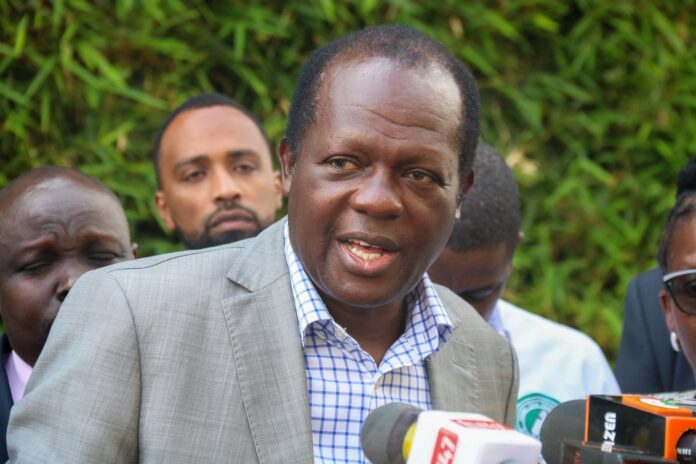
Speaking at Tendeno Primary School in Tendeno/Soget Ward in Kipkelion East constituency during the launch of the last mile electricity connectivity for the constituency, Wandayi said, although the war had caused jitters among nations which were relying on Iran for fuel, the government had put in place measures to ensure a steady and adequate supply of fuel in the country.

“A major conflict has erupted in the Middle East between the US, Israel, and Iran. This war has caused widespread fear among citizens not just in Kenya, but across the world. I want to assure you that regarding fuel, Kenyans should not worry. The national government, led by His Excellency President Dr Ruto, has put in place comprehensive strategies to ensure that there is enough fuel today, tomorrow, and in the future. Therefore, citizens should not be anxious,” he said.

He said the government was working closely with international oil companies like Saudi Aramco, Abu Dhabi National Oil Company, Emirates Oil Company, among others, under the arrangement of government-to-government supply to ensure that the country would not run out of fuel.

Wandayi said the ministry’s role was to ensure that there was enough supply of fuel so as to assist the country in moving forward.

“We are working very closely with international oil companies through government-to-government supply arrangements. We are cooperating with all these companies to ensure that fuel in Kenya will not run out,” the CS added.

The CS warned Kenyans against panic-buying of fuel to store it in their homes, saying it was dangerous for their safety.

He said on Saturday, the Energy and Petroleum Regulatory Authority (EPRA) will be announcing the fuel prices for Kenya for the next month, and the fuel will be available without any problem since the government had ensured that there was an adequate supply so that Kenyans would not suffer.

Chelsea’s Pedro Neto handed additional one-game ban, fined after Arsenal red card

Chelsea winger Pedro Neto has been handed an additional one-game ban by the Football Association (FA) for his conduct after being sent off at Arsenal earlier this month.

The 26-year-old was shown two yellow cards in the space of three minutes by referee Darren England during the 2-1 defeat at the Emirates Stadium on March 1. The first was for dissent and the second, which saw him sent off in the 70th minute, was due to a bad challenge on Gabriel Martinelli.

The Portugal international, who was automatically suspended for the following game at Aston Villa, was seen protesting against the decision before going down the tunnel.

In a statement on Friday, the FA said: “Pedro Neto has been given a one-match suspension and a £70,000 fine for misconduct that occurred after he was sent off in Chelsea’s Premier League match against Arsenal on Sunday 1 March.

“It was alleged that the player acted in an improper manner by failing to leave the pitch promptly and/or using abusive words towards the match official/s following his dismissal in the 70th minute.

“Pedro Neto subsequently admitted the charge against him. An independent Regulatory Commission imposed these sanctions following a hearing, and the written reasons for its decisions will be published in due course.”

Neto is now banned for Chelsea’s game at home to Newcastle on Saturday but is also currently facing possible punishment from UEFA as well for pushing a ball boy during the side’s 5-2 defeat at Paris Saint Germain in the Champions League.

UEFA have opened disciplinary proceedings into the altercation. There is a possibility it could be resolved before the second leg of their last 16 tie next week. A suspension is one of the options open to European football’s governing body.

Chelsea head coach Liam Rosenior said earlier on Friday, before the FA decision on the Arsenal dismissal was announced, that Neto needs to learn from these experiences.

He said: “I’ve seen the (PSG) incident back now and it doesn’t look good in terms of … I understand Pedro’s perspective. He wants to get the ball back in play as quickly as possible. He wants to win for the club. There are ways you go about it.

“What I was so impressed with was for him, and it was his idea, to apologise straight away. Like I’ve just said, whether it’s a goalkeeper, whether it’s me as a manager or a player, we make mistakes. It’s about learning from those mistakes and making sure they don’t happen again.”

All six crew members killed after US refuelling plane crashes in Iraq

All six members of a US military refuelling aircraft’s crew have now been confirmed dead after it crashed in western Iraq, US Central Command (Centcom) has said.

The US initially said it had located four of the deceased crew. It said neither hostile nor friendly fire were involved in the loss of the KC-135 aircraft on Thursday.

The tanker had been involved in ongoing US operations against Iran and was one of two aircraft involved in the incident. The second landed safely.

The Boeing-manufactured aircraft are capable of refuelling planes midair and play a major role in US military operations. They were used extensively in the first Gulf War to extend the range of fighter jets and bombers.

Centcom said the incident occurred at about 14:00 ET (19:00 GMT) on Thursday and that the circumstances of the crash were now under investigation.

A search and rescue operation was then launched to locate the remaining two crew members.

The US military command unit added that the identities of the personnel who had been killed were being withheld for 24 hours so their next of kin could be notified.

Gen Dan Caine, chair of the US Joint Chiefs, told a news conference on Friday that the plane had crashed “while the crew was on a combat mission”.

US Defense Secretary Pete Hegseth hailed the aircraft’s crew members as “American heroes”, stressing that their “sacrifice will only recommit us to the resolve of this mission”.

The KC-135 usually has a crew of at least a pilot, a co-pilot and a boom operator responsible for controlling the refuelling arm of the aircraft.

Centcom earlier described the crash as happening over friendly airspace – but this is a region of Iraq where pro-Iranian militias operate. Iran’s military claimed on state TV that an allied group had targeted the plane with a missile.

Thursday’s crash brings the official US military death toll in the US-Israel war with Iran, which began a fortnight ago, to 13. 

The US military has now lost at least four aircraft during the current war. 

Earlier this month, three F-15s were shot down in “an apparent friendly fire incident” over Kuwait, officials said. All six crew members were able to safely eject.

Boeing manufactured the KC-135 Stratotanker for the US military in the 1950s and early 1960s.

It has been a backbone to the US military’s air refuelling fleet, and allow combat aircraft to carry out longer missions without needing to land.

Separately, Israel’s military said on Friday that it had launched a fresh “wide-scale wave of strikes” targeting Iranian infrastructure across Tehran.

Explosions were later reported in and near the Iranian capital.

It came after the US loosened sanctions on other countries buying Russian oil and petroleum already loaded on vessels at sea to curb the economic impact of the US-Israel war with Iran.

Oil prices climbed above $100 (£75) a barrel again on Thursday, while stock markets fell after three more cargo vessels were hit in the Gulf and Iran’s new supreme leader vowed to keep blocking the Strait of Hormuz, a vital shipping lane.

US President Donald Trump has indicated that the war could end “very soon” since the price of oil shot up, while also suggesting the US could “go further”.

France’s military announced on Friday that a drone had killed a French soldier, who it identified as Staff Sgt Arnaud Frion, and wounded six others at a Kurdish military base in northern Iraq yesterday.

It said the soldiers had been stationed at the base to train Iraqi units.

Ig Kanja Holds Security Dialogue With Senior Dci Officers At Ksg, Kwale County

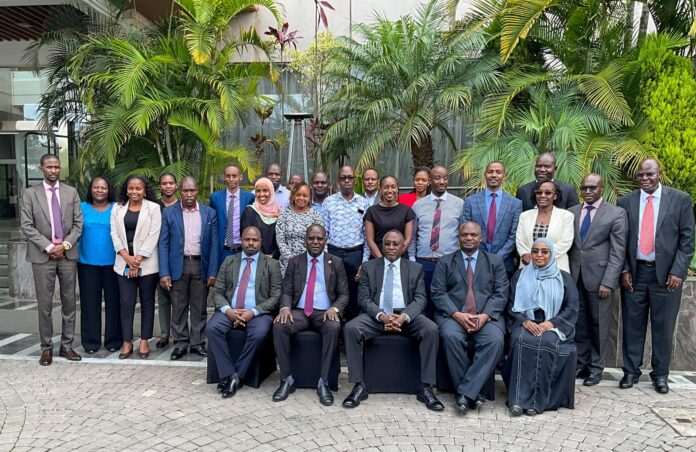
The Inspector General of the National Police Service (IG-NPS), Mr. Douglas Kanja, today participated in a day-long, high-level strategic retreat for senior officers of the Directorate of Criminal Investigations (DCI). The retreat was organised by the Director of Criminal Investigations (DCI), Mr. Mohamed Amin, at the Kenya School of Government (KSG) in Matuga, Kwale County.

The five-day event, which concludes tomorrow, has brought together all heads of directorates, regions, and formations within the Directorate of Criminal Investigations.

In his remarks, IG Kanja reminded the senior officers present that they hold a strategic position, not only in ensuring that acts of criminality are dealt with firmly, but also in fulfilling their command-and-control role within their jurisdictions. This includes directing and leading the officers under them in matters of investigations and service delivery to the public.

Thanking Mr. Amin for his strategic leadership at the DCI, the IG commended him for organising the retreat, a vital platform dedicated to reviewing emerging security challenges, strengthening investigative strategies, and reinforcing collaboration across investigative formations in an increasingly complex security environment.

On matters of illicit brews and drugs, cybercrimes, money laundering, human and game trophy trafficking, terrorism, homicides, and robberies, among others, the IG called upon the officers to continuously sharpen their investigative skills to build an irrefutable body of evidence.

He stressed that every successful prosecution not only validates the tireless commitment of the National Police Service but also equally entrenches a bond of trust and collaboration between the police and the public. To attain this, the IG reiterated, commanders must focus on investigative excellence at all times.

The Inspector General emphasised the need to work collaboratively with other agencies and commended the cooperation between the National Police Service, the Asset Recovery Agency, the Office of the Director of Public Prosecutions, the Independent Policing Oversight Authority, and the Ethics and Anti-Corruption Commission, all of whom have been invited as guest presenters during the retreat.

For his part, the Director of the DCI, Mr. Mohamed Amin, thanked the IG for gracing and participating in the retreat and for sharing invaluable insights, reaffirming the Inspector General’s commitment to leading the National Police Service from the front.

Present during the retreat included the Deputy Director of the DCI, Mr. John Onyango, SAIG; the Director of Personnel, Ms. Rosemary Kuraru, SAIG; the Head of the Investigations Bureau (IB), Mr. Francis Ndiema, SAIG; and the Head of Forensics, Mr. Sospeter Munyi, SAIG, amongst other senior officers.

By Anthony Solly

Create a free account, or log in.

Gain access to read this content, plus limited free content.

Yes! I would like to receive new content and updates.

Sponsored Ad

Ad 1
Ad 2
Ad 3
Ad 4
Ad 5
Ad 6