Sponsored Ad

Ad 1
Ad 2
Ad 3
Ad 4
Ad 5
Ad 6
25.4 C
Kenya
Monday, May 11, 2026
Home Blog Page 447

High Court Denies Bail to Police Officer Klinzy Baraza Charged with Killing Mask Vendor Boniface Kariuki

By Andrew Kariuki

The High Court has declined to release police officer Klinzy Baraza on bail in connection with the fatal shooting of street mask vendor Boniface Kariuki, citing compelling reasons advanced by the prosecution.

In its ruling, the court noted that the circumstances surrounding the shooting were exceptional and had attracted significant public attention, raising concerns over witness safety and the integrity of the trial process.

The court was informed that the deceased’s family has allegedly been subjected to harassment, including unsolicited phone calls and messages, following the incident.

Baraza is accused of shooting Kariuki on June 17, 2025, in Nairobi’s central business district.

Kariuki was reportedly vending face masks outside Imenti House when he was shot in the head.

He later died while undergoing treatment in hospital.

In declining the bail application, the court observed that the accused is a serving police officer and therefore holds authority and access that could potentially be used to interfere with witnesses or ongoing investigations.

The judge held that the prosecution had demonstrated compelling reasons to justify continued detention, warning that releasing the accused at this stage could undermine public order, compromise witness protection, and jeopardise the administration of justice.

Although Baraza urged the court to grant him bail, citing his willingness to comply with court conditions and the need to care for his young family, the court found these considerations insufficient to outweigh the risks identified.

The court directed that the trial be fast-tracked and placed the matter before the registry on February 17, 2026, for further directions.

Baraza will remain in custody as the case proceeds.
High Court Orders Attorney General to Respond in Long-Delayed Muthurwa Estate Eviction Case

By Andrew Kariuki 

The High Court has directed the Attorney General to file a response within seven days in a long-standing petition concerning the eviction of alleged illegal occupants from Nairobi’s Muthurwa Estate, a case in which a ruling has been pending since March 2022.

The matter came up before Justice Lawrence Mugambi, where advocate Cecil Miller, appearing for the Registered Trustee of the Kenya Railways Staff Retirement Benefits Scheme, expressed concern that the state’s legal representative was unaware that the court had yet to deliver a ruling nearly four years after submissions were made.

Miller informed the court that he was ready to serve the application and urged the judge to set a ruling date, arguing that the dispute was old and required urgent resolution.

The court subsequently ordered the Attorney General to file a response within seven days.

Advocate Marwa was also granted the same period to comply with the court’s directions.

The parties were instructed to return to court on February 16 for the purpose of confirming compliance and fixing a ruling date.

The application seeks orders compelling Kenya Railways Corporation to facilitate the eviction of individuals described as illegal settlers from the Muthurwa Estate.

According to court documents, former High Court judge Isaac Lenaola had previously issued orders directing the petitioners to vacate the estate.

However, enforcement of the orders reportedly stalled after the Commandant of the Kenya Railways Police declined to provide security support during the eviction process.

The applicant argues that without fresh court orders, the commandant will continue to withhold police assistance, effectively undermining the enforcement of the earlier ruling.

Miller told the court that although the trustees are prepared to proceed with the eviction, they remain unable to do so in the absence of police support.

The case will be mentioned on February 16 to confirm compliance with the court’s directions and to set a date for the long-awaited ruling.

Umrah Visa Fraud Case : Court to Rule on Bail for Imam Accused of Umrah Visa Scam

By Andrew Kariuki 

A Nairobi court is set to deliver its ruling tomorrow on whether to grant bail or bond to Omar Athman Omar, who is facing charges of obtaining money by false pretences in a case involving alleged Umrah travel fraud.

The prosecution has strongly opposed his release, arguing that the accused is a flight risk and should remain in custody pending the hearing and determination of the case.

According to an affidavit sworn by an investigating officer attached to the Directorate of Criminal Investigations (DCI), the accused allegedly obtained Ksh 774,000 from a complainant, Mohamed Salim Bahlewa, in December 2025.

The money was reportedly paid through bank transfers and M-Pesa after the accused claimed he could facilitate Umrah visas for the complainant and his family.

The prosecution told the court that despite receiving the funds, the accused failed to secure the visas and continued issuing assurances until the intended travel date of December 29, 2025 passed, after which he allegedly went silent.

Court documents indicate that investigations revealed the accused had left the country for the Kingdom of Saudi Arabia, effectively evading arrest and frustrating investigations.

He was eventually arrested on February 7, 2026 upon arrival at Jomo Kenyatta International Airport, an arrest the prosecution says was not voluntary.

In opposing bail, the prosecution argued that the accused has no known fixed place of abode within the court’s jurisdiction, raising concerns over his availability to attend trial if released.

Investigators further alleged that the accused presents himself as an imam and religious leader, a position they say gives him influence that could be used to intimidate or interfere with witnesses, including the complainant.

The prosecution also informed the court that investigations are ongoing and may reveal additional victims who were similarly defrauded under the guise of facilitating Umrah travel arrangements.

Another complaint of a similar nature has reportedly been lodged against the accused at Lang’ata Police Station, reinforcing claims of a pattern of conduct.

Additionally, the prosecution warned that releasing the accused could jeopardize efforts to trace and recover the alleged proceeds of crime and could expose the accused to potential harm from members of the public angered by the alleged fraud.

The Office of the Director of Public Prosecutions maintained that the case against the accused is strong and supported by documentary evidence, including transaction records and communication logs linking him to the offence.

The court is expected to deliver a ruling on bail and bond terms on the matter tomorrow.

Government Warns Kenyans Against 2 Fake Agencies Promising Overseas Jobs

The State Department for Diaspora Affairs has issued a warning to Kenyans seeking jobs abroad, cautioning them against two agencies claiming to be recruiting job seekers for overseas placements.

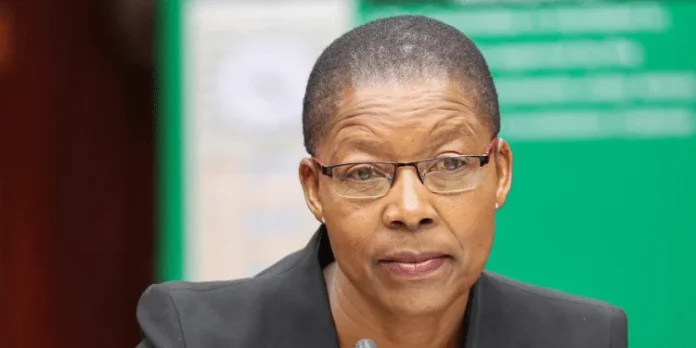
In a statement on Monday, February 9, State Department for Diaspora Affairs Principal Secretary Roseline Njogu said the agencies are not licensed.

“It has come to our attention that these outfits, Triple K and Kenka Company, who are not licensed are trying to recruit people for diaspora jobs,” she said.

Njogu warned that engaging with such agencies could expose job seekers to serious risks, including falling victim to human trafficking schemes.

“Do not fall for this scam. You could be a victim of human trafficking. These fliers are circulating on various WhatsApp groups. Always confirm that you’re working with a licensed agent through National Employment Authority Integrated Management System (NEAMIS),” she added.

File image of Roseline Njogu

This case comes a week after the Ministry of Labour uncovered a fraudulent overseas recruitment scheme involving forged documents and an unlicensed recruitment network targeting Kenyans seeking jobs in Oman.

In a statement on Friday, January 30, Labour and Social Protection Cabinet Secretary Alfred Mutua said the scheme involved the recruitment of three women, Jeneffer, Matilda, and Caroline, who were scheduled to travel to Oman under what has now been confirmed as a fake process.

According to the report, the recruitment was conducted outside Kenya’s legal labour migration framework and relied on falsified government clearances.

The three job seekers were processed through an informal network rather than a licensed recruitment agency.

The primary local contact, Elijah’s Ticketing Tours, admitted to not holding a recruitment license, claiming instead that he only handled ticketing and reservations for what he described as ‘direct hires.’

The report further names a Mohamed, allegedly based in Oman, as the foreign recruiter, while the local contact claimed that labour clearance and contract attestation were being handled by a supposed Ministry of Labour official identified as ‘Raphael.’

However, investigations by the Ministry exposed multiple red flags.

“Verification with the Ministry’s Attestation Department confirmed that no officer by the name of Mr. Raphael exists within that unit. The stamps used on the recruitment documents are fake and did not originate from the Ministry of Labour,” the report read.

Authorities also established that the alleged work visas were invalid.

“A search of the Oman e-Visa Portal returned no records for the said work visas,” the report noted.

The Ministry concluded that the entire recruitment process was illegal and deliberately designed to bypass established migration safeguards.

“The recruitment process for Jeneffer, Matilda, and Caroline is fraudulent. The operation relies on forged Ministry of Labour clearances and unauthorised ticketing agents to bypass legal migration protocols, significantly increasing the risk of exploitation for the job seekers involved,” the report further read.

Isaac Mwaura Responds to Ruth Odinga’s Concerns of NADCO Report Implementation

The government has dismissed claims of inaction on the implementation of the National Dialogue Committee (NADCO) Report.

Government Spokesperson Isaac Mwaura said the implementation process is firmly on course, guided by a structured framework that includes administrative, legislative, and constitutional pathways.

“The Government reaffirms its full and public commitment to the implementation of the NADCO Report. Claims of inaction are totally misguided. The five-member implementation committee remains on course, following the comprehensive briefing with all principal secretaries,” Mwaura said.

He disclosed that the five-member NADCO implementation committee remains operational and has already undertaken a comprehensive briefing with all principal secretaries to align State departments with the reform agenda.

According to Mwaura, three clear implementation pathways have been adopted to fast-track delivery of the report’s recommendations.

“Three clear implementation pathways have been adopted: administrative, legislative and constitutional,” he said.

To ensure accountability and measurable progress, Mwura said the government has developed structured templates for all 54 State Departments outlining specific mandates and deliverables.

“Templates have been developed for all 54 State Departments, clearly outlining mandates and deliverables to ensure accountability on issues such as cost of living,” Mwaura said.

On the legislative front, the spokesperson revealed that 16 bills linked to the NADCO agenda are currently at various stages in both the National Assembly and the Senate.

He clarified that of the ten agreed agenda items under NADCO, eight were implementable administratively, while two require constitutional amendments through a referendum process.

“Of the ten agreed agenda items, eight were implementable administratively, while two required a referendum to be guided by Chapter 16, Articles 255, 256, and 257 of the Constitution, due to their implications on the structure of the Executive and Parliament,” Mwaura said.

The government, he added, remains resolute in seeing through the reform process under President William Ruto’s leadership.

The NADCO Report emerged from bipartisan talks aimed at easing political tensions and addressing key governance, electoral, and cost-of-living concerns, with its implementation viewed as critical to sustaining political stability and institutional reforms.

In an earlier statement, Odinga had raised concerns about the implementation of the 10-point agenda, which was central in the handshake deal between former Premier Raila Odinga and President William Ruto.

She reckoned that the realisation of the recommendations in the report was critical, even as a review of the broad-based government deal approaches in March.

Earlier, NADCO chairperson Agnes Zani assured Kenyans that the committee will deliver on its mandate within the set timelines.

Zani urged the public to have confidence in the committee, saying that they now have a full picture of what Kenyans want addressed.

She noted that the political class has been putting pressure on the team to speed up the report.

The committee, tasked with overseeing the implementation of the 10-point agenda, conducted a public participation exercise in Homa Bay county over the weekend.

The 10-point agenda was signed by the late former Prime Minister Raila Odinga and President William Ruto on behalf of the ODM and UDA parties, respectively.

The team has a timeline of March 7 to present the report.

Governors To Boycott Senate Summons, Cite Harassment, Extortion

The Council of Governors (CoG) has announced the suspension of engagements with the Senate County Public Accounts Committee (CPAC) and the limitation of engagements with the Senate County Public Investment Committee.

In a press release on Monday, February 9, the CoG said appearances before the Senate County Public Accounts Committee have increasingly been marked by alleged extortion, intimidation, and humiliation.

“The Council of Governors notes with great concern the continuous and escalating extortion, political witch-hunt, harassment, intimidation and humiliation of Excellency Governors by certain Senators when they appear before the County Public Accounts Committee,” the statement read.

As a result, the council said governors will no longer appear before CPAC until the matter is resolved through formal talks between the two institutions.

“To this effect, the Council has resolved that Governors will not appear before the CPAC committee until these concerns are addressed through a structured engagement between the leadership of the Senate and the Council of Governors,” the statement added.

Separately, the CoG took issue with repeated summons by the Senate County Public Investment Committee, saying governors are often required to appear multiple times within the same audit cycle to discuss similar investment-related issues.

To address this, the governors resolved to limit their appearances before the investment committee to a single session per audit cycle.

“We note with concern that Governors are required to appear several times before this committee to discuss investment issues, including various funds in the Counties, municipalities, and Individual hospitals.

“In this regard, Governors have therefore resolved that they will only appear once for every audit cycle,” the statement further read.

This comes months after President William Ruto accused senators of turning oversight proceedings into a marketplace.

The standoff escalates long-standing tension between county governments and the Senate, which is constitutionally mandated under Article 96 of the Constitution to oversee counties and protect their interests.

Governors have repeatedly complained that some oversight hearings have turned into adversarial forums rather than accountability mechanisms, while senators have defended their role as essential to safeguarding public funds.

The Senate County Public Accounts Committee examines reports from the Auditor-General on county expenditure, while the Public Investments Committee reviews the management of county-owned entities.

Article 226 requires accountability for public funds, while Article 185 assigns county assemblies a primary oversight role at the county level, creating an overlap that has frequently sparked institutional friction.

The Council of Governors said it is seeking dialogue with Senate leadership to resolve the dispute and restore what it called “mutual respect and professionalism” in intergovernmental relations.

The Senate leadership had not publicly responded to the accusations by the time of publication.

Haiti enters political limbo as transition government’s mandate ends

Haiti entered political limbo on Saturday as the mandate of the Caribbean nation’s transitional governing council, a body intended to curb a bloody gang conflict and bring about long-delayed elections, ended with no succession plan in place.

The nine-member Transitional Presidential Council (CPT, by its French initials) was installed in April 2024 after Prime Minister Ariel Henry resigned. It has been led by a rotating roster of council presidents.

However, its term has been marked by a deterioration in security, corruption accusations and political infighting.

In late January, several members of the CPT said they were seeking to oust Prime Minister Alix Didier Fils-Aime, even as the US threatened serious consequences should they do so and backed Fils-Aime staying on after February 7.

The US also said the CPT must leave power and has imposed sanctions on five council members.

“As the Transitional Presidential Council’s mandate ends on February 7, we support Prime Minister Fils-Aime’s leadership in building a strong, prosperous and free Haiti,” the US embassy in Haiti said on Wednesday.

A day earlier, three US warships arrived in the Bay of Port-au-Prince. The embassy said their presence “reflects the United States unwavering commitment to Haiti’s security, stability, and brighter future.”

Although there is broad agreement between Haiti’s civil and political leaders that the CPT should step down, a consensus has yet to emerge over what structure should replace it.

Speaking to the Miami Herald on Wednesday, former lawmaker Antoine Rodon Bien-Aime, who has been involved in discussions, said there had been many proposals but an agreed solution has yet to emerge.

The Caribbean’s most populous nation has been without an elected president since the 2021 assassination of Jovenel Moise, and its last senators’ terms expired over three years ago.

It last held elections in 2016. The spread of armed groups over the capital Port-au-Prince, the Artibonite farmlands and central parts of the country have further complicated the logistics of organizing a free and fair vote.

Around 1.4 million people were internally displaced across Haiti by October, according to UN data, a million more than when the CPT began their mandate.

The UN also approved an international security force intended to help police restore security, but more than two years later less than 1,000 troops – mostly Kenyan police – were deployed. The UN says it aims to have 5,500 by this summer.

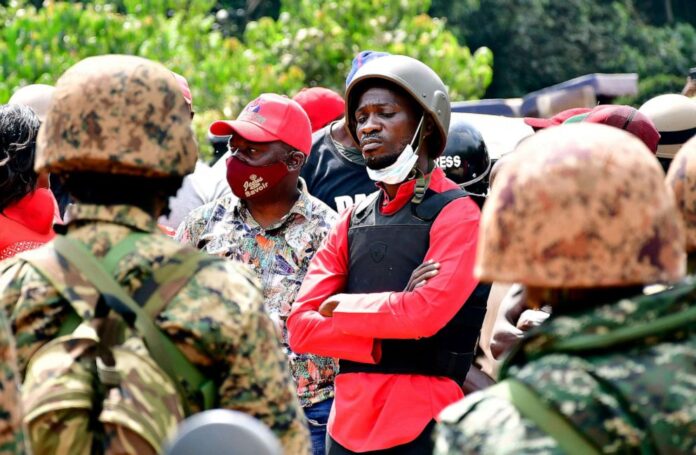
Uganda minister condemns military raid on Bobi Wine’s home

Uganda’s Information Minister Chris Baryomunsi condemned a military raid on opposition leader Bobi Wine’s home last month, telling Reuters that the popstar-turned-politician had not committed any crime and was free to return there.

Wine has been in hiding for weeks after fleeing his home in the capital, Kampala, hours before he was announced the runner-up to President Yoweri Museveni in the January 15 presidential election.

On January 24, Wine said his wife had been taken to hospital after soldiers invaded their residence, alleging that they partially undressed and choked her.

Uganda’s military chief, Muhoozi Kainerugaba, who is also Museveni’s son, denied soldiers assaulted Wine’s wife, but later said on X that they had “captured and then released” her.

Baryomunsi, who is also a spokesperson for the government, said the authorities would investigate the incident.

“We do not condone any acts of indiscipline on the side of the army and security forces,” he said in an interview. “So invading his (Wine’s) home, causing damage, assaulting his wife, or anybody, is wrong.”

He declined to say if security personnel would face any penalties if they were found to have violated the law.

A spokesperson for Wine’s National Unity Platform party did not respond to calls or messages requesting comment.

Kainerugaba has stated in social media posts that the military is looking for Wine, who has rejected the election results, alleging fraud. The army chief has not said why they are looking for Wine or what crime he may be charged with.

Rights groups and the opposition have long accused the government of Museveni, who has been in power for four decades, of using the military to suppress dissent, accusations the government denies.

Baryomunsi also said that Uganda had no plans to withdraw its military contingent from an African Union mission to fight jihadists in Somalia, contradicting recent comments from Kainerugaba, who last week threatened in a post on X to pull troops out of Somalia over financing issues.

Kainerugaba has a history of controversial social media posts that he often later deletes. He once threatened to behead Wine and also boasted the military had killed 30 opposition supporters.

Baryomunsi said Kainerugaba’s posts should be taken as “casual comments that do not reflect state policy and state decisions.”

Mystery of breaking medals baffles Milano Winter Olympics organisers

Whether gold, silver or bronze, there is one thing Milano Cortina Winter Olympics medals have in common: they can break.

Games organizers on Monday said they have launched an investigation into a spate of mishaps that have left Olympic medallists, including American downhill skiing champion Breezy Johnson, sporting a cracked and chipped medal.

“We are fully aware of the situation and you have seen the pictures,” Milano Cortina Chief Games Operations Officer Andrea Francisi told a press conference on Monday. “We are looking into what exactly the problem is.”

“We will pay maximum attention to the medals … so that everything will be perfect because this is one of the most important things for the athletes.”

Johnson is one of several decorated athletes in Italy who have seen their medals snap, crack and pop only minutes after the award ceremonies in the first few days of the Games.

“It is heavy, it’s broken. It’s a look,” Johnson told reporters shortly after the podium ceremony, showing off her cracked and chipped medal in one hand as the separated ribbon hung around her neck. “I was jumping up and down in excitement, then it just fell off.”

She is not the only one, with Germany biathlete Justus Strelow seeing his bronze medal lying cracked on the floor during celebrations at their team headquarters.

Sweden’s cross-country skier Ebba Andersson’s silver prize from the women’s skiathlon suffered a similar fate.

“The medal fell in the snow and broke in two,” Andersson was quoted as saying by Swedish broadcaster SVT. “Now I hope the organizers have a ‘Plan B’ for broken medals.”

KRA reactivates ‘Nil Returns’ on iTax after system validation

The Kenya Revenue Authority (KRA) has reactivated the ‘Nil Returns’ option following the completion of system validation, ahead of the June tax filing timeline.

The move comes just two weeks after the authority suspended the option in a bid to convert nil filers and non-filers into active taxpayers.

During the suspension, the authority scrutinised other transactions, including income taxes, withholding taxes, eTIMs, and customs records, to identify those who have not been captured in the tax net.

The authority has indicated that taxpayers who are nil-filers will use the option to file their January to December 2025 income tax returns after March 31.

“The Nil Filing return option has been reinstated after the necessary system validations have been embedded for the 2025 returns to be filed after March 31, 2026,” the authority said.

“Filing for 2024 income tax returns and prior periods, and other monthly obligations like PAYE (pay-as-you-earn), excise, MRI (monthly rental income), TOT (turnover tax), etc., can proceed as before,” it added.

The move to suspend the nil filing options came amid concerns that most Kenyans continue to file nil returns despite earning taxable income, thereby undermining tax compliance.

Speaking during an interview in late January, Deputy Commissioner Patience Njau assured that the move was intended to spread the tax burden more evenly and include other Kenyans such as those who earn rental income.

Njau revealed that out of 22 million registered individuals with KRA PINs, only 8 million actively pay taxes, and of these, just 4 million consistently meet their tax obligations, limiting the government’s ability to maximise tax revenue.

“This year, our focus will be very different as we aim to convert the nil and non-filers and zero payers into paying taxpayers. We have systems in place to monitor other transactions, such as withholding tax, income earned, eTIMs, and customs, among others,” Njau said.

“To mitigate the risks of missing out on that section, at this time, we will not be filing nil returns until the validation is done. Between now and March 30, you cannot file your 2025 income tax return,” she added.

Create a free account, or log in.

Gain access to read this content, plus limited free content.

Yes! I would like to receive new content and updates.

Sponsored Ad

Ad 1
Ad 2
Ad 3
Ad 4
Ad 5
Ad 6