Sponsored Ad

Ad 1
Ad 2
Ad 3
Ad 4
Ad 5
Ad 6
30.4 C
Kenya
Wednesday, April 29, 2026
Home Blog Page 5715

NGO scouts for female drivers in a bid to end discrimination in matatus, taxis

PHOTO TONY KARUMBA | Credit: AFP via Getty Images

A team of Non-governmental Organizations is taking the fight against domestic violence among women to new levels.

Flone Initiative is a Kenyan women-led organization registered as a Charitable Trust working to end violence against women and girls in public spaces with a focus on the transport industry.

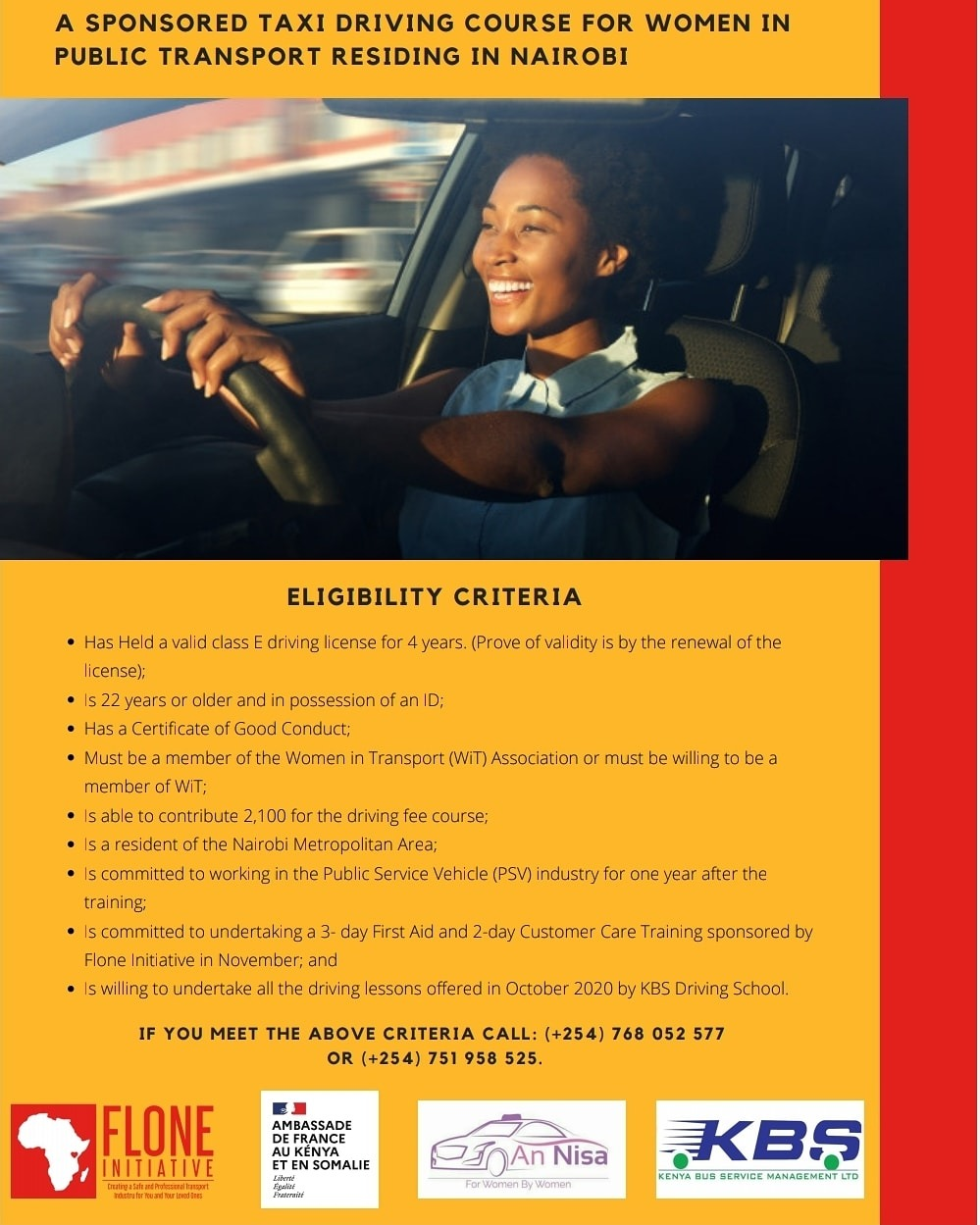
The NGO has advertised for women drivers who have attained the minimum driving experience bracket and are interested in driving the public sector to new horizons.

The course will feature a variety of training excercises including a first aid an customer care training sponsored by Flone Initiative.

Female applicants will be required to provide evidence of 4 years experience in driving the class E vehicle, a certificate of good conduct and should be 22 years or higher

The project is backed by the French embassy in Kenya, and the Kenya Bus Service (KBS).

According to FLONE, the transport sector still remains a male-dominated field, and through this input FLONE will reitarate the importance of inclusive and safe urban mobility as a tool of women empowerment.

In a survey conducted by the same NGO, women in the transport industry reported frequent headaches among other problems linked to loss of jobs, presence of children at home, rent, fear of Covid-19 and food insecurity. 

The survey sampled 30 out of 70 women in the transport business, including; include drivers, conductors, and a mechanic.

The survey recommended that the Ministry of Transport should collaborate with the gender and youth affairs ministry to raise online campaigns that highlight the impacts of Covid-19 on women professionals in the transport industry and recognise women in public transport as unsung heroes and essential workers. 

COVID-19: Baffled experts pose theories explaining Africa’s low death rates

Commuters stand in a line to curb the COVID-19 coronavirus from spreading as they proceed to a ferry in front of a police officer wearing a mask at the Likoni ferry terminal, in Mombasa (Photo by - / AFP) (Photo by -/AFP via Getty Images)

As the threat of a COVID-19 pandemic emerged earlier this year, many felt a sense of apprehension about what would happen when it reached Africa. Concerns over the combination of overstretched and underfunded health systems and the existing load of infectious and non-infectious diseases often led to it being talked about in apocalyptic terms.

However, it has not turned out quite that way. On September 29th, the world passed the one million reported deaths mark (the true figure will of course be higher). On the same day, the count for Africa was a cumulative total of 35,954.

Africa accounts for 17% of the global population but only 3.5% of the reported global COVID-19 deaths. All deaths are important, we should not discount apparently low numbers, and of course data collected over such a wide range of countries will be of variable quality, but the gap between predictions and what has actually happened is staggering. There has been much discussion on what accounts for this.

As leads of the COVID-19 team in the African Academy of Sciences, we have followed the unfolding events and various explanations put forward. The emerging picture is that in many African countries, transmission has been higher but severity and mortality much lower than originally predicted based on experience in China and Europe.

We argue that Africa’s much younger population explains a very large part of the apparent difference. Some of the remaining gap is probably due to under reporting of events but there are a number of other plausible explanations. These range from climatic differences, pre-existing immunity, genetic factors and behavioural differences.

Given the enormous variability in conditions across a continent – with 55 member states – the exact contribution of any one factor in a particular environment is likely to vary. But the bottom line is that what appeared at first to be a mystery looks less puzzling as more and more research evidence emerges.

The importance of age

The most obvious factor for the low death rates is the population age structure. Across multiple countries the risk of dying of COVID-19 for those aged 80 years or more is around a hundred times that of people in their twenties.

This can best be appreciated with a specific example. As of September 30th, the UK had reported 41,980 COVID-19 specific deaths while Kenya, by contrast, had reported 691. The population of the UK is around 66 million with a median age of 40 compared with Kenya’s population of 51 million with a median age of 20 years.

Corrected for population size the death toll in Kenya would have been expected to be around 32,000. However if one also corrects for population structure (assumes that the age specific death rates in the UK apply to the population structure of Kenya), we would expect around 5,000 deaths. There is still a big difference between 700 and 5,000; what might account for the remaining gap?

Other possible contributors

One possibility is the failure to identify and record deaths.

Kenya, as with most countries, initially had little testing capacity and specific death registration is challenging. However, Kenya quickly built up its testing capacity and the extra attention to finding deaths makes it unlikely that a gap of this size can be fully accounted for by missing information.

There has been no shortage of ideas for other factors that may be contributing.

A recent large multi-country study in Europe reported significant declines in mortality related to higher temperature and humidity. The authors hypothesised that this may be because the mechanisms by which our respiratory tracts clear virus work better in warmer more humid conditions. This means that people may be getting less virus particles into their system.

It should be noted however that a systematic review of global data – while confirming that warm and wet climates seemed to reduce the spread of COVID-19 – indicated that these variables alone could not explain most of the variability in disease transmission. It’s important to remember that there’s considerable weather variability throughout Africa. Not all climates are warm or wet and, if they are, they may not stay that way throughout the year.

Other suggestions include the possibility of pre-existing protective immune responses due either to previous exposure to other pathogens or to BCG vaccination, a vaccine against tuberculosis provided at birth in most African countries. A large analysis – which involved 55 countries, representing 63% of the world’s population – showed significant correlations between increasing BCG coverage at a young age and better outcomes of COVID-19.

Genetic factors may also be important. A recently described haplotype (group of genes) associated with increased risk of severity and present in 30% of south Asian genomes and 8% of Europeans is almost absent in Africa.

The role of these and other factors – such as potential differences in social structures or mobility – are subject to ongoing investigation.

More effective response

An important possibility is that public health response of African countries, prepared by previous experiences (such as outbreaks or epidemics) was simply more effective in limiting transmission than in other parts of the world.

However, in Kenya it’s estimated that the epidemic actually peaked in July with around 40% of the population in urban areas having been infected. A similar picture is emerging in other countries. This implies that measures put in place had little effect on viral transmission per se, though it does raise the possibility that herd immunity is now playing a role in limiting further transmission.

At the same time there is another important possibility: the idea that viral load (the number of virus particles transmitted to a person) is a key determinant of severity. It has been suggested that masks reduce viral load and that their widespread wearing may limit the chances of developing severe disease. While WHO recommends mask wearing, uptake has been variable and has been lower in many European countries, compared with many parts of Africa.

So is Africa in the clear? Well, obviously not. There is still plenty of virus around and we do not know what may happen as the interaction between the virus and humans evolves.

However, one thing that does seem clear is that the secondary effects of the pandemic will be Africa’s real COVID-19 challenge. These stem from the severe interruptions of social and economic activities as well as the potentially devastating effects of reduced delivery of services which protect millions of people, including routine vaccination as well as malaria, TB and HIV control programmes.

Research agendas

Major implications of the emerging picture include the need to re-evaluate African COVID-19 research agendas. While many of the priorities originally identified may still hold, their relative importance is likely to have changed. The key point is to deal with the problems as they are now rather than as they were imagined to be six months ago.

The same thing applies for public health policy. Of course, basic measures such as hand washing remain essential (regardless of COVID-19) and wearing masks should be continued while there is any level of COVID-19 transmission. However, other measures with broader effects on society, especially restrictions on educational and economic activity, should be under continuous review.

A key point now is to increase surveillance and ensure that flexible responses are driven by high quality real time data.The Conversation

Kevin Marsh, Professor of Tropical Medicine, University of Oxford and Moses Alobo, Programme Manager for Grand Challenges Africa, African Academy of Sciences

This article is republished from The Conversation under a Creative Commons license. Read the original article.


Uhuru’s unconditional apology to Ruto allies

President Uhuru Kenyatta has moved to heal political tension in the country by extending an olive branch to feuding politicians.
Uhuru, speaking during the National prayer breakfast at State House apologized for perceived political actions that may have offended his deputy, William Ruto.


But Kenyatta did not commit to stop working with Raila Odinga or implementing the BBI initiatives being pushed by the ODM leader. In a thanks giving speech delivered on State House lawns, the President appears to accommodate the DP Ruto brigade, without offering them solutions to their demands.


The President’s unconditional apology will do little to assure DP Ruto of support from GEMA and the President, which he had taken for granted prior to 2017.


The BBI report, which has caused heightened political tension in Kenya will be handed over to the President anytime. Last Sunday, two people died in Muranga during a visit to the County by DP William Ruto. October 10th was hitherto called Moi day. But it is now emerging as a national prayer day after the High Court declared the day a Public Holiday.

Harambee stars dim Zambia 2-1 in a friendly at Nyayo stadium

Kenya punished Chipolopolo of zambia and handed coach Micho his debut defeat in charge in Nairobi.

Kenya beat Zambia 2-1 in a match the Harambee Stars dominated the first hour and deservingly went into the break leading 2-0.

kenya took the lead in the 21st minute when TP Mazembe defender Tandi Mwape turned Cliff Nyakeya’s effort into his own net.

Six minutes later, Nyakeya finally got on the score sheet when he stole the ball from Zanaco midfielder Kelvin Kapumbu in the center circle to race unabated passed four Zambian players before beating goalkeeper Sebastian Mwange.

Kenya had started off hungrier and dominant side and almost got the opener in the ninth minute through Brian Mandela, whose effort went wide despite being in a good position to finish off with a goal.

Zambia stabilised and created a chance in the 13th minute but were unable to break the deadlock as Fashion Sakala’s first-time shot went off target. Three minutes after Sakala failed to put Chipolopolo ahead, Lubambo Musonda wasted yet another big opportunity for them.

Zambia came back a stronger side in the 2nd half as their strong substitutions had kenyas team backpeddling all nthrough to keep off the danger.

Zambia fought hard and got a goal in the 80th minute through Chabula as the former African champions raced against time to get an equaliser,

Four minutes later, Zambia were denied an equalizer after the ball had crossed the line but the referee saw nothing wrong with Kenneth Muguna’s desperate clearance of a clear goal to rob the visitors of a fortunate draw.

Kenya were without their top striker Michael olunga, captain victor wanyama among other professional contigents due to covid-19 restrictions.

Zambia head to South Africa for another friendly as Francis kimanzi Stars refocus on AFCON qualifiers against Comoros next month.

AstraZeneca strike deal for COVID-19 antibody treatment touted by Trump

The U.S. government has awarded $486 million to AstraZeneca Plc to develop and secure supplies of up to 100,000 doses of COVID-19 antibody treatment, a similar class of drug that was used in treating President Donald Trump.

The agreement, under the Trump administration’s Operation Warp Speed, is for developing a monoclonal antibody cocktail that can prevent COVID-19, especially in high-risk population like those over 80 years old, the U.S. Department of Health and Human Services said.

The treatment has come under the spotlight after Trump was treated with Regeneron Pharmaceuticals’ antibody drug last week. The president has also released a video on Twitter touting its benefits.

In a call earlier on Friday, a top U.S. health official said the government was expecting to provide more than 1 million free doses of antibody treatments to COVID-19 patients, similar to the one that was administered to Trump.

Regeneron and Eli Lilly have both applied to the U.S. Food and Drug Administration for emergency use authorizations of their antibody treatments.

AstraZeneca said it was planning to supply up to 100,000 doses starting toward the end of 2020 and that the U.S. government could acquire up to an additional one million doses in 2021 under a separate agreement.

Regeneron signed a $450 million deal in July to sell Operation Warp Speed enough doses of its antibody treatment, REGN-COV2, to treat around 300,000 people.

Eli Lilly said on Friday it had not signed an agreement with Operation Warp Speed.

AstraZeneca plans to evaluate the treatment, AZD7442, which is a cocktail of two monoclonal antibodies, in two studies.

One trial will evaluate the safety and efficacy of the experimental treatment to prevent infection for up to 12 months in about 5,000 participants, while the second will evaluate post-exposure preventative and pre-emptive treatment in roughly 1,100 participants.

Novak Djokovic beats Stefanos Tsitsipas in five sets to make final

Tennis - French Open - Roland Garros, Paris, France - October 1, 2020 Serbia's Novak Djokovic celebrates winning his second round match against Lithuania's Ricardas Berankis REUTERS/Christian Hartmann

Top seed Novak Djokovic withstood a gutsy fightback from Greek fifth seed Stefanos Tsitsipas to set up a French Open final against long-time rival Rafael Nadal on Sunday.

Djokovic, 33, missed a match point in the third set before eventually winning 6-3 6-2 5-7 4-6 6-1 at Roland Garros.

The Serb could not take a second match point in what was the final game before cracking a forehand winner to seal it.

Nadal, who is going for a 13th title, beat Argentina’s Diego Schwartzman.

The top two seeds in the men’s draw will face each other for the 56th time in their careers – no two men have played each other more – and the ninth time in a Grand Slam final.

The match could also be pivotal in the long-running battle between Djokovic, Nadal and Swiss rival Roger Federer in determining which man finishes with the most Grand Slam titles.

If Nadal lifts the Coupe des Mousquetaires trophy yet again, it will see him equal Federer’s all-time leading record of 20 men’s majors.

Djokovic, whose only triumph at Roland Garros came in 2016, knows a victory will move him to 18 – within one more of Nadal and two adrift of 39-year-old Federer.

“I’m not feeling exhausted physically so much after the match,” said Djokovic, whose victory in three hours and 54 minutes was only 45 minutes longer than Nadal’s semi-final.

“It was a great battle. But I feel fine. I think a day and a half will be plenty of time for me to recover. I’m really looking forward to a great battle with Rafa.”

Seedorf believe Christiano Ronaldo will equal his record

The former Netherlands star is the only player to have won the competition with three teams, but he believes the Juventus star can match him

Clarence Seedorf is not worried about the prospect of Cristiano Ronaldo equalling his record of winning the Champions League with three different teams.

Having lifted the European crown during his spells at Manchester United and Real MadridPortugal icon Ronaldo is aiming to win the competition once again with current side Juventus.

Seedorf is the only player in history to have won the Champions League with three sides, having done so with Ajax, Madrid and AC Milan.

How Barca bit, spat on record scorer

Luis Suarez has scored twice since joining Atletico Madrid, Luis Suarez says he cried over the way he was treated by Barcelona before leaving for Atletico Madrid.

The Uruguay forward ended a six-year spell at Barca in September and says he was stopped from training with the first team before his departure.

“Those days were very difficult. I cried because of what I was having to go through,” said Suarez, 33. “I was hurt most of all by the way they did things, because one has to accept it when a cycle comes to an end.”

Suarez joined Barcelona from Liverpool for £74m in 2014 and became the Spanish giants’ third all-time top scorer with 198 goals, winning four La Liga titles, four domestic cups and the 2015 Champions League in the process.

He netted 21 goals in 2019-20 – his lowest tally during the six years – and, after not being involved in Barca’s pre-season matches, he left with one-year remaining on his contract.

Atletico paid a nominal fee of no more than 6m euros for Suarez.

“I didn’t take the club’s message that they were looking for a solution for me in order to mix things up very well,” added Suarez, who has two goals in three games for Atletico.

“Not everyone knows what happened but the worst thing was going to training and being sent to a different group from everyone else because I was not allowed to play in practice matches.

“My wife could see how unhappy I was and she wanted to see me smile again and when the chance came to join Atletico I had no doubts.”

Barcelona’s record scorer Lionel Messi posted a message of support for Suarez on social media, saying he had been “kicked out”.

Messi says Suarez deserved more from Barca in move to Atletico
“I wasn’t surprised that Messi supported me publicly because I know him too well,” said Suarez. “He knew the pain I was going through, the feeling that I was being kicked out was what hurt me the most.

“The way they did things was not right and Leo knows how me and my family suffered.”

Battle for Msambweni Parliamentary by-elections gathers momentum as small parties and independent candidates go on the loose, asking for votes

As the battle for the Msambweni by election seat gather momentum, small parties and independent candidates are also on the prowl trying to outwit the Orange Democratic Movement (ODM) which has staged the by-election as a one easy go for the Raila Odinga led political party. 

No daggers have been left as the December date narrows down and little time remaining for the candidates to ask for votes from the people of Msambweni. 

The Msambweni seat in Kwale County fell vacant following the death of legislator Suleiman Dori in March this year. He died at the Aga Khan Hospital in Mombasa where he was receiving treatment for cancer. 

Since his death, politicians have slowly been silently campaigning until recently when the Independent Electoral and Boundaries Commission (IEBC) announced that the by-election will be conducted in December. 

The seat has so far attracted six candidates who are Omar Boga(ODM),  Shee Abdulrahman (Wiper),Bashir Kilalo(Kadu Asili),Feisal Abdallah(Independent), Sharlet Mariam Akinyi (Independent) and Mohammed Mwakaonje (United Green Movement Party). 

According to Kwale ODM chairman Hassan Mwanyoha, the party is keen to win the seat 

“We are campaigning on a clear target of winning this seat because it belongs to us as ODM and that is what will happen,” he said. 

Kadu Asili party leader Gerald Iha Thoya and his Deputy Party leader Daniel Mangi said they will camp in Msambweni to campaign for their candidate Bashir Kilalo. 

“It is not about a big political party but rather a person who will look at addressing the needs of the people of Msambweni. As Kadu Asili, we shall pitch tent in Kwale and campaign for our candidate who is conversant with the issues in Msambweni. ODM will have a run for their money.  

It will not be a walk in the park because our candidate campaigns on the ideals of our party manifesto which calls for the development of the Coast region,” said Mr Thoya. 

Mr Boga a former Gombato/Bongwe MCA won the ticket after he floored ODM Kwale Vice-chair Nicholas Zani in what was dubbed as do or die primaries. 

ODM has termed the Parliamentary by-election as a contest pitting Mombasa Governor Hassan Joho and Deputy President William Ruto who is silently supporting an independent candidate Feisal Bader whom he recently paraded in his Karen home in Nairobi after Jubilee Party declined to field a candidate in the by-election. 

Jubilee Vice-Chairman David Murathe has insisted that the party will back the ODM candidate. 

“For us, we will support the ODM candidate so let them continue with their defiance against the party leader and the position of the party,” Mr Murathe said. 

An NGO asks President Uhuru Kenyatta to stop eviction of Njukini residents in Taita Taveta County

A Non-Governmental Organization (NGO) based in Mombasa has asked President Uhuru Kenyatta to intervene and stop the eviction of residents of Njukini location in Taita Taveta County. 

The NGO, Haki Yetu through its Executive Director Fr Gabriel Dolan said that as the President calls for nation to prayers,there is need to halt the evictions that have caused dear among those living in the disputed area.

“Please note that as the President calls the nation to prayers for three days that should be matched with good deeds. 

The President should  cancel the eviction threat. Besides that, he must also consider doing the following as acts of mercy to the people. 

First he should order for the reopening of the water points in the vast Gacheha estate and let the recently settled families access,” said Fr Dolan 

In his statement he said that for two years residents have been deprived of the water from River Tsavo. 

“Please, give more land to the community because at the moment the vast estate is occupied by wild animals yet there are people without land,” Fr Dolan said in the statement. 

The organization in the statement said it had been closely following developments in the Njukini area of Taita Taveta, in relation to land injustices.  

“Hundreds of families were evicted in 2018 from Gicheha farm, a land believed to be the property of the first family, and resettled in adjacent land, popularly known as Sir Ramson land. This became the Ziwani Settlement Scheme, Taveta Sub-county,” the statement further said. 

Fr Dolan said during the resettlement, some of the targeted beneficiaries were not allocated land. 

“A dispute and complaints committee established to look into their cases did not render actionable verdict, leaving the affected families with nowhere to settle except on rocky grounds and hilltops, where no one had been allocated land. It is these families, approximated at 76 that are the subject of the prevailing notices to vacate or face forceful evictions.  

He further says that during a recent public baraza conducted at Ziwani settlement scheme, the area Assistant County Commissioner, Chala/Njukini Division, said that the hills and rocky grounds where the families settled on belonged to Gicheha farm, and were not part of the Ziwani Settlement scheme, despite the hills being located within the perimeter of the settlement scheme and reiterated the need for the families to vacate the land, without offering an alternative.  

The organization has written to Taita Taveta county Commissioner asking for the cessation of the planned evictions until an alternative has been explore. 

The letter has also been copied to the regional commissioner.

The county government of Taita Taveta has equally written to the county commissioner demanding the planned evictions be halted until discussions have been had and alternatives explored.  

On 7th October, the county government also  called for the suspension of the evictions until both parties meet for discussion for an amicable solution. 

County Lands Executive Julius Mwandawiro Mghanga said the fear of evictions had caused a great worry among the residents and said it might cause untold crisis for both governments. 

The evictions are slotted for Monday next week. 

“While we respect private property, still it would have been better that the matter was discussed by both governments and the owners of the land to address the problem so as to take sustainable measures to avoid the impending crisis now and in the future. In this regard, I am requesting that the planned eviction, if indeed it is true, be suspended until we first meet with the owners of the land,” Mr Mwandawiro said in a letter seen by Uzalendo News. 

Create a free account, or log in.

Gain access to read this content, plus limited free content.

Yes! I would like to receive new content and updates.

Sponsored Ad

Ad 1
Ad 2
Ad 3
Ad 4
Ad 5
Ad 6