Sponsored Ad

Ad 1
Ad 2
Ad 3
Ad 4
Ad 5
Ad 6
32.1 C
Kenya
Wednesday, April 29, 2026
Home Blog Page 5714

Entire city of Qingdao, China to be tested after COVID-19 wave

QINGDAO COVID
Photo:Xinhua

State health officials have zeroed in on China’s Qingdao city population for COVID-19 tests after new cases were reported in a hospital.

The coastal city reported six new COVID-19 cases and six asymptomatic cases as of late October 11 with most of the cases linked to the Qingdao Chest Hospital.

China confirmed it has already tested 140,000 employees of “medical institutions, newly admitted patients and personnel” since the cases were confirmed.

After the announcement, the National Health Commission (NHC) said mainland China had 21 confirmed COVID-19 cases on October 11. The report did not, but not include any confirmed infections in Qingdao, and it was not immediately clear why.

The number of new asymptomatic cases, which China does not count as confirmed cases, rose to 32 from 23 a day earlier, the NHC said. It did not offer a breakdown on where the new asymptomatic cases were reported, although it said 29 of these cases involved people returning

The coronavirus first emerged in the central city of Wuhan late last year, and the city and its surrounding province of Hubei were sealed off after cases surged towards the end of January.

China has bounced back since then and daily COVID-19 cases have fallen drastically from those peaks, but the country remains on high alert.

In June, large areas of Beijing were subject to mass tests after the capital, which is home to more than 20 million people, detected virus cases linked to a food market.

Qingdao has already locked down Qingdao Chest Hospital as well as the emergency department of its central hospital. The buildings where those diagnosed with the disease live have also been sealed off as part of the authorities’ containment measures.

China is also eager to be first to roll out a coronavirus vaccine, with several companies in final-stage trials. Although unproven, vaccines have already been administered to hundreds of thousands of key workers and soldiers.

The total number of confirmed COVID-19 cases in mainland China now stands at 85,578, while the death toll remained unchanged at 4,634.

  • Assisted by Aljazeera.

School calendar resumes after a 6-month pandemic holiday

School going child attends a lesson wearing a facemask | PHOTO COURTESY

School gates have finally reopened to students and teachers after a 6 month holiday that was brought about by the COVID-19 pandemic. – By Gerald Gekara

Grade four pupils, Class eight and form four candidates reported for resumption of classes early Monday morning, with the hope of recovering lost time.

The candidates, who had considered 2020 a wasted year, will now have to dust old books and rekindle knowledge ahead of their April 2021 examination papers.

The Ministry of Education while issuing the directive, urged parents to allow their children back to school.

They argued that the society has to find a way to live with the coronavirus pandemic, noting that a vaccine would be available later in 2021.

Schools reopening will have to comply with the ministry’s guidelines on how to maintain social distancing within the institution.

Interventions such as increasing school infrastructure, furniture, and provision of sanitizing points, tanks, and sanitizers have been stepped up, in compliance with these guidelines.

Learners, teachers and school workers will also be required to wear face masks at all times.

President Uhuru Kenyatta allocated Ksh 1 Billion to public institutions for the provision of school desks and lockers, to ease the challenge of sharing desks in schools.

He said besides equipping secondary and primary schools, the project which is part of the government’s post-COVID-19 economic stimulus program, is aimed at boosting the informal sector commonly referred to as jua kali (hot sun) sector.

Mudavadi: I am still in the 2022 race

ANC Party leader Musalia Mudavadi has brushed off claims that he is rescinding his position for a more popular candidate in the run up to the 2022 presidential elections. – By Gerald Gekara

Mudavadi instead, called upon Kenyans to shun tribalist politics and fight against corruption.

Speaking in Chepsonoi Constituency, Nandi County during the burial of Allan Savala the son to ANC Executive Director Margaret Ndanyi, the ANC leader has maintained that his eye remains on the top seat and nothing short of vying for the Presidency come 2022.

He made the remarks after attending the National Prayer day that was hosted by President Uhuru Kenyatta at State House, Nairobi earlier in the day.

Mudavadi reiterated the need for Kenyans to remain cautious as the number of cases of the Coronavirus being recorded have once again started rising just days after the President partially opened the economy and lifted the measures that were put in place to curb the rising cases of the virus.

Mudavadi has been seen as the humblest politician in the run up to the 2022 elections. He has been at the forefront in forking the government when issues of political interest supercede interests of serving the people.

Despite being taunted for his inability to unite the western Kenya vote, Mudavadi still believes he is the right candidate for the top job, come 2022.

WTO race tightens for the first female chief Executive officer

The World Trade Organization is set to be led by a woman for the first time in its 25-year history.

The final contestants are; South Korean trade minister Yoo Myung Hee and former Nigerian finance minister Ngozi Okonjo-Iweala.

The candidates were narrowed down from five to two on Thursday in the second round of the process to succeed Roberto Azevedo as director general.

The winner will be decided by consensus after the third and final round of the selection process scheduled to take place from Oct. 19 to 27, according to the Geneva-based global trade watchdog.

If Yoo will be considered, she would be the second Asian to lead the WTO after Supachai Panitchpakdi, a former Thai deputy prime minister who served as director-general from 2002 to 2005.

Okonjo-Iweala on the other hand, is the longest-serving finance minister in Nigeria and the first woman to hold that position. In her 25-year career at the World Bank, she rose to the No. 2 position of managing director of operations.

The selection process comes at a tough time, when an escalating trade war between the United States and China has shaken the flow of goods in the world.

US President Donald Trump has on numerous occasions threatened to leave the body, arguing WTO has failed to hold China to account for breaches of global trade rules

India hits 7 Million COVID-19 cases, Vaccines expected in July 2021

India’s confirmed coronavirus toll crossed 7 million on Sunday with a number of new cases dipping in recent weeks, even as health experts warn of mask and distancing fatigue setting in.

India is expected to become the pandemic’s worst-hit country in the coming weeks, surpassing the U.S., where more than 7.7 million infections have been reported.

The number of people who have died of COVID-19 has remained relatively low in South and Southeast Asia — from India to Vietnam and Taiwan — compared to European countries and the United States, said Dr. Randeep Guleria, a government health expert.

India aims to provide vaccines to 250 million people by July 2021, Health Minister Harsh Vardhan said last week. He said that the government was planning to receive 450 million to 500 million vaccine doses and would ensure “equitable access”.

India saw a steep rise in cases in July and added more than 2 million in August and another 3 million in September. India has a high recovery rate of 85% with active cases below 1 million, according to the Health Ministry. Kalantri, a hospital director in the village of Sevagram in India’s worst-hit western Maharashtra state, said that people in his village had stopped wearing masks, maintaining distance or washing their hands regularly. Nearly 600 million Indians live in rural areas, and with the virus hitting India’s vast hinterlands, experts worry that hospitals could be overwhelmed.

Nationwide, India is testing more than 1 million samples per day, exceeding the World Health Organization’s benchmark of 140 tests per 1 million people.

With the economy contracting by a record 23.9% in the April-June quarter, leaving millions jobless, the Indian government is continuing to relax lockdown restrictions that were imposed in late March.

Kenya cases rebound amid imminent school opening

School going child attends a lesson wearing a facemask | PHOTO COURTESY

Kenya has continued to record rising cases of the Coronavirus, raising concerns over the state of the pandemic once schools reopen on Monday, 13 October. – By Gerald Gekara

In today’s tally, 388 people have tested positive of coronavirus from a sample size of 4,287.

This brings the country’s tally of positive cases to 41,546. From the cases, 383 are Kenyans & 5 are foreigners. 284 are males and 104 females.

In terms of Counties; Nakuru led with (86) cases, Nairobi (84), Mombasa (51), Trans Nzoia (49), Kiambu (29), Kisumu (17), Kericho (11), Meru (10), Busia (10), Bungoma (8), Machakos (7), and Garissa (5).

Kajiado, Tharaka Nithi, and Nyamira recorded (3) cases each, while Nyeri, Siaya, Makueni, Nandi, Kwale, and Nyandarua each reported (2) cases .

6 more patients succumbed to the disease bringing the fatality to 766.

Currently, the prison institution, akin to public school setting are being controlled after cases broke out inside Industrial Area remand prison.

Parents are however concerned over how the state will manage a sudden spike among schools, that may put learners at peril while struggling to save the 2020 school calendar.

Churches record mass ‘thirst for God’ after lifted restrictions

Father Joseph Mungai was today the celebrant priest. In his summon he encouraged Christians to keep their faith in God. | PHOTO COURTESY Meshack Makau for Uzalendo News

Churches all around the country have recorded near normal attendance of congregants two weeks after restrictions on in-person worship was lifted. – By Meshack Makau.

At the Holy Family Basilica church hosted three-quarters of the normal congregants.


Father Joseph Mungai who was the celebrant priest, encouraged Christians to keep their faith in God, despite the devastating effects of the pandemic.

“Prophet Isaiah spoke to the children of Israel when they almost lost their faith in God and encouraged them to change their ways and keep their promise of worshiping only one God.” he spoke.

Father Joseph further urged Christians to consider God’s unconditional love and encouraged everyone to live a good life and focus on life after death.

“In life, we are living, we must keep in mind that our life does not end here on earth, there is a place we are hoping to meet with God.”

The vast Holy family basilica church almost occupied by ¾ of the congregants. | PHOTO COURTESY

A couple of weeks ago only congregants aged seven to fifty-four years old were allowed to attend church services.

Since the president reopened the second phase of the country’s economy, one will easily conclude that Kenyans were not only eager for the economy’s reopening but also thirsty for God.

The Vatican said it was “necessary and urgent” to return to in-person Masses as soon as anti-coronavirus measures permitted.

However, Pope Francis urged the Catholic faithful to obey anti-COVID measures, saying government authorities were responsible for public health. He has on numerous occasions wearing a face mask and has been using hand sanitizer.

Francis has resumed public gatherings and has celebrated a handful of public Masses before limited, socially distanced groups.

NGO scouts for female drivers in a bid to end discrimination in matatus, taxis

PHOTO TONY KARUMBA | Credit: AFP via Getty Images

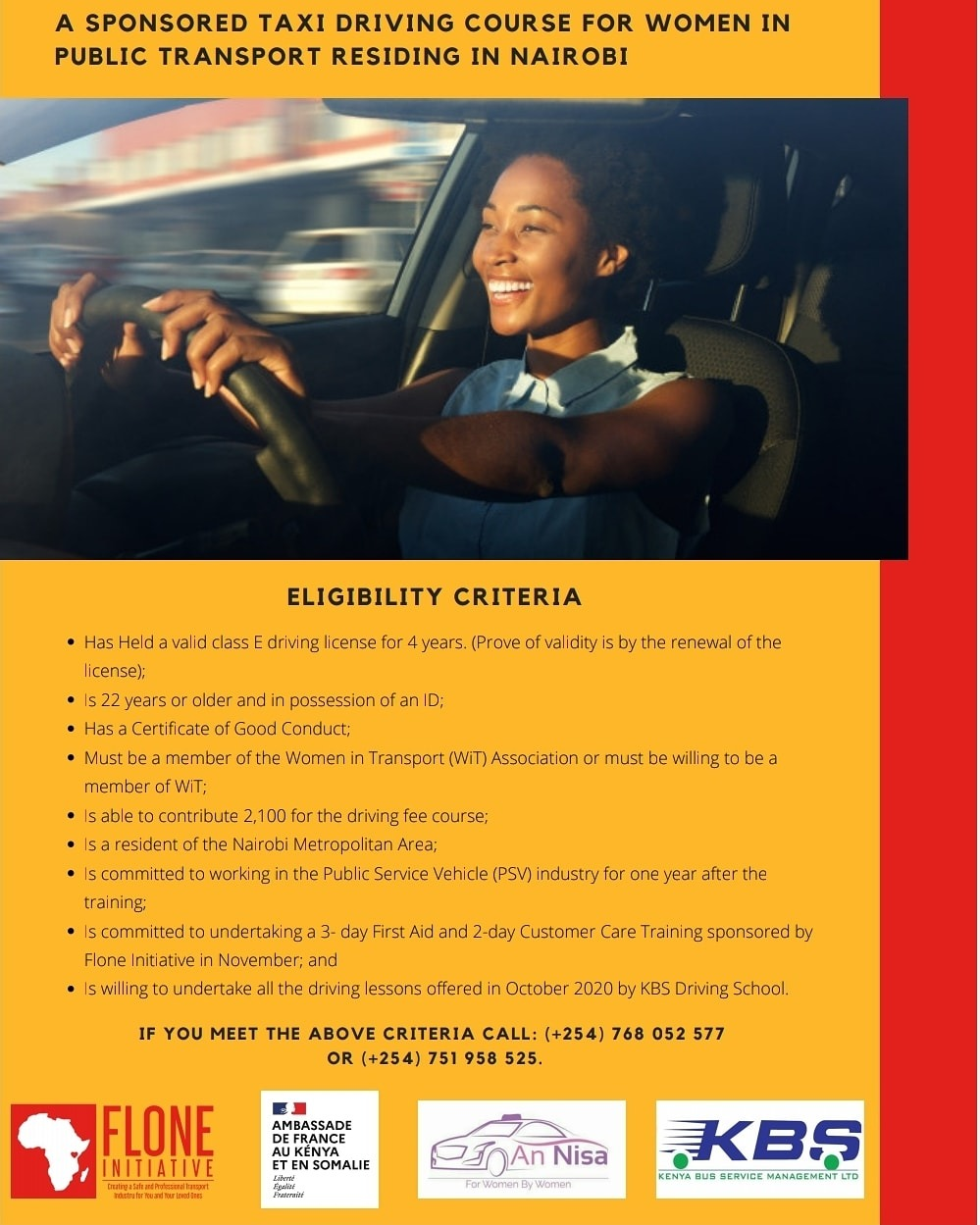
A team of Non-governmental Organizations is taking the fight against domestic violence among women to new levels.

Flone Initiative is a Kenyan women-led organization registered as a Charitable Trust working to end violence against women and girls in public spaces with a focus on the transport industry.

The NGO has advertised for women drivers who have attained the minimum driving experience bracket and are interested in driving the public sector to new horizons.

The course will feature a variety of training excercises including a first aid an customer care training sponsored by Flone Initiative.

Female applicants will be required to provide evidence of 4 years experience in driving the class E vehicle, a certificate of good conduct and should be 22 years or higher

The project is backed by the French embassy in Kenya, and the Kenya Bus Service (KBS).

According to FLONE, the transport sector still remains a male-dominated field, and through this input FLONE will reitarate the importance of inclusive and safe urban mobility as a tool of women empowerment.

In a survey conducted by the same NGO, women in the transport industry reported frequent headaches among other problems linked to loss of jobs, presence of children at home, rent, fear of Covid-19 and food insecurity. 

The survey sampled 30 out of 70 women in the transport business, including; include drivers, conductors, and a mechanic.

The survey recommended that the Ministry of Transport should collaborate with the gender and youth affairs ministry to raise online campaigns that highlight the impacts of Covid-19 on women professionals in the transport industry and recognise women in public transport as unsung heroes and essential workers. 

COVID-19: Baffled experts pose theories explaining Africa’s low death rates

Commuters stand in a line to curb the COVID-19 coronavirus from spreading as they proceed to a ferry in front of a police officer wearing a mask at the Likoni ferry terminal, in Mombasa (Photo by - / AFP) (Photo by -/AFP via Getty Images)

As the threat of a COVID-19 pandemic emerged earlier this year, many felt a sense of apprehension about what would happen when it reached Africa. Concerns over the combination of overstretched and underfunded health systems and the existing load of infectious and non-infectious diseases often led to it being talked about in apocalyptic terms.

However, it has not turned out quite that way. On September 29th, the world passed the one million reported deaths mark (the true figure will of course be higher). On the same day, the count for Africa was a cumulative total of 35,954.

Africa accounts for 17% of the global population but only 3.5% of the reported global COVID-19 deaths. All deaths are important, we should not discount apparently low numbers, and of course data collected over such a wide range of countries will be of variable quality, but the gap between predictions and what has actually happened is staggering. There has been much discussion on what accounts for this.

As leads of the COVID-19 team in the African Academy of Sciences, we have followed the unfolding events and various explanations put forward. The emerging picture is that in many African countries, transmission has been higher but severity and mortality much lower than originally predicted based on experience in China and Europe.

We argue that Africa’s much younger population explains a very large part of the apparent difference. Some of the remaining gap is probably due to under reporting of events but there are a number of other plausible explanations. These range from climatic differences, pre-existing immunity, genetic factors and behavioural differences.

Given the enormous variability in conditions across a continent – with 55 member states – the exact contribution of any one factor in a particular environment is likely to vary. But the bottom line is that what appeared at first to be a mystery looks less puzzling as more and more research evidence emerges.

The importance of age

The most obvious factor for the low death rates is the population age structure. Across multiple countries the risk of dying of COVID-19 for those aged 80 years or more is around a hundred times that of people in their twenties.

This can best be appreciated with a specific example. As of September 30th, the UK had reported 41,980 COVID-19 specific deaths while Kenya, by contrast, had reported 691. The population of the UK is around 66 million with a median age of 40 compared with Kenya’s population of 51 million with a median age of 20 years.

Corrected for population size the death toll in Kenya would have been expected to be around 32,000. However if one also corrects for population structure (assumes that the age specific death rates in the UK apply to the population structure of Kenya), we would expect around 5,000 deaths. There is still a big difference between 700 and 5,000; what might account for the remaining gap?

Other possible contributors

One possibility is the failure to identify and record deaths.

Kenya, as with most countries, initially had little testing capacity and specific death registration is challenging. However, Kenya quickly built up its testing capacity and the extra attention to finding deaths makes it unlikely that a gap of this size can be fully accounted for by missing information.

There has been no shortage of ideas for other factors that may be contributing.

A recent large multi-country study in Europe reported significant declines in mortality related to higher temperature and humidity. The authors hypothesised that this may be because the mechanisms by which our respiratory tracts clear virus work better in warmer more humid conditions. This means that people may be getting less virus particles into their system.

It should be noted however that a systematic review of global data – while confirming that warm and wet climates seemed to reduce the spread of COVID-19 – indicated that these variables alone could not explain most of the variability in disease transmission. It’s important to remember that there’s considerable weather variability throughout Africa. Not all climates are warm or wet and, if they are, they may not stay that way throughout the year.

Other suggestions include the possibility of pre-existing protective immune responses due either to previous exposure to other pathogens or to BCG vaccination, a vaccine against tuberculosis provided at birth in most African countries. A large analysis – which involved 55 countries, representing 63% of the world’s population – showed significant correlations between increasing BCG coverage at a young age and better outcomes of COVID-19.

Genetic factors may also be important. A recently described haplotype (group of genes) associated with increased risk of severity and present in 30% of south Asian genomes and 8% of Europeans is almost absent in Africa.

The role of these and other factors – such as potential differences in social structures or mobility – are subject to ongoing investigation.

More effective response

An important possibility is that public health response of African countries, prepared by previous experiences (such as outbreaks or epidemics) was simply more effective in limiting transmission than in other parts of the world.

However, in Kenya it’s estimated that the epidemic actually peaked in July with around 40% of the population in urban areas having been infected. A similar picture is emerging in other countries. This implies that measures put in place had little effect on viral transmission per se, though it does raise the possibility that herd immunity is now playing a role in limiting further transmission.

At the same time there is another important possibility: the idea that viral load (the number of virus particles transmitted to a person) is a key determinant of severity. It has been suggested that masks reduce viral load and that their widespread wearing may limit the chances of developing severe disease. While WHO recommends mask wearing, uptake has been variable and has been lower in many European countries, compared with many parts of Africa.

So is Africa in the clear? Well, obviously not. There is still plenty of virus around and we do not know what may happen as the interaction between the virus and humans evolves.

However, one thing that does seem clear is that the secondary effects of the pandemic will be Africa’s real COVID-19 challenge. These stem from the severe interruptions of social and economic activities as well as the potentially devastating effects of reduced delivery of services which protect millions of people, including routine vaccination as well as malaria, TB and HIV control programmes.

Research agendas

Major implications of the emerging picture include the need to re-evaluate African COVID-19 research agendas. While many of the priorities originally identified may still hold, their relative importance is likely to have changed. The key point is to deal with the problems as they are now rather than as they were imagined to be six months ago.

The same thing applies for public health policy. Of course, basic measures such as hand washing remain essential (regardless of COVID-19) and wearing masks should be continued while there is any level of COVID-19 transmission. However, other measures with broader effects on society, especially restrictions on educational and economic activity, should be under continuous review.

A key point now is to increase surveillance and ensure that flexible responses are driven by high quality real time data.The Conversation

Kevin Marsh, Professor of Tropical Medicine, University of Oxford and Moses Alobo, Programme Manager for Grand Challenges Africa, African Academy of Sciences

This article is republished from The Conversation under a Creative Commons license. Read the original article.


Uhuru’s unconditional apology to Ruto allies

President Uhuru Kenyatta has moved to heal political tension in the country by extending an olive branch to feuding politicians.
Uhuru, speaking during the National prayer breakfast at State House apologized for perceived political actions that may have offended his deputy, William Ruto.


But Kenyatta did not commit to stop working with Raila Odinga or implementing the BBI initiatives being pushed by the ODM leader. In a thanks giving speech delivered on State House lawns, the President appears to accommodate the DP Ruto brigade, without offering them solutions to their demands.


The President’s unconditional apology will do little to assure DP Ruto of support from GEMA and the President, which he had taken for granted prior to 2017.


The BBI report, which has caused heightened political tension in Kenya will be handed over to the President anytime. Last Sunday, two people died in Muranga during a visit to the County by DP William Ruto. October 10th was hitherto called Moi day. But it is now emerging as a national prayer day after the High Court declared the day a Public Holiday.

Create a free account, or log in.

Gain access to read this content, plus limited free content.

Yes! I would like to receive new content and updates.

Sponsored Ad

Ad 1
Ad 2
Ad 3
Ad 4
Ad 5
Ad 6