By Bonface Mulyungi
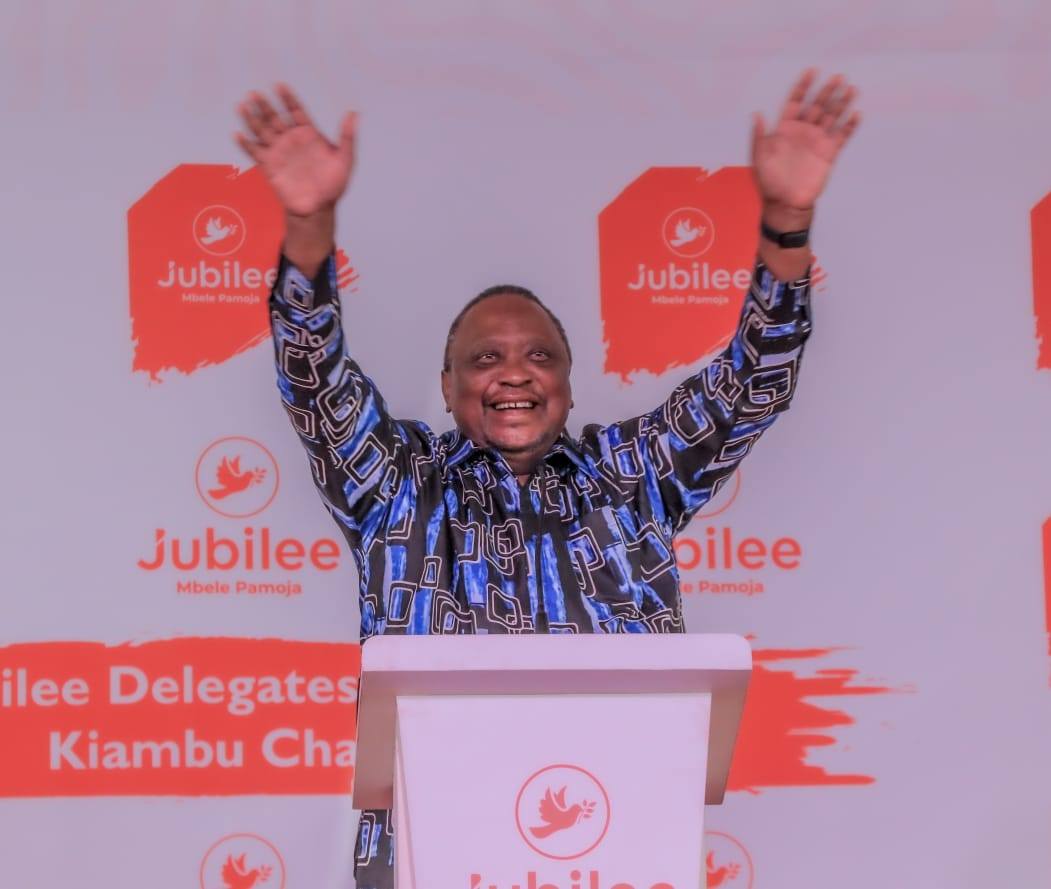
Uhuru, who is the Jubilee Party leader, spoke on Monday at the Kiambu Golf Club where he met party delegates, using the forum to address both Jubilee’s internal challenges and the country’s wider political climate.
He said Jubilee’s recent troubles were not self-inflicted, claiming they were engineered after he handed over power peacefully and began a process of renewing the party’s leadership.
“Tumekuwa na matatizo nyingi kwa chama chetu, lakini matatizo yetu ni matatizo ya kuletewa,” Uhuru said, adding that after leaving office he started a plan to help Jubilee get new leaders to take it forward through a lawful process.
However, he claimed some people sought to “muddy” the party’s name and took it to court, disrupting the leadership transition.
Uhuru said he had intended to leave the party leadership earlier but remained in office because court processes blocked him from stepping aside.
“Hadi leo mimi bado nashikilia uongozi wa chama kwa sababu walinizuia… ningekuwa nimewaachia kitambo,” he said.
He told delegates Jubilee would push on “until the end” and reorganise from the grassroots, including registration.
“Lakini sasa tutaendelea hadi mwisho… tuanze mashinani tujiandikishe,” he said.
Uhuru also spoke about internal party democracy, saying Jubilee’s next leadership election would be conducted fairly.
“Uchaguzi wetu utakuwa huru na haki,” he said.
He underscored that Jubilee is not a regional outfit but a national party that must unite the country, warning that leaders should not use intimidation or discrimination to win political support.
“Nikiwa kiongozi wa chama chetu, chama chetu si cha eneo fulani. Chama chetu ni cha kitaifa… Hatuwezi kukubali kurudishwa nyuma. Hakuna mtu anastahili kutisha mwenzake, kutisha jamii fulani,” he said.
Uhuru said he was concerned by what he described as leaders openly peddling divisive rhetoric “even in front of the leaders of the country”, yet no one calls them out.
“Tumeanza kuona wengine wakianza siasa ya mgawanyiko… wakiongea mbele ya viongozi wa nchi, na hakuna mtu anasimama kuwaambia,” he said.
He warned that such rhetoric can have grave consequences, insisting that Kenya must learn from past mistakes.
“Tusipoambiana ukweli tutarudia makosa… ya mwisho tuliona 2007, na ilianza kwa maneno watu wanaongea,” he said.
Uhuru appealed to national leaders not to allow the rhetoric to continue, arguing that Kenyans are not angry because of politics, but because of economic pressure.
He gave an example of what he said many households face: low wages while fuel and taxes take up much of their income.
“Issue ni simple… watu wanapiga kelele kwa sababu mimi ni mtu mshahara wangu ni 20k, 800 inaenda kwa mafuta, 12 inaenda kwa kodi. Hiyo ndiyo shida—ongelesha shida,” he said.
He said political blame games and repeated finger-pointing at individuals will not put food on the table or build roads.
“Wakenya hawatakula maneno akiwa na njaa. Barabara hazijengwi na maneno,” he said.
The former president also challenged young leaders to avoid what he called “cheap popularity”, urging them to sell policies and present solutions that can improve livelihoods, create jobs and stabilise the economy.
“Nyinyi vijana mjue ni viongozi. You cannot be leaders with cheap popularity… mtafute mkiwaeleza namna mtakavyo wabadilishia maisha,” he said.
Uhuru further urged politicians not to recycle old political labels to mobilise division, saying Kenyans are more concerned with practical solutions.