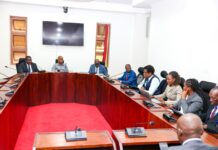
The National Assembly’s Departmental Committee on Transport and Infrastructure, chaired by George Kariuki, today held a consultative meeting with the management of Kenya Airways to address critical challenges facing the national airline, as well as broader issues affecting the aviation sector.
The session, attended by senior government and aviation officials, focused on ongoing strategic initiatives and emerging concerns that may require policy or legislative intervention.
The Aviation Sector’s delegation was led by Principal Secretary, State Department for Aviation and Aerospace Development Ms. Teresia Mbaika, with Kenya Airways Acting Managing Director Captain George Kamal presenting on behalf of the airline.


Kenya Airways outlined a range of operational and structural hurdles, including supply chain disruptions such as spare parts shortages, aircraft delivery delays, and an aging fleet.
” Several aircraft remain grounded due to engine and landing gear issues, while others are operating under constrained conditions due to engine limitations”, noted Mr. Kamal
Labour challenges were also cited, particularly a shortage of skilled personnel and increasing poaching of talent by Gulf carriers and, more recently, the United Kingdom.
The airline further pointed to geopolitical and economic instability, including regional conflicts, economic headwinds, and blocked funds in parts of Africa, as significant constraints on operations.
In addition, the airline raised concerns about sustainability pressures, noting that Sustainable Aviation Fuel (SAF) costs are approximately four times higher than conventional jet fuel, alongside complex regulatory requirements. Cybersecurity threats were also flagged as an emerging risk with a growing threat profile.
Kenya Airways urged the government to accelerate infrastructure improvements at Jomo Kenyatta International Airport to sustain its position as East Africa’s leading aviation hub.
The airline called for urgent attention to operational inefficiencies, including baggage handling system breakdowns, unstable air bridges, unreliable power supply, apron potholes, inadequate air conditioning, poor terminal layouts, insufficient signage, congestion, and bird strike risks.
Among its proposals, the airline requested include consideration of Kenya Airways as part of national aviation infrastructure, implementation of pro-aviation policies, including favorable tax regimes.
They also urged for the fast-tracking of its Economic Free Zone request to attract investment as well as for the exclusive use of Terminal 1A by Kenya Airways and its partners.
The lawmakers pressed the airline on several issues, including its financial obligations to the Kenya Airports Authority and the ownership structure of its aircraft fleet. Questions were also raised on whether Kenya Airways should remain the country’s anchor airline.
“How much does KQ owes KAA and who owns the largest fleet of aircraft?” asked Hon. Hussein Weytan
The lawmakers further demanded clarity on the airline’s turnaround strategy, allegations of cartels within both Kenya Airways and the Kenya Airports Authority, and concerns over staffing levels.
Additionally, Members criticized the poor state of airport infrastructure, particularly washroom facilities that have led to passenger complaints.
The Committee also encouraged Kenya Airways to promote its aviation training academy to attract more Kenyan youth into the industry.
The Committee is expected to continue its engagements tomorrow, when officials from Jomo Kenyatta International Airport will present the airport’s Master Plan, as Parliament intensifies oversight of the aviation sector.
By Anthony Solly