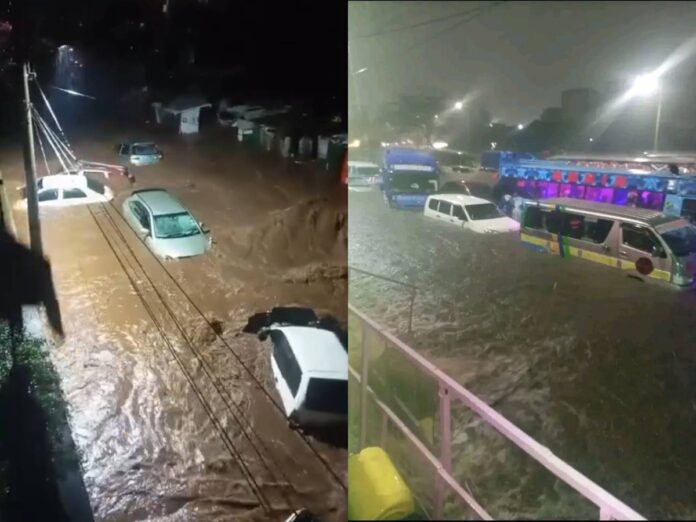
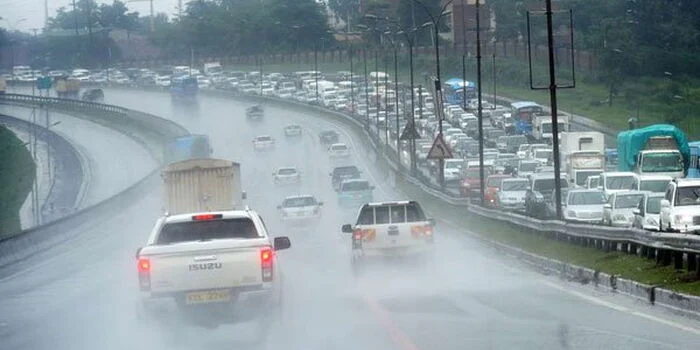
The Kenya Meteorological Department has warned that moderate to heavy rainfall is expected in parts of Nairobi and surrounding counties over the next 24 hours.
In a rainfall update issued on Thursday afternoon, Met said that the rainfall will mainly affect areas within the highlands east of the Rift Valley, including Nairobi County, from 9 pm.
“Moderate to heavy rainfall expected in parts of Nairobi and surrounding counties over the next 24 hours (09:00 today – 09:00 tomorrow),” stated Met.
“Showers and thunderstorms expected over a few places tonight in the highlands east of the Rift Valley, which include Nyeri County, Murang’a County, Kirinyaga County, Embu County, Meru County, Kiambu County, Tharaka-Nithi County, Laikipia County and Nyandarua County.”
According to the forecast, cloudy conditions are expected in the morning before giving way to sunny intervals, with a chance of light rain in high-ground areas.
“Showers and thunderstorms expected over a few places in the afternoon,” the forecast added.
Elsewhere across the country, the meteorological department said sunny intervals are expected in most regions, although rainfall will occur in parts of the highlands both east and west of the Rift Valley as well as the south-eastern lowlands.
In western Kenya, including counties in the Lake Victoria Basin such as Kisumu County, Kakamega County, Bungoma County and Siaya County, showers and thunderstorms are expected over a few places tonight and in the afternoon.
The forecast also warned of strong southeasterly winds exceeding 25 knots (12.5m/s) in parts of Turkana County and Marsabit County.
Coastal counties, including Mombasa County, Kwale County, Kilifi County, Lamu County and Tana River County, are expected to experience light showers tonight, with more rainfall likely in the morning and afternoon, especially along the south coast.
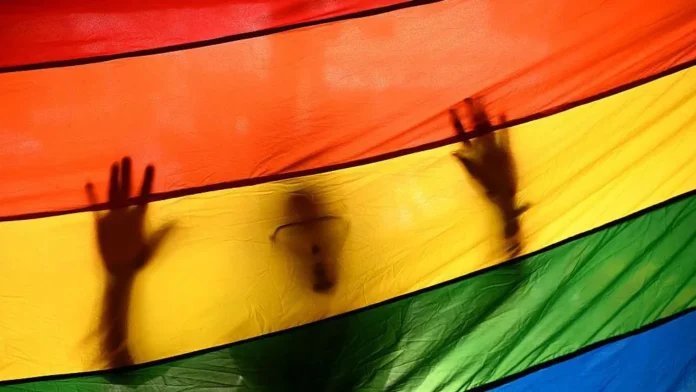
BBC -Senegal’s parliament has approved a new law doubling to 10 years the maximum prison term for sexual acts by same-sex couples and criminalising the “promotion” of homosexuality.
The measure was supported by 135 MPs, none voted against it while three abstained. The next step will be for the president to sign it into law.
UN human rights chief Volker Türk said the bill was “deeply worrying” and urged the president not to sign it.
The government spokesman dismissed international criticism of the bill, arguing that the move reflected the views of Senegalese people.
“The majority of Senegalese do not accept homosexuality. Our culture rejects it and we are firmly opposed to it,” said Amadou Moustapha Ndieck Sarré.
Some conservative activists in Senegal have long demanded harsher penalties.
The movement And Sàmm Jikko Yi, which campaigns to defend what it calls Senegalese moral values, has repeatedly urged authorities to adopt stricter legislation criminalising homosexual acts. Its leaders argue the law is necessary to protect Senegalese cultural and religious norms.
However, rights groups warn the move could worsen discrimination and violence against sexual minorities. Human Rights Watch researcher Larissa Kojoué said the proposed changes were worrying.
“Criminalising same-sex conduct and arresting people for their sexual orientation violates multiple internationally protected rights, including equality and non-discrimination.”
She added that such measures risked exposing people who were already stigmatised to “violence and fear.”
Alioune Tine, founder of the think-tank Afrikajom Center, told the media that the current climate could worsen social tensions. “If it is true that social concerns must be addressed, [the law] also has to respect human rights and protecting public-health policies.”
Others have pointed out that same-sex relationships are a part of life and cannot be abolished by a law.
“Most of the same-sex relationships were hidden anyway. There are even people who are married in the society and who are still entertaining a safe-sex relationship because of the norm and the cultural norm in that society,” Senegal LGBTQ Association head and medical doctor Charles Dotou told media.
All that will happen is “people will be hiding more, it will create more fear and people will be scared to live normally in that community. So there will be an exodus of people, particularly people who were already exposed so that that creates a bit of chaos in society,” Dr Dotou added.
The toughing of Senegal’s law follows a wave of arrests last month over alleged same-sex relationships. Police detained 12 men – among them two public figures and a prominent journalist.
Some supporters of the tougher legislation say they have concerns about HIV transmission, although it has long been scientifically established that people of any sexuality can contract and spread the illness.
Experts warn that further criminalising same-sex relations could vilify gay people living with HIV to the point that they shy away from receiving the vital medical care they need.
Senegal has been praised for its efforts to control HIV. Between 42,000 and 44,000 people are living with the virus in the country, with a national prevalence of about 0.3% among adults, one of the lowest rates in West Africa, according to the health ministry.
At the Fann University Hospital in Dakar, the executive secretary of the National Council for the Fight Against Aids (CNLS) – the body that has coordinated the country’s HIV response for decades – is worried about the situation with LGBTQ+ people.
“We have managed to control the HIV epidemic and we are moving towards eliminating Aids as a public health problem in Senegal,” Dr Safiétou Thiam told BBC News Afrique. “But what is happening now risks undermining the results of 30 to 35 years of efforts in the fight against the disease.”
Ousmane Sonko, the longtime firebrand opposition leader appointed prime minister in 2024, had told lawmakers the bill would punish what it describes as “acts against nature” with fines of up to 10,000,000 CFA francs ($17,600; £13,000) and prison sentences ranging from five to 10 years, compared with the current one- to five-year terms in the Muslim-majority country.
Several other African countries have also introduced tough new laws against the LGBTQ+ community in recent years.
In September last year, Burkina Faso’s transitional parliament approved a bill banning homosexual acts, following its neighbour Mali in 2024.
In 2023, Uganda voted in some of the world’s harshest anti-homosexual legislation meaning that people engaging in same-sex relationships can be sentenced to death in certain circumstances.
Ghana is also planning to re-introduce an anti-homosexual bill that activists say threatens basic human rights, safety and freedom.
A red fox that sneaked onto a cargo ship off the coast of Southampton has successfully made it thousands of miles across the Atlantic and is now in the care of the Bronx Zoo in New York.
The zoo said on Wednesday that the fox – a two-year-old male weighing roughly 11lb (5kg) – is currently in the Animal Health Center with animal and veterinary teams.
“Once the veterinary team determines that the fox is healthy, the zoo will work with wildlife experts to identify an appropriate long-term home for the animal,” the zoo said in a press release.
The fox was detected among the ship’s cargo by US officials at the Port of New York and New Jersey, and was brought to the Bronx Zoo on 19 February.
It is not clear how the animal managed to gain access to the ship while it was docked at the English port city.
The zoo said initial examinations suggested the fox appeared to be in good health and that additional results from a separate routine health screening were pending.
“He seems to be settling in well,” Keith Lovett, the zoo’s director of animal programmes, told the Associated Press. “It’s gone through a lot.”
A spokesperson for Associated British Ports (ABP) Southampton said: “The Port of Southampton handles everything from cars to containers to cruises, but even we were surprised to find a fox had booked itself a transatlantic crossing.
“Clearly it fancied swapping the Solent for the Staten Island Ferry. Though next time we’d recommend it considers the Queen Mary 2, which offers the Southampton to New York route with considerably more comfort!”
According to the Bronx Zoo, red foxes are among the most widespread carnivorous mammals in the world.
Known for their reddish coat and white-tipped bushy tail, they are found across Europe, Asia, North America and parts of Africa.
The red fox’s remarkable adaptability allows them to thrive in environments ranging from forests and grasslands to urban areas, the zoo said, feeding off everything from fruits to rodents.
One person has died and two others were injured at Old Dominion University in Norfolk, Virginia, in a shooting that the FBI is investigating as an act of terrorism.
The suspect was also killed in the incident on Thursday.
The FBI identified the alleged gunman as Mohamed Bailor Jalloh, a former Virginia National Guard member who had previously been jailed for trying to support the Islamic State group.
Jalloh allegedly opened fire into a classroom and some students were able to subdue and kill him, said Dominique Evans, Special Agent in Charge of the Norfolk FBI field office, at a news conference.
The students “subdued him, and rendered him no longer alive”, she said, adding that he was not shot, without providing further details.
They were members of the Reserve Officers’ Training Corps (ROTC) programme, which combines college coursework with military leadership training.
Officers first responded to reports of a shooting inside a classroom in Constant Hall, the university’s business school building, university police chief Garrett Shelton said on Thursday afternoon.
When the suspect walked in, he asked if it was an ROTC class, and after someone answered in the affirmative, he opened fire, law enforcement sources told the BBC’s US partner CBS News.
When officers arrived, they found that the gunman was already dead, Shelton said.
FBI Director Kash Patel said the shooter died “thanks to a group of brave students who stepped in and subdued him – actions that undoubtedly saved lives along with the quick response of law enforcement”.
Three people in the room were shot, one of whom later died of their injuries in hospital, officials said.
Two of the victims were Army personnel, Army Secretary Dan Driscoll said on social media.
“I’m praying for them and all those impacted by this terrible event,” Driscoll said.
CBS News reported that the victim who was killed was the class instructor, a retired military officer.
In 2016, Jalloh was arrested and pleaded guilty to attempting to provide material support to the Islamic State group, the FBI’s Evans said.
He was sentenced in 2017 and was released from prison in 2024, she said. When asked what kind of aid Jalloh was giving to the IS group back then, Evans said he had wanted to conduct a terrorist attack similar to the 2009 attack at a military base in Fort Hood, Texas, that killed 13 people.
Evans said Thursday’s shooting is being investigated as an act of terrorism because of the suspect’s prior conviction and because he allegedly shouted “Allahu Akbar”, an Arabic phrase that means “God is greater”, before the incident.
There was no mention of the war in Iran, Evans said.
The shooting came hours before another incident in Michigan, where a vehicle rammed into a synagogue and school.
There, all children and staff were safely evacuated and one security guard was injured but is expected to recover, authorities have said.
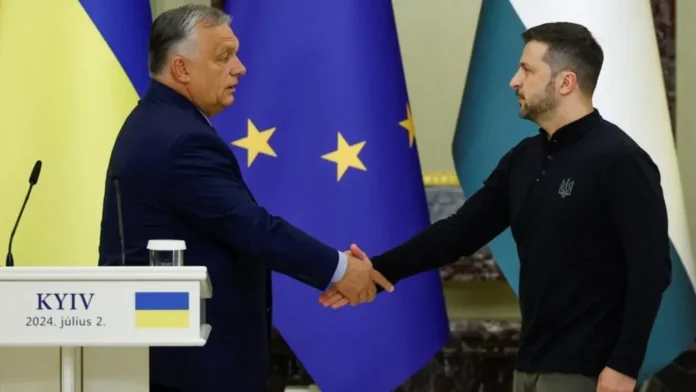
War-torn Ukraine “will stop at nothing” to prevent Prime Minister Viktor Orbán and his Fidesz party winning the upcoming Hungarian elections, the Hungarian government claims. Physical violence against the prime minister and his family, and attacks or sabotage of key energy installations, are being prepared, ministers allege.
The Ukrainian government, in turn, accuses its Hungarian counterpart of whipping up a hate campaign against it to frighten Hungarians into voting Fidesz back into office.
The Financial Times reported on Wednesday morning that the Social Design Agency, a Kremlin-linked media consultancy firm, was preparing a mass disinformation campaign in Hungary, to bolster Orbán and discredit the opposition Tisza Party and its leader, Peter Magyar.
With just 30 days to go until the parliamentary election in Hungary, some analysts believe the anti-Ukraine hysteria proves that Orbán is panicking in the face of probable defeat.
His Fidesz party trails to Tisza by 39% to 50% in the latest poll.
Others say Orbán knows his electorate well – and that if they can be convinced that the country is in mortal danger, he could win a remarkable fifth consecutive victory on 12 April.
Fidel election poster: ‘Fidesz is the certain choice: They [Zelensky and Magyar] are the risk’
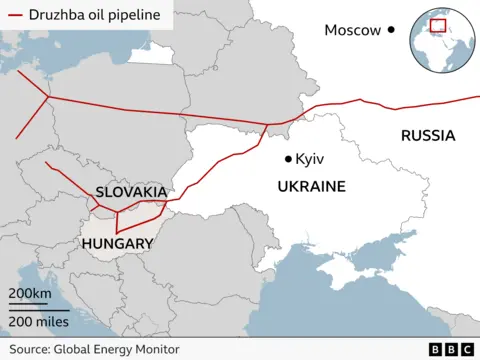
At the core of the dispute is the disruption of the Druzhba (Friendship) pipeline on which Hungarian and Hungarian-run Slovak refineries depend.
Oil deliveries through the pipeline stopped on 27 January, after a Russian drone strike caused a fire at the Brody oil hub in western Ukraine.
No oil has arrived in Hungary since then.
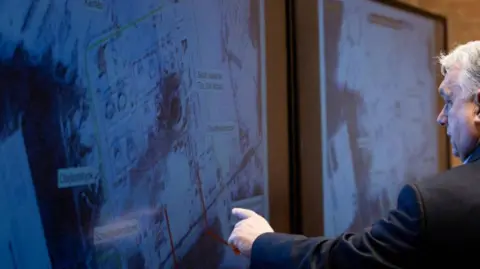
Last week, Orbán produced satellite images which, according to him, show that the pipeline is intact. He and his ministers accuse Ukraine of delaying repairs, in order to harm Orban’s re-election chances, by causing a fuel shortage in Hungary.
“The Orbán government is not telling the full truth,” András Rácz a security analyst, at the German Council on Foreign Relations, told the BBC, regarding Hungarian government claims that no technical obstacles remain to restarting the flow of Russian oil to Hungary.
In the 27 January Russian attack, Rácz said, an oil tank containing 75 million litres of crude oil at Brody was damaged, and to save the oil and prevent an environmental disaster, it was pumped into the pipeline for storage.
The presence of that oil, and other technical damage resulting from the first and a subsequent Russian attack, prevent the restoration of supply.
Ukraine says it could take six weeks to repair.
The Ukraine hysteria in Hungary takes many forms.
Giant billboards and city lights posters cover the country. Some show Ukrainian President Volodymyr Zelensky begging for money from EU chiefs.
Others juxtapose Zelensky and Peter Magyar. His Tisza is accused of planning to get Hungary involved in the Ukraine war, by joining what is dubbed “the pro-war lobby” in Brussels – something Magyar vehemently denies.
“We are the real party of peace,” Magyar tells crowds at his daily rallies across the country.
Orbán and his ministers tour the country, too, addressing what they bill as “anti-war” assemblies of Fidesz supporters.
The most shocking video – an artificial intelligence production by Fidesz – shows a little girl asking her weeping mother when her dad will come home. This cuts to a firing squad where her blindfolded father is about to be executed. This will happen to Hungarians, the video suggests, if they vote for Tisza.
Facebook has rejected readers’ complaints that the advert violates its rules on both political and violence grounds.
In a highly unusual move in peacetime, the army has been deployed to patrol key energy installations – “to reassure’ the public” in the Fidesz narrative or “to frighten” them in the Tisza one.
In the eastern city of Debrecen, Defence Minister Kristof Szalay-Bobrovniczky warned that the city could be a target for “hybrid operations” such as sabotage.
The dominant pro-government media act as an echo-chamber for the government message.
“Many people contact us, asking why, if the danger of attack is real, the government does not provide information about air-raid shelters,” Tamas Polgar Toth, a journalist at the independent Debreciner news portal told the BBC. The Fidesz mayor of Debrecen, Laszlo Papp, later told the portal that this was being considered.
On 21 February, Orbán vetoed the delivery of the EU loan, until the oil flow through the Druzhba pipeline was restored. Ukraine has resorted to a €1.5bn loan from the International Monetary Fund to tide it over until the dispute is settled.
But on 4 March, Zelensky appeared to exacerbate the stand-off.
“We hope that no-one in the European Union will block the €90bn (£78bn) [of EU aid, currently vetoed by Hungary]. Otherwise we will give that person’s address to our armed forces so they can call on him and speak to him in their own language,” Zelensky said. He did not name Orbán.
The Hungarian prime minister was not pleased.
“They want to get rid of us, with threats if possible, because if nice words don’t work, then with threats and blackmail,” Orbán told state radio on 6 March.
The Hungarian PM says this satellite image shows the pipeline is not damaged
A day earlier two vehicles of the Ukrainian state savings Oschadbank were seized crossing Hungary.
The TEK anti-terror troops used in the operation were depicted on the front cover of the independent HVG weekly on Wednesday as Viktor Orbán’s “private army” moving gold bars around the symbol of the Tisza party.
Pro-government media allege that one of the lawyers at the company representing the Ukrainian bank as it tries to get back its money and vehicles is an ardent Tisza supporter.
A decree issued by the government on Monday ordered prosecutors to investigate “whether Hungarian criminal organisations, terrorist organisations or political organisations present in Hungary may have benefited from the transported assets”.
On Wednesday, several members of a so-called fact-finding mission set up by the Hungarian government entered Ukraine by car. Their aim was to report on the Druzhba.
“Our job is to assess the status of the pipeline and create conditions for its restart,” Deputy Energy Minister Gábor Czepek said in a Facebook post.
But Ukraine said the group were being treated as tourists.
“This group of individuals holds no official status, nor do they have any scheduled official meetings; therefore, it is fundamentally incorrect to refer to them as a delegation,” a statement from Ukraine’s foreign ministry said.
The aftermath brought another sharp exchange between the neighbours. Hungary’s Foreign Minister Péter Szijjártó accused Zelensky of lying after the Ukrainian president said he “was not aware” of a Hungarian delegation arriving in Ukraine – and published an official note from the Hungarian embassy in Kyiv to prove his point.
In its response, Ukraine said it had already informed the Hungarians that “the dates for the visit proposed in the above-mentioned note from the embassy are not acceptable for the Ukrainian side”.
A 60-year-old British man has been charged under cyber-crime laws in Dubai after allegedly filming Iranian missiles over the city.
UK Foreign Office officials are understood to be supporting his family.
The tourist was detained under a law in the United Arab Emirates that prohibits publishing or sharing material that could disturb public security, according to Detained in Dubai, which provides legal assistance in the country.
Lana Nusseibeh, the UAE’s minister of state to the EU, told the BBC she was “aware” there had been “some violations” of the law but did not have specific details about the British man’s detention.
She said “due process” would be followed, and that “this kind of filming puts yourself in harm’s way”.
The CEO of Detained in Dubai, Radha Stirling, said 21 people had been “charged together under the UAE’s cybercrime laws in connection with videos and social media posts relating to the recent missile strikes”.
She said police found a video of an Iranian missile strike in Dubai on the British man’s phone.
She told the BBC the formal charges were “very vague”.
“I’ve reviewed the charge sheet and, from reading it, you wouldn’t know what they’ve done wrong,” Stirlingsaid.
“We’re seeing more and more people being charged under the UAE’s cyber-crime rules.”
She added that the man’s family had been able to speak to him after he was detained.
Stirling said she believed the UAE was cracking down on people filming missiles in order to “maintain the facade that it is safe for tourists”.
Criticism of the government is illegal in the UAE, and it exercises strict control over the flow information out of the country.
UK-based human rights group Amnesty International has said the UAE has”continued to criminalise the right to freedom of expression through multiple laws and to punish actual or perceived critics of the government”.
Nusseibeh, who was also formerly the UAE’s ambassador to the UN, said: “My best advice to everyone here who we welcome being here; citizens, residents, tourists, journalists is follow the guidelines.”
She also said “the basis of the legislation” around controlling the sharing of information in the UAE was put in place “in order for everyone to feel safe”.
“It’s important that the information is credible and the sources are reliable.”
For years, Dubai has cultivated a reputation as a glamorous and attractive destination for expats pursuing business opportunities and travel.
Conflict across the Middle East has entered a second week after the US and Israel launched wide-ranging strikes on Iran, killing the country’s supreme leader on 28 February.
Iran has continued to respond by launching attacks on Israel and US-allied states in the Gulf, which have extended to non-military targets, including civilian sites and energy facilities.
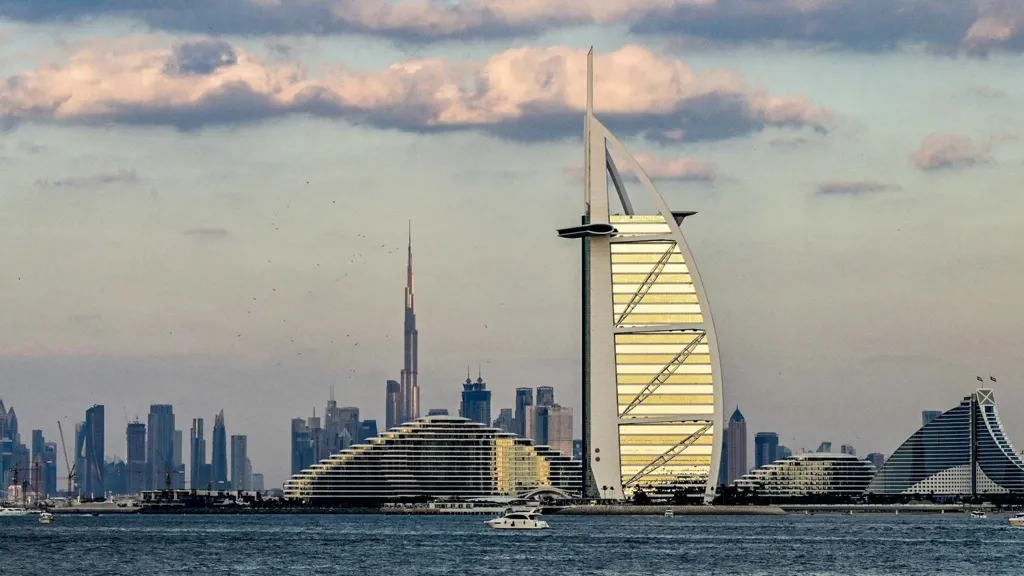
Some of the UAE’s most iconic buildings have been damaged – including Fairmont The Palm hotel, in the luxurious Palm Jumeirah area, and the Burj Al Arab hotel.
Flights across the Middle East have also been severely disrupted by the conflict.
The High Court in Kisumu has ordered the immediate release of Maximilian Mutai, who had been detained after allegedly testing a currency note, ruling that the offence he was suspected of committing does not allow custodial remand under the Constitution.
In a ruling delivered in court, the judge found that the lower court’s decision to detain Mutai in custody at Central Police Station in Kisumu pending a ruling was unconstitutional.
The court held that the offence of mutilating currency notes under Section 367A of the Penal Code carries a maximum penalty of three months’ imprisonment or a fine of up to Ksh.2,000, or both.
The judge noted that such an offence falls within the protection provided under Article 49(2) of the Constitution, which prohibits remanding a suspect in custody for offences punishable only by a fine or imprisonment of not more than six months.
The court emphasised that subordinate courts must strictly follow the constitutional provision, which clearly bars custodial remand for minor offences carrying short prison terms.
The judge therefore found that the order issued on March 11, 2026, in Kisumu Miscellaneous Criminal Application No. E086 of 2026 directing that the applicant remain in police custody was irregular and improper.
Invoking its supervisory powers under Sections 362 and 364 of the Criminal Procedure Code, the High Court revised and quashed the custodial remand orders issued by the lower court.
The court directed that the applicant be released immediately from Central Police Station, Kisumu, noting that no criminal charges had been formally filed against him.
Additionally, the court ordered that the lower court file be closed, stating that the application for custodial remand should not have been entertained in the first place because of the constitutional prohibition under Article 49(2).
The Deputy Registrar was also directed to serve the orders on the officer commanding Central Police Station, Kisumu, and place a copy of the ruling in the lower court file.
Iran’s new supreme leader ordered his forces to keep the vital Strait of Hormuz shipping lane shut on Thursday, as Tehran launched more devastating attacks on Gulf energy targets that sent global oil prices soaring.
The International Energy Agency warned the Middle East war could lead to “the largest supply disruption” in history, but US President Donald Trump said stopping the Islamic Republic’s “evil empire” was more important than crude prices.
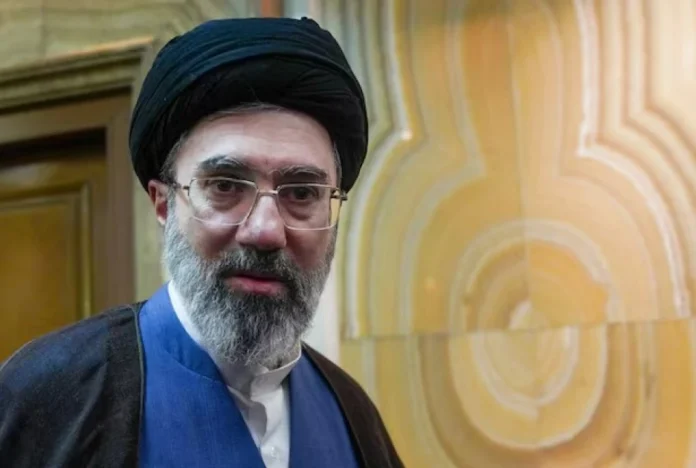
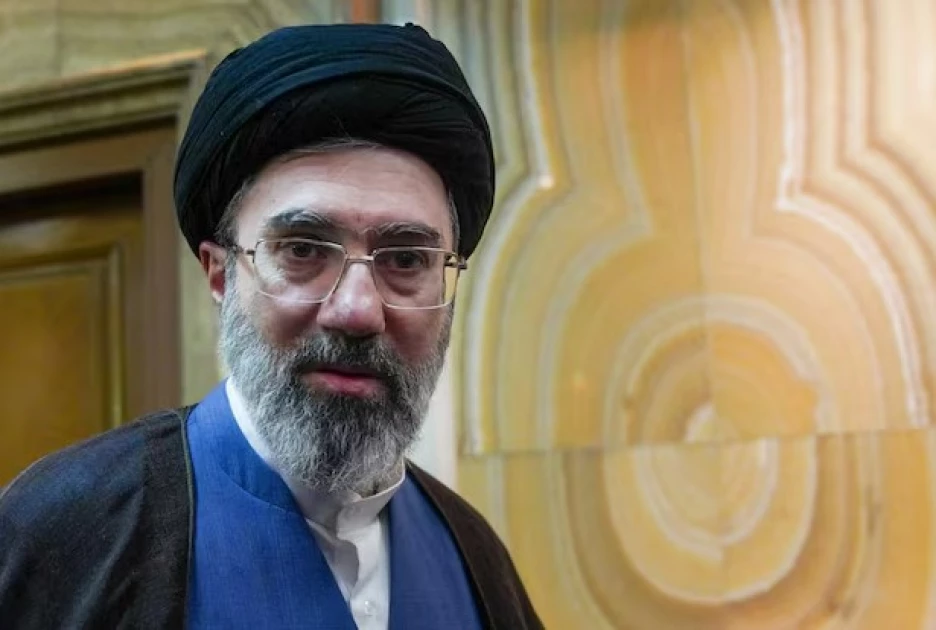
Ayatollah Mojtaba Khamenei, who was reportedly injured in an air strike, has yet to appear publicly since his nomination last Sunday as supreme leader, and his defiant first message was read by a newscaster on state television.
Khamenei, whose father and predecessor Ali Khamenei was killed in the first wave of US-Israeli attacks at the start of the war, called for Gulf countries to close their US military bases and vowed to avenge “the blood of our children and grandchildren”.
“The lever of blocking the Strait of Hormuz must definitely be used,” Khamenei said of the waterway through which a quarter of the world’s seaborne oil trade usually transits.
The Revolutionary Guards reacted swiftly, with the force’s navy commander Alireza Tangsiri saying: “In response to the order of the commander-in-chief, we will deliver the harshest blows to the aggressor enemy while maintaining the strategy of closing the Strait of Hormuz.”
Under attack from Iran, shipping in and around Hormuz has been at a near-standstill for days, with another three vessels targeted in the Gulf off the coast of the United Arab Emirates and Iraq.
Trump has faced intense political pressure as the global economic fallout of the crisis has mounted, and he has given repeated mixed messages on when the US air campaign might end.
As oil prices spiked above $100 a barrel, Trump wrote on social media that “of far greater interest and importance to me, as President, is stopping an evil Empire, Iran, from having Nuclear Weapons, and destroying the Middle East and, indeed, the World.”
– Vessels attacked –
Gulf states have borne the brunt of retaliatory attacks from Iran.
Images from Bahrain on Thursday showed thick smoke rising after a strike on fuel tanks in Muharraq, with residents told to stay inside and close their windows.
Drones caused damage again at Kuwait’s international airport and in downtown Dubai, while Saudi Arabia said it had intercepted drones headed towards its Shaybah oil field and its embassy district.
The Paris-based IEA, a world authority on energy markets, warned Thursday that the 13-day conflict “is creating the largest supply disruption in the history of the global oil market”, which would surpass those of the 1970s.
With Gulf states slashing production and oil tankers stuck in the Gulf, benchmark oil prices have risen 40-50 per cent since the US and Israel attacked Iran on February 28, threatening to crimp growth and stoke inflation.
– ‘War of attrition’ –
The Strait of Hormuz, which also normally sees the transit of a fifth of the world’s liquefied natural gas (LNG) passes, lies off Iran and is just 54 kilometres (34 miles) wide at its narrowest point.
Tehran has vowed that not one litre of oil will be exported from the Gulf while US-Israeli attacks continue, although industry figures suggest its own sanction-hit exports are continuing to get through.
Iran’s deputy foreign minister told AFP that ships from “some countries” were being allowed to cross the strait, without giving details, and denied reports that Iran was laying mines in the waterway.
“We want to see that war is not going to be imposed again on Iran,” Majid Takht-Ravanchi said in an interview in Tehran.
“If the White House imagines the conflict will stop when Donald Trump decides it… they’re making a mistake and ignoring the lessons of history,” Pierre Razoux, director of studies at the Mediterranean Foundation for Strategic Studies, told AFP.
“The Iranian regime, which no longer has anything to lose, will wage a war of attrition against the United States and Israel to punish them for their aggression.”
Iranian security forces have also warned government opponents against taking to the streets in protest, saying they would be considered as “enemies”.
One Tehran resident hoping for the fall of the Islamic republic told AFP she was worried about the US and Israel calling off their air campaign despite her fears about the daily bombardment.
“I don’t know what will happen to us mentally and emotionally if it doesn’t work out this time,” she told AFP on condition of anonymity.
– ‘Expanding’ attacks on Lebanon –
The conflict has spread across the region, with Lebanese authorities reporting 687 people killed by Israeli strikes, including at least eight more who died on Beirut’s blood-stained seafront where displaced families were camping in tents.
After the Iran-backed Hezbollah group announced a new operation against Israel on Wednesday, Israeli Defence Minister Israel Katz said he was ordering troops to “prepare for expanding” attacks on Lebanon.
In Iran, over three million people have been displaced by the war, according to new figures issued Thursday by the UN’s refugee agency.
Iran’s health ministry said on March 8 that more than 1,200 people have been killed in the war, a figure AFP has not been able to independently verify.
In Israel, authorities said 14 people have been killed, while attacks in the Gulf have killed 24 people, including 11 civilians and seven US military personnel, according to local authorities and the US Central Command.
One student has died, and 10 others were injured at AIC Kapsabet School for the Deaf after falling into a septic tank in the school compound.
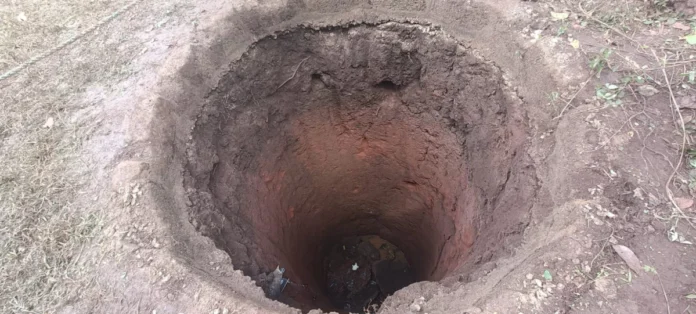
In the Thursday morning incident, the students were rushing to have a glimpse of President William Ruto, whose motorcade was passing by the school. The students stood on an old septic tank, about 20 feet long.
Unable to carry the weight of the curious learners, the tank collapsed, sinking 11 learners.
The incident was confirmed by Nandi County CEC Angeline Kirui, who was among the first responders at the scene.
Rescuers and County Disaster officers arrived at the scene, where the injured students were rescued and rushed to Kapsabet County Referral Hospital.
On hearing the reports, the Head of State made a stop at the school where he expressed regret for the disaster.
President Ruto then gave Ksh. 5 million for the development of infrastructure at the affected school.
The Head of State then headed to his destination at Kapsabet Girls.
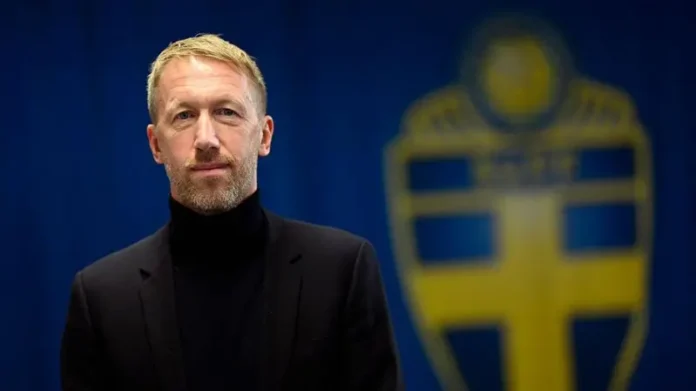
Sweden coach Graham Potter has extended his contract until 2030, saying he feels “great pride and a great responsibility” as his side target qualification for this summer’s World Cup.
The 50-year-old former West Ham, Chelsea and Brighton boss succeeded the sacked Jon Dahl Tomasson in October, initially on a short-term basis, in a bid to turn around the country’s faltering campaign.
Sweden can still reach the tournament, which gets under way in the United States, Canada and Mexico in June, if they come through play-off matches against Ukraine and then Poland or Albania later this month.
However, he was quickly identified as a favourite for the Sweden head coach’s job, having taken Ostersund from the country’s fourth division to the top flight, while also winning a domestic cup in 2017.
“To be able to continue in this role means a lot to me,” Potter said in a statement released by the Swedish Football Association.
“I feel both a great pride and a great responsibility. It’s a big day for me and a fantastic opportunity to do something important going forward.
“Sweden is a football country with a proud history of teams that have made it to the finals of major championships and competed there, which we want to return to.”