Sponsored Ad

Ad 1
Ad 2
Ad 3
Ad 4
Ad 5
Ad 6
25.9 C
Kenya
Sunday, May 10, 2026
Home Blog Page 419

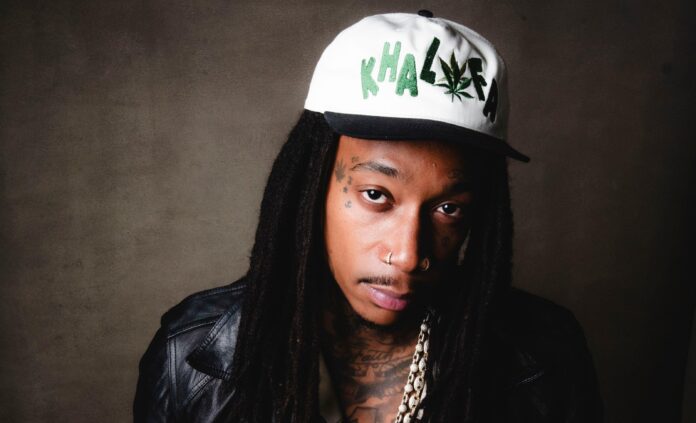
Wiz Khalifa mourns father with emotional tribute: “I’ll love you always”

Wiz Khalifa is mourning the death of his father, Laurence W. Thomaz, who passed away on Friday, February 13, 2026. 

The rapper shared the news through emotional posts on X (formerly Twitter) and Instagram, describing his father’s passing as peaceful. 

“Decided Not to Wake Up”: Wiz wrote that his father “went out like a true yogi, at peace and on his own time,” adding, “I will always love him, miss him and be grateful for the things he taught me”.

He shared several throwback photos of them together on his Instagram Stories, captioned with “Love you big guy”.

Laurence Thomaz, a military veteran, was a significant influence on Wiz’s life and career, often seen supporting him at events like the 2019 premiere of his Apple Music documentary. 

The hip-hop community and fans have since flooded social media with condolences for the artist.

By Anthony Solly

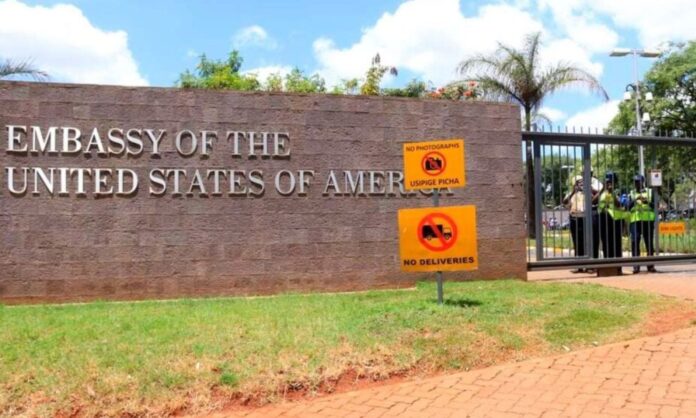
US Embassy in Nairobi announces closure on Monday, February 16

The U.S. Embassy in Nairobi has announced it will be closed on Monday, February 16, 2026, in observance of Presidents’ Day. 

The closure is a standard observation of a U.S. federal holiday, legally known as Washington’s Birthday, which honors all past and present American presidents.

Routine consular services, including visa processing, passport renewals, and document authentication, will be suspended for the day.

Emergency assistance for American citizens will remain available through 24-hour hotlines during the closure.
Normal operations are scheduled to resume on Tuesday, February 17, 2026. 

Recent reports circulating online claiming the embassy has been “permanently shut down” are false. The February 16 closure is a temporary, scheduled observance typical of U.S. embassies worldwide for federal holidays.

By Anthony Solly

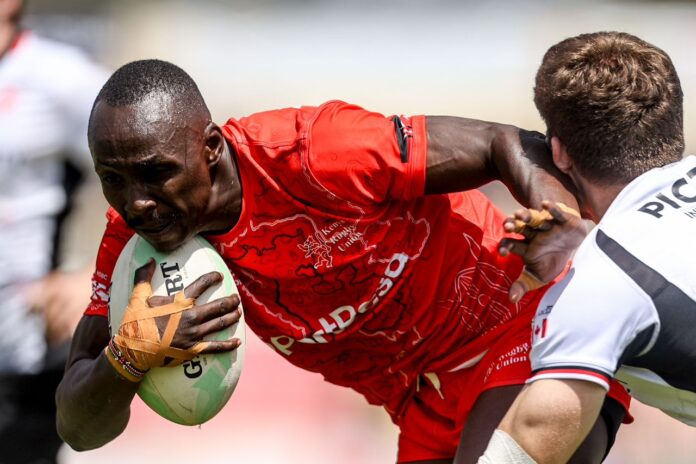
Shujaa demolish Belgium to extend perfect run at World Rugby Division 2

Shujaa continued their dominant run at the opening leg of the 2026 HSBC World Rugby SVNS 2 Tournament with a commanding 33-0 victory over Belgium in their second match of the day at Nyayo National Stadium on February 14.

Fresh from a 29-12 win over Canada earlier in the morning, Kevin Wambua’s charges wasted no time asserting control against the Europeans.

Assistant captain Samuel Asati opened the scoring just two minutes into the contest, capitalizing on close-range possession to dot down. Nygel Amaitsa added the conversion for a 7-0 lead.

Shujaa doubled their advantage after winning a scrum inside their own 22. Christan Ojwang received a well-timed offload, broke through Belgium’s defensive line and sprinted clear to score between the posts. Amaitsa converted again to make it 14-0.

Kenya remained relentless as halftime approached. Asati turned provider, offloading to Kevin Wekesa who finished clinically to extend the lead.

Moments later, speedstar Patrick Odongo burst through the Belgian backline to score under the posts. With both conversions successful, Shujaa went into the break firmly in control at 26-0.

The second half followed a similar pattern, with Kenya dominating possession and territory. Floyd Wabwire, introduced off the bench, added the fifth try to seal the result.

Debutant David Nyangige calmly slotted the conversion to complete the 33-0 rout.

Belgium struggled to gain momentum throughout the match, repeatedly contained by Kenya’s organized defence and quick transitions.

The result marked Shujaa’s second consecutive win of the tournament, reinforcing their intent to push for promotion to the top-tier SVNS World Championship.

With the Nairobi leg running through to Sunday, Shujaa have made a strong statement on home soil, combining defensive discipline with clinical finishing to maintain their unbeaten start in the Division 2 campaign.

They next face Germany at 1654hrs EAT on Saturday.

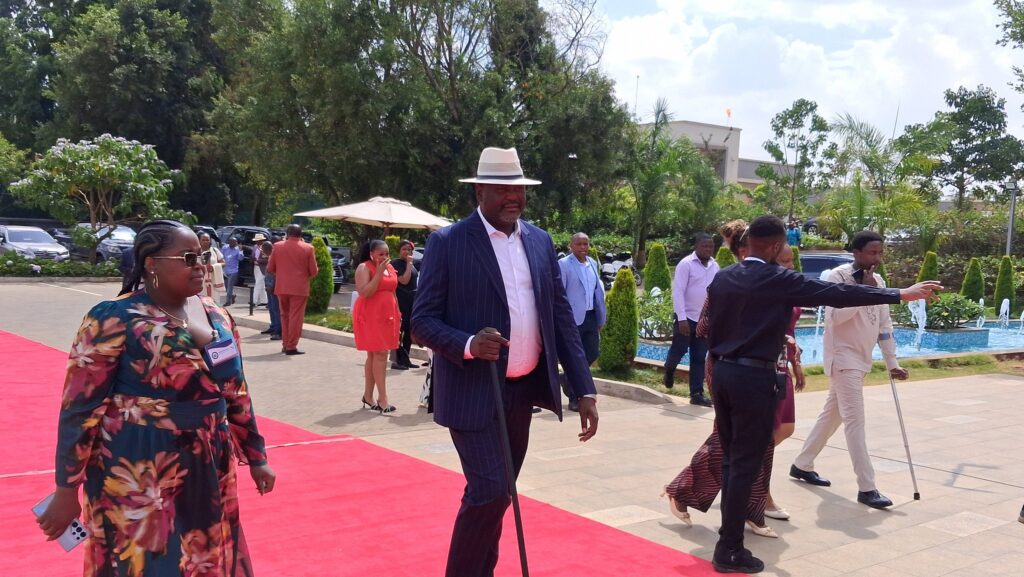
Lavish Wedding as Lari MP Mburu Kahangara marries long-time partner Monicah in beautiful church occasion.

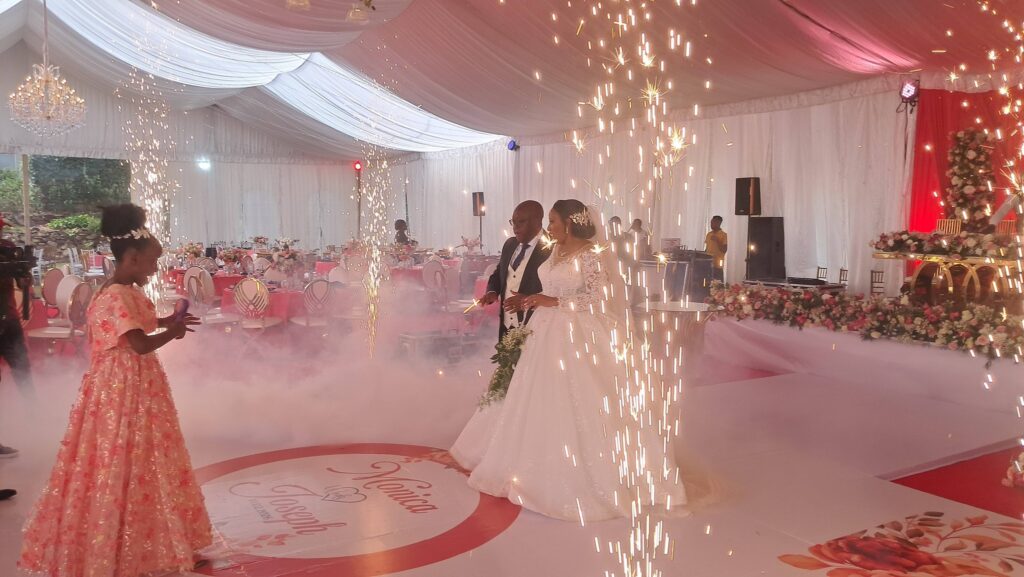
Lari Member of Parliament (MP) Mburu Kahangara has walked down the aisle with his long-time partner Monicah Mugure Maina in a stunning church wedding held on Saturday, February 14, 2026.

The memorable day commenced with a Catholic Mass, where close members of both families had gathered and a priest presided over the solemn exchange of vows.

At the reception, politicians and celebrities streamed in by the droves, including CS Geoffrey Ruku, who took a moment to share heartfelt words with the MP ahead of his married life with his beautiful wife.

Other notable public figures who graced the event included YouTuber and aspiring politician Kogi Investor, as well as Kiambaa MP John Wanjiku, popularly known as Kawanjiku.

CS Ruku and MP Mburu shared a warm dance with his wife on the dais as family members and close friends joined in.

The couple enjoyed a surreal moment and fed each other cake and sharing champagne as the wedding reached its joyful climax.

Relief for Kenyans as Fuel Prices Drop in the Latest EPRA Review

Relief for Motorists and households after the Energy and Petroleum Regulatory Authority (EPRA) lowered the maximum retail prices of petroleum products across the country.

The new prices, effective February 15 to March 14, 2026, will see Super Petrol drop by Sh4.24 per litre, Diesel by Sh3.93 and Kerosene by Sh1.00.

“In the period under review, the maximum allowed petroleum pump prices for Super Petrol, Diesel and Kerosene decrease by Sh4.24 per litre, Sh3.93 per litre and Sh1.00 per litre respectively,” EPRA said.

Under the new review, the maximum pump prices in key towns will be:

Nairobi: Petrol Sh178.28, Diesel Sh166.54, Kerosene Sh152.78

Mombasa: Petrol Sh175.00, Diesel Sh163.26, Kerosene Sh149.49

Nakuru: Petrol Sh177.34, Diesel Sh165.95, Kerosene Sh152.21

Eldoret: Petrol Sh178.16, Diesel Sh166.77, Kerosene Sh153.03

In northern and remote areas, prices remain significantly higher due to transport costs. 

For instance:

Mandera: Petrol Sh200.41, Diesel Sh188.72, Kerosene Sh174.80

Elwak: Petrol Sh196.43, Diesel Sh184.70, Kerosene Sh170.93

Moyale: Petrol Sh194.22, Diesel Sh182.48, Kerosene Sh168.72

Wajir: Petrol Sh193.93, Diesel Sh182.19, Kerosene Sh168.43

EPRA attributed the reduction to declining international petroleum costs.

“The average landed cost of imported Super Petrol decreased by 2.69 per cent from US$592.24 per cubic metre in December 2025 to US$576.34 per cubic metre in January 2026,” the authority said.

Diesel recorded a sharper drop of 6.37 per cent, while kerosene declined by 1.44 per cent over the same period.

Kenya imports all its petroleum requirements in refined form, meaning local pump prices are directly influenced by global market movements and the prevailing exchange rate.

“Currently, Kenya imports all its petroleum product requirements in refined form, and the products are traded in international markets based on a pricing benchmark,” EPRA noted.

EPRA Director General Daniel Kiptoo Bargoria said the monthly price controls are meant to protect consumers while allowing investors to recover legitimate costs.

“The purpose of the Petroleum Pricing Regulations is to cap the retail prices of petroleum products which are already in the country so that importation and other prudently incurred costs are recovered while ensuring reasonable prices to consumers,” said Bargoria.

He added that the regulator remains committed to fairness in the sector.

“EPRA wishes to assure the public of its continued commitment to the observance of fair competition and protection of the interests of both consumers and investors in the energy and petroleum sectors.”

The prices include 16 per cent VAT in line with the Finance Act 2023 and other applicable taxes and will remain in force until March 14, 2026, when the next monthly review is expected.

Gov’t expands maternal care under new SHA to cut deaths

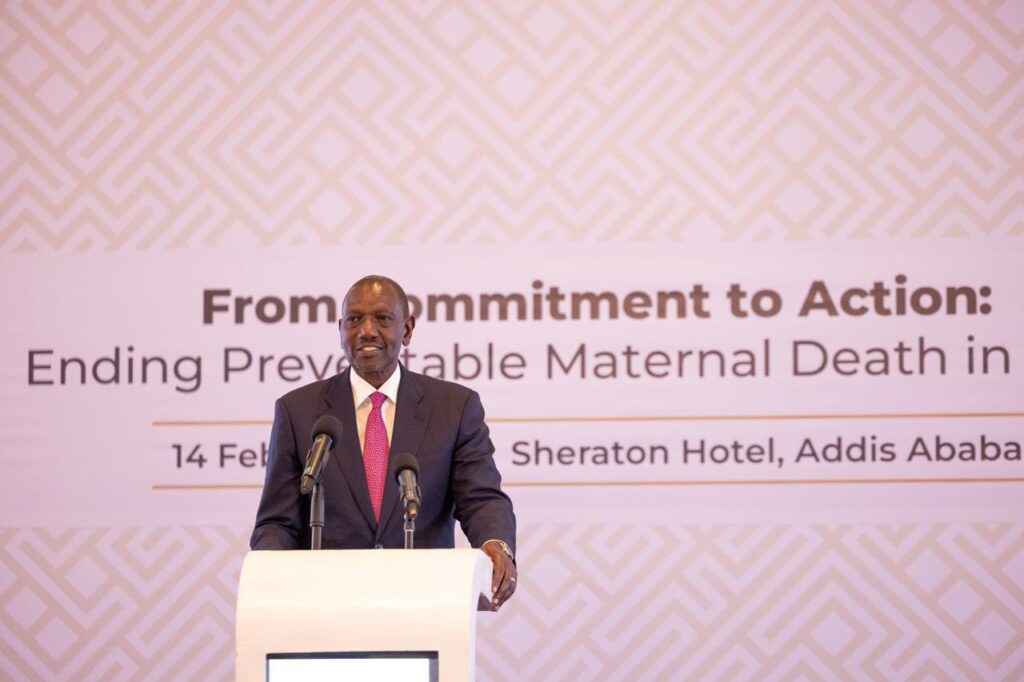
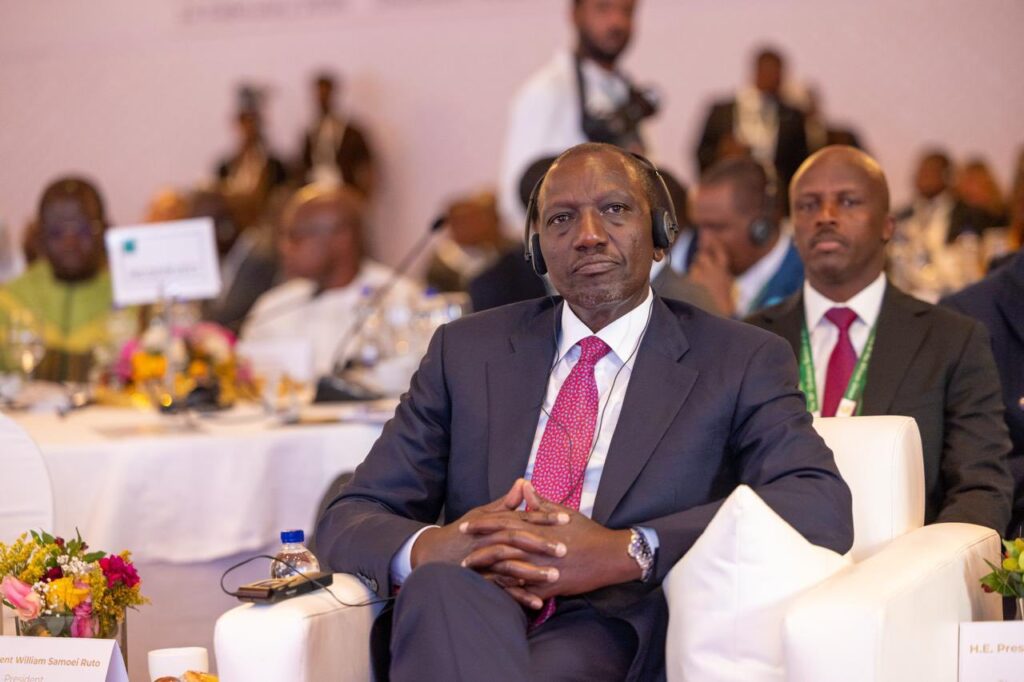
Kenya is implementing sustained, wholesome health reform and delivery of services to curb maternal and neo-natal mortality, President William Ruto has said.

The President said the government has restructured Kenya’s health financing framework, expanding pre-paid access to maternal care through the new Social Health Authority (SHA).

So far, he pointed out that the government has facilitated direct coverage for 50,000 vulnerable adolescent mothers, guaranteeing ante-natal, safe delivery and post-natal services.

Additionally, he said 38,000 mothers have been onboarded to ensure that cost is never the reason a young woman is denied safe childbirth.

“In this day and age, it is unacceptable that women continue to lose their lives while giving birth,” he added.

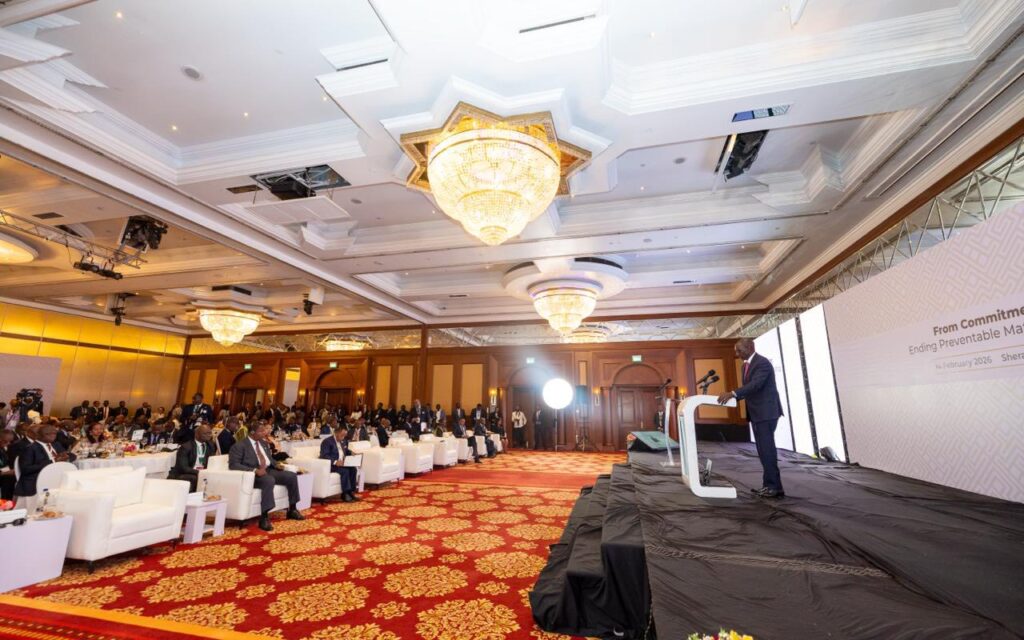
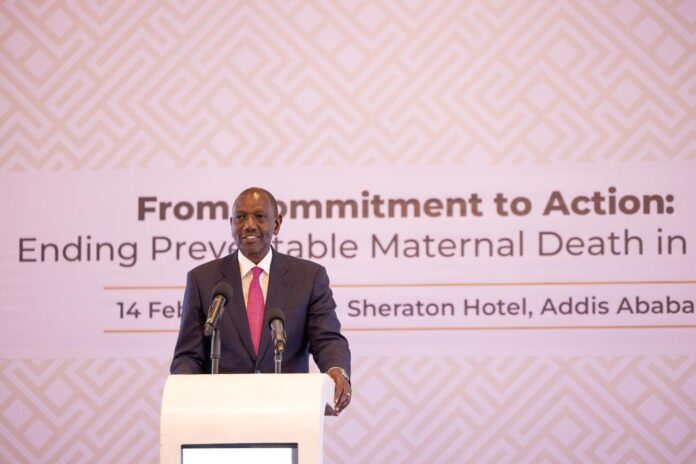
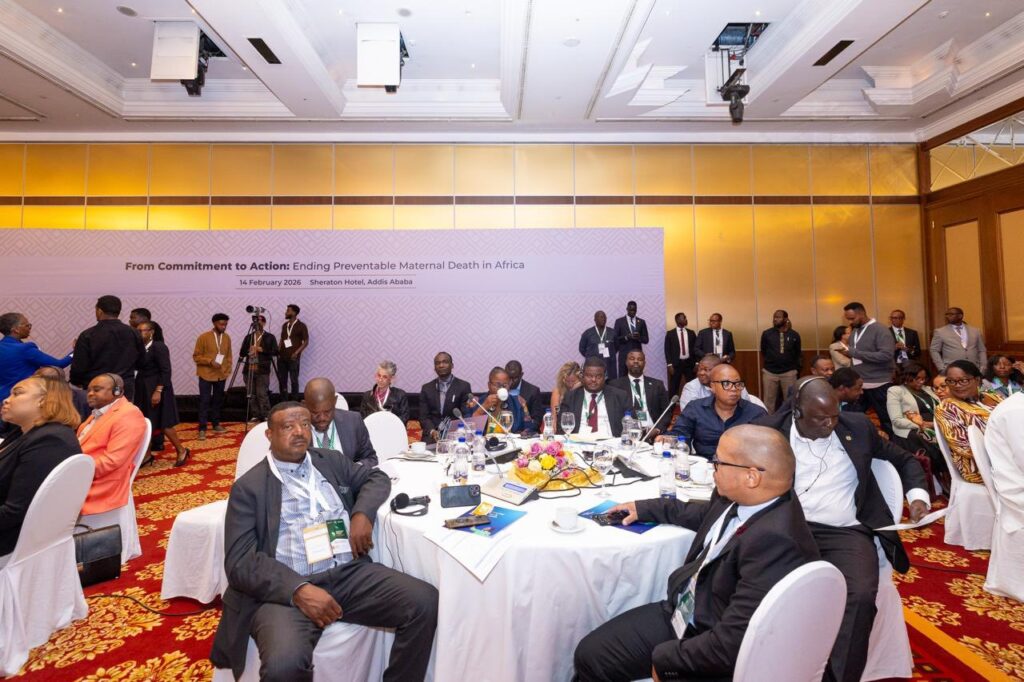
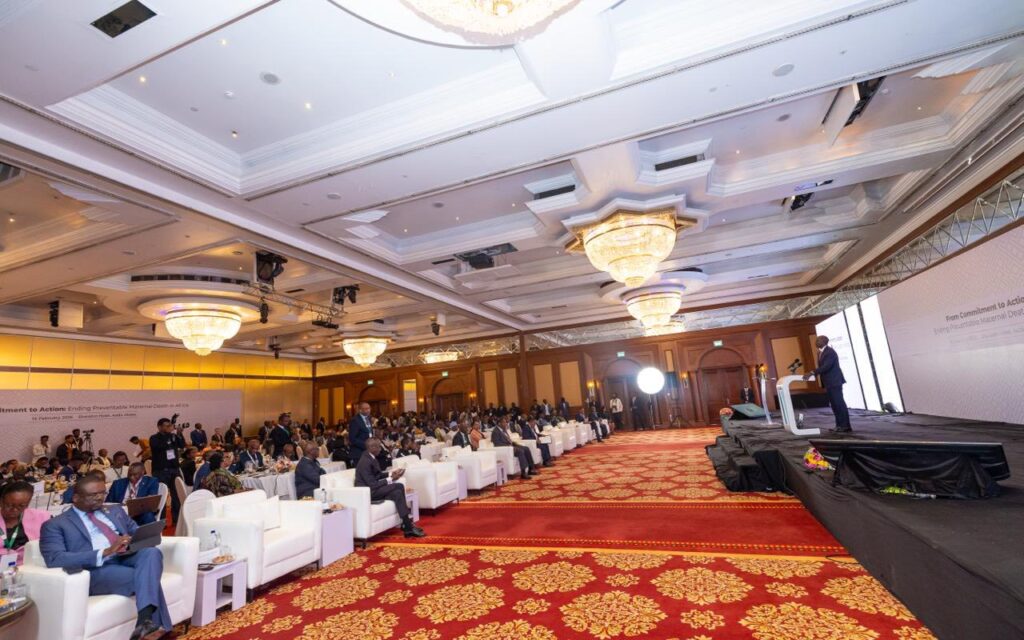
The President spoke during a High-Level Heads of State Side Event: From Commitment to Impact – Accelerating Maternal Mortality Reduction in Africa, on the sidelines of the 39th Ordinary African Union Summit, Addis Ababa, Ethiopia.

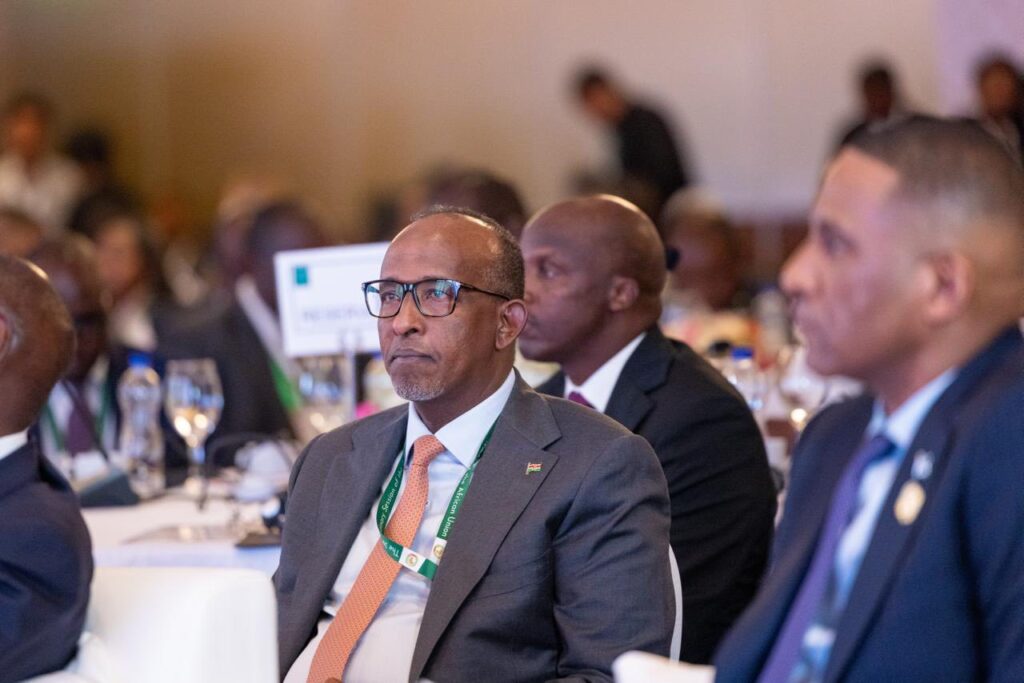
Present were Presidents Julius Maada of Sierra Leone, Duma Boko of Botswana, Faustin-Archange Touadéra of Central African Republic, Taye Atske Selassie of Ethiopia and Rwanda Prime Minister Justin Nsengiyumva.

To ensure equity in healthcare delivery, the President said the government is also concentrating resources in 26 high-burden counties and delivering bundled medical equipment directly to last-mile facilities to strengthen emergency obstetric and newborn care.

He said the government has deployed 2,880 Community Health Promoters and 192 Community Health Assistants to extend coverage at grassroots level.

“These teams serve as the first point of contact in our villages and are supported by 25 Primary Care Networks that link local facilities to specialised referral care,” he said.

He noted that the recent reductions in global health financing, including support to the United Nations Population Fund (UNFPA) Supplies Partnership, threaten to reverse hard-won gains in family planning, maternal care and birth spacing across our region.

“Kenya’s response is to strengthen supply security through domestic capacity. We are implementing a 40% local procurement requirement to reduce exposure to external shocks,” he said.

The President said Kenya is keen on strengthening health intelligence and is moving from broad estimates to precise measurement through the Reproductive Age Mortality Survey approach.

He said this will ensure the government knows exactly who is dying, where and why.

The President invited partners to support accurate implementation and full digitisation of this data within a National Health Intelligence Platform.

President Maada of Sierra Leone said Africa has made a clear commitment to end maternal deaths, commitments he said must now be turned into tangible results.

“The question before us now is whether we are prepared to turn those commitments to results deliberately and consistently,” he said.  

President Ruto proposes AU Extraordinary Summit to boost Africa local health manufacturing.

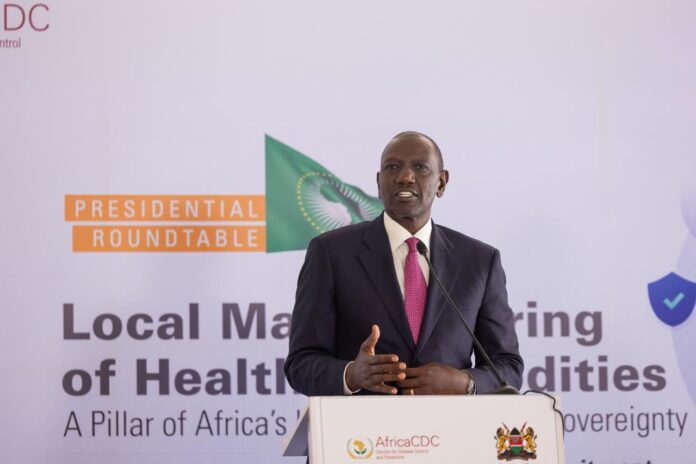
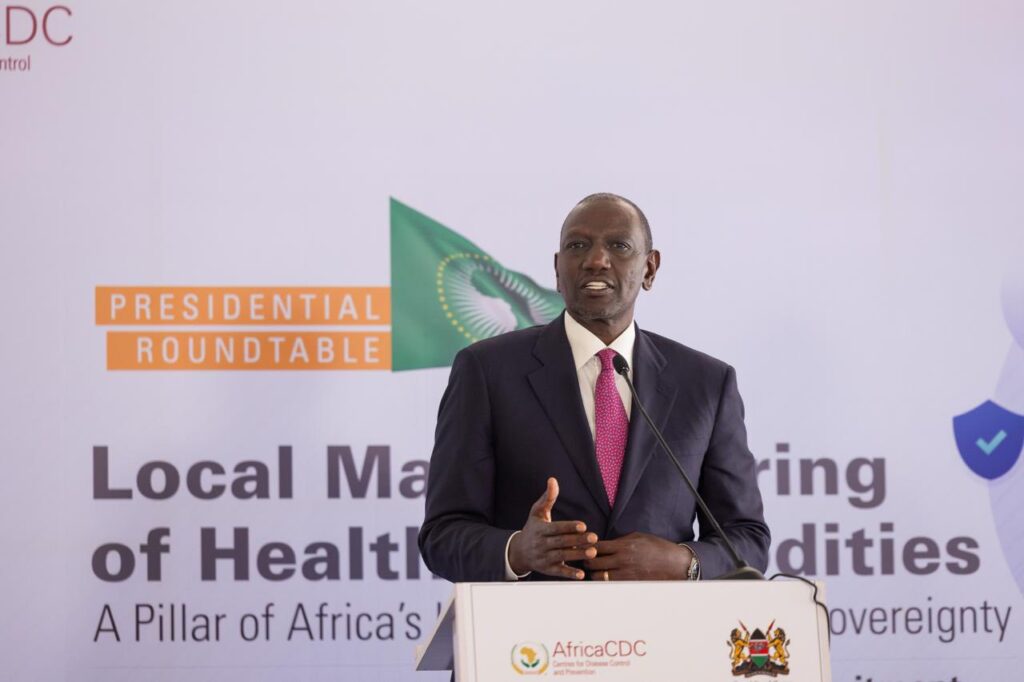
President William Ruto has proposed that the African Union convene an Extraordinary Summit in April 2026 to accelerate local manufacturing of health products, setting a target for Africa to produce at least 60 per cent of its health commodities on the continent by 2040.

Speaking in Addis Ababa, Ethiopia, during a side event co-hosted by the Government of Kenya and the Africa Centres for Disease Control and Prevention on the margins of the 39th Ordinary Session of the Assembly of the African Union, the President said local production was now an urgent priority for the continent.

“For far too long, Africa has remained at the periphery of the global health economy largely as a net consumer of health commodities produced elsewhere,” he said.

“This has come at a significant cost to our national budgets, the sustainability of our healthcare ecosystems, and the resilience of our people.”

He added: “Local manufacturing of health products is no longer a goal we can postpone; it is an urgent priority. It sits at the heart of Africa’s health security and sovereignty agenda.”

Ruto said nearly 60 per cent of health expenditure in many African countries is paid out of pocket by citizens. He noted that millions obtain essential medicines through informal markets, “where the risk of sub-standard or falsified products is high.”

“We must address this challenge to both protect our people and to reduce the economic leakage that weakens trust and undermines formal pharmaceutical markets,” he said.

The President also outlined what he described as a strong economic case for local manufacturing. He said Africa’s pharmaceutical market was valued at about 36 billion US dollars in 2023 and is projected to exceed 122 billion dollars by 2032.

“If we manufactured even half of the products we currently import, we could save between $30 and $50 billion annually, resources that could be redirected toward infrastructure, social protection, and innovation,” he said.

He pointed to the continent’s demographic and market advantages, citing Africa’s youthful workforce and a single market of 1.4 billion people under the African Continental Free Trade Area framework.

He said the launch of the African Pooled Procurement Mechanism through Africa CDC was aimed at addressing market fragmentation and aggregating demand across countries.

“Without predictable and aggregated markets, local manufacturers cannot scale or remain viable,” he said.

“Pooled procurement is therefore not optional; it is necessary. It can help secure better prices, improve availability, and provide demand certainty, giving African producers the confidence to invest and scale up.”

According to the President, Africa now hosts more than 570 registered health product manufacturers and over 27 vaccine manufacturing initiatives. He said regulatory systems were advancing, with nine national authorities having reached World Health Organisation Maturity Level 3, and noted that the African Medicines Agency is operational.

To address skills gaps, he said the Regional Capability and Capacity Network was being developed to build a qualified workforce.

He called on all member states to subscribe to the African Pooled Procurement Mechanism and align procurement plans “so that measurable progress can be achieved within the year.”

Ruto said industrialisation would require regional manufacturing ecosystems and value addition, urging African countries to move away from exporting raw materials and importing finished products.

He called for harmonised standards, sustained investment in research and development, and an enabling environment that includes sound policy, reliable infrastructure, effective regulation and affordable finance.

He said continental financial institutions, including the African Development Bank and Afreximbank, should continue converting commitments into practical, bankable projects for manufacturers.

“The African Continental Free Trade Area must be powered by African production,” he said.

“Without strong local manufacturing, it risks becoming a channel for imports rather than a driver of African industry.”

The proposed summit, he said, would provide an opportunity to review progress and strengthen partnerships needed to meet the 2040 target.

KeNHA announces closure of A8 Road between Rironi and James Gichuru Junction

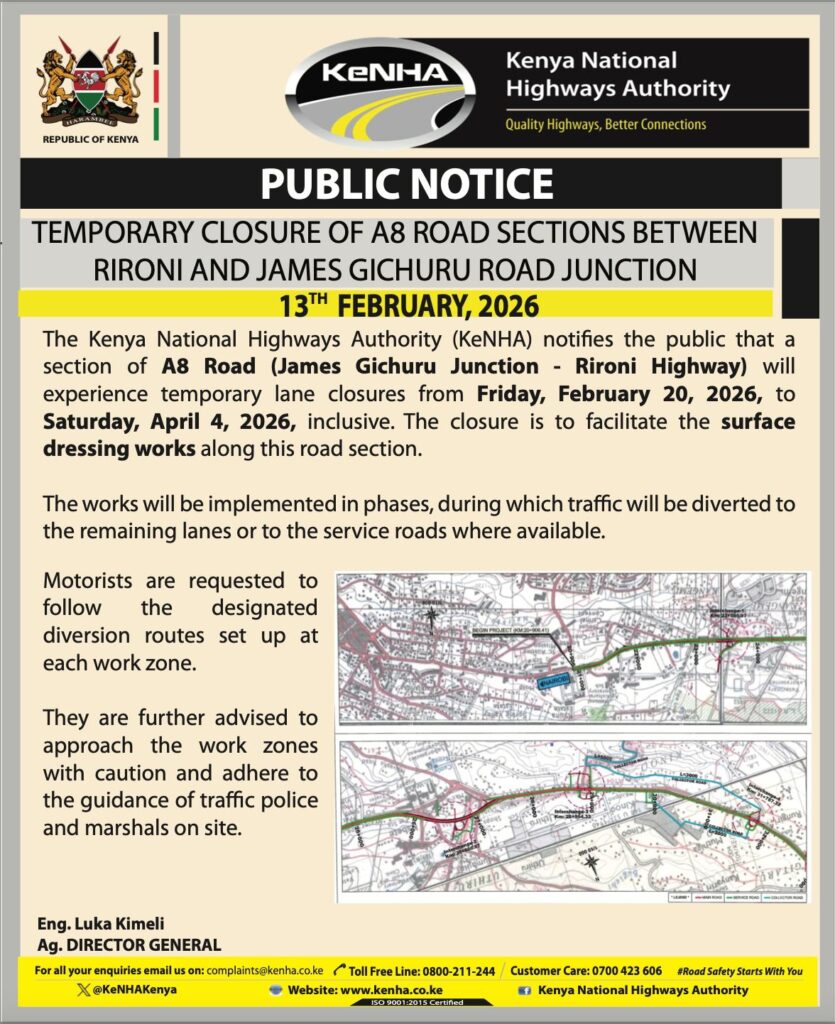
Motorists using one of Kenya’s busiest corridors will face disruptions after the Kenya National Highways Authority (KeNHA) announced temporary lane closures on the A8 road section between James Gichuru Junction and Rironi.

The closures will take effect from Friday, February 20, 2026, and run until Saturday, April 4, 2026, a period of over 40 days.

“The Kenya National Highways Authority (KeNHA) notifies the public that a section of A8 Road (James Gichuru Junction – Rironi Highway) will experience temporary lane closures from Friday, February 20, 2026, to Saturday, April 4, 2026, inclusive,” read the statement in part.

The works aim to carry out surface dressing, a maintenance technique that applies a new layer of bitumen and stone chippings to restore skid resistance, seal cracks, and extend the road’s lifespan.

“The closure is to facilitate the surface dressing works along this road section,” KeNHA explained.

While parts of the road have been upgraded to dual carriageways and six-lane sections, regular maintenance is essential to handle the high traffic volumes.

KeNHA stated that the works will be executed in phases to minimise disruption. During each phase, traffic will be diverted to the remaining open lanes or adjacent service roads where available. Designated diversion routes will be clearly marked at every work zone to guide motorists safely through the affected areas.

“The works will be implemented in phases, during which traffic will be diverted to the remaining lanes or to the service roads where available.”

Safety advisories and alternative routes

Motorists have been urged to exercise extra caution when approaching construction zones and to follow instructions from traffic police officers and marshals on site. “Road safety starts with you,” KeNHA reminded the public in a notice by Acting Director General Luka Kimeli.

Commuters should anticipate delays, particularly during morning and evening peak hours, and plan their journeys accordingly.

The announcement is part of KeNHA’s ongoing efforts to maintain and upgrade the country’s major highways. KeNHA further advised the public to approach the work zones with caution and adhere to the guidance of traffic police and marshals on site.

Uproar as Russian man secretly records encounters with Kenyan women, uploads videos

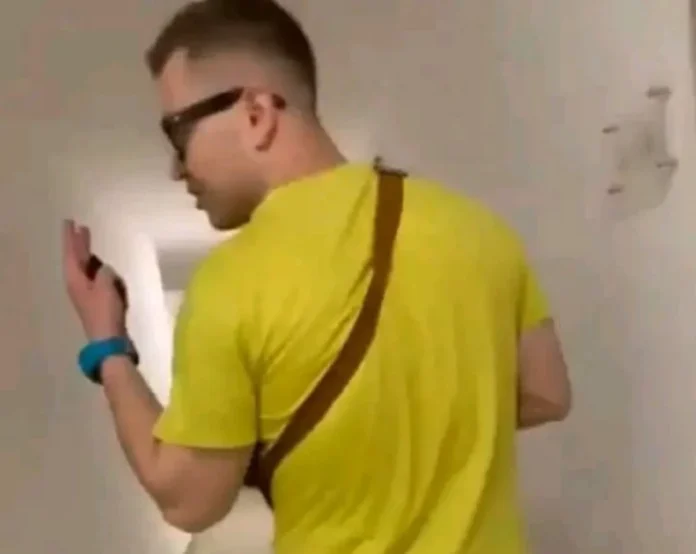
Over the past 24 hours, a man of Russian origin, only identified as Yaytseslav, has been trending on various social media platforms, and all for the wrong reasons.

This follows revelations that he has been secretly recording private encounters with multiple women across Africa and sharing the videos on his social media pages.

His actions only came to light recently after he released a series of videos featuring Ghanaian women, which led to further discoveries.

A deeper look revealed that Yaytseslav has reportedly shared videos of women from Kenya, South Africa, Ghana, and many other African countries.

In the videos, which have dominated conversations online, the Russian reprobate meets the women on the streets or in shopping malls, casually introduces himself, strikes up a light conversation and showers women with compliments before extending his hand and, in most cases, leading the women in a quick, awkward salsa. 

“Hello, what’s your name? You look beautiful, I really like you. Can you please share your phone number?” he is heard saying while approaching the women in some of the clips.

Yaytseslav then shares the short clips on TikTok and YouTube for free, while the full versions, which probably feature X-rated activities, are available exclusively on his private Telegram channel, where he charges a monthly subscription of $5.

In most of the videos doing rounds online, unsuspecting women are seeing going about their day as the Russian man approaches them.

At first, they appear hesitant to talk but he quickly wins their trust before, somewhat magically, convincing them to follow him to his rented apartments, where they are now seen letting loose, getting cozy, interacting freely and even dancing coyly.

The most shocking part of these encounters is how easily the women appear to trust him, and how unreasonably fast they agree to a private, intimate date at his random rented homes, merely hours or days after meeting the man.

Appearing to only be doing it for sport, and not necessarily sexual attraction, Yaytseslav picks up just about any woman in the vicinity – a mother walking her kids home, a random pair of middle-aged women at the market, a hotel attendant, a mall guard, a supermarket merchandiser and random women idling around the market.

While the initial interactions with the women are published for all to see, the Russian man doesn’t share what happens in the apartments he takes the women to, although he does pointedly share that the women not only agreed for an intimate, indoors date but also appear to be comfortably within the confines of his bed. 

In one rather daring instance, which explicitly demonstrates the Russian man’s unbridled notoriety, the freak attends Bishop Edward Mwai’s Roysambu mega church where he engages the preacher in a comical back and forth before convincing a worshipper to follow him back to his residence. 

Shockingly, she obliges. 

As outrage grew over his actions, many online users began speculating how he managed to record the women on the streets without their knowledge.

Some suggested that he must have used Ray-Ban Smart Glasses, also known as Meta Glasses, to film the unsuspecting women. This speculation arose after he was seen wearing glasses that resembled the Meta devices.

The Ray-Ban Meta glasses, developed with EssilorLuxottica’s Ray-Ban, let’s wearers take photos, stream content and talk to an AI assistant.

The newest models allow the wearer to capture 12MP photos, record 3K video, livestream to social media, and interact with Meta AI to identify objects or translate languages in real-time.

The fact that someone would casually wear Meta glasses, armed with recording capabilities, and expose so many women to ridicule and photographic exposure without their consent, caused massive uproar amongst Kenyans online, with many vehemently castigating the Russian man and others calling for his immediate arrest.

Journalist Ferdinand Omondi wrote: “Guys. A foreigner travels to African countries, engages in consensual sex with women, secretly records them, and then publishes the videos online. The sex was consensual. The recording and distribution were not. That is sexual exploitation.” 

He added: “What’s troubling is that instead of focusing on the violation, many are laughing at the women. Adults make personal choices every day. Some wise, some risky. But no such personal decision cancels the right to privacy, and grants one permission to secretly record and expose someone.”

Omondi went on to point out that the fact that the women agreed to the sexual pursuits did not mean that they agreed to have their faces plastered to the world. 

“We can debate ethics, morality and safety. But those debates must not erase the principle of consent. Consent to sex is not consent to filming. Consent to filming is not consent to publication,” he wrote.

Someone else said: “This isn’t travel content, it’s predatory behavior dressed up as vlogging. He is using African women as trophies for clicks. And instead of outrage, there’s excitement in weaponizing this saga to shame women. All the facts about how disgusting this man’s actions are get ignored, just so women can be dragged.”

Gladys Njoroge wrote, “This behavior is criminal. It is predatory. And anyone laughing at the victims is part of the problem. We cannot tolerate a world where exploitation is dismissed as “mischief” or “bad luck.” It is violence. It is abuse. And it must be condemned in the strongest terms.”

Social commentator Sholla Ard however wrote: “What disturbed me wasn’t just his behavior; it was how easily trust was given to a stranger… while he openly mocked it in Russian. Within minutes, phone numbers were shared. Within hours, some were in his house. No background check. No verification. No caution. Hard truth: skin color, nationality, charm, or perceived status does NOT equal safety. Predators rely on speed. They exploit politeness, curiosity, loneliness, and lowered guard.”

Dorothy Waigwe wrote, “Unfortunately, for black women the lure of white skin is an achievement, something to brag about. White automatically is attractive and smells of a better life, exotic so our sisters lower their guard and give in easily no second thought because everything becomes a fantasy.  How do you meet a stranger and the next hour you are comfortable in their apartment?”

While the concept of the pick-up artist is nothing new, experts are sounding the alarm over the rise of so-called “manfluencers” who are covertly filming women to create misogynistic content online.

In this online sphere, women are often positioned “as a conquest, prize or reward,” Stephanie Wescott, a feminist academic, writer and speaker, and a lecturer in Education, Culture and Society at Australia’s Monash University, told CNN.

Smart glasses can play into the hands of these content creators as they offer a clear message about power, she warned. Namely, that men can “be watching, recording and therefore controlling women’s images in public spaces without their knowledge and therefore, that the public spaces belong to men.”

For Wescott, the phenomenon represents another example of the gendered abuse of technology – and a danger for women that is difficult to anticipate. “The danger is the loss of bodily autonomy without even being aware that it is happening,” she said.

In response to a request for comment by CNN, Meta said: “Our glasses have an LED light that activates whenever someone captures content, so it’s clear to others that the device is recording and features tamper detection technology to prevent people from covering that light.”

Meta said its terms of service clearly state its smart glasses should not be used to engage in harmful activities like “harassment, infringing privacy rights, or capturing sensitive information.” 

Court of Appeal reorganizes benches after recruitment of 15 new judges

The Judiciary has announced a comprehensive reorganization of the Court of Appeal benches following the recent recruitment of 15 new judges to the appellate court.

In a deployment schedule released on Friday, February 13, 2026, the judges have been strategically distributed across six court stations in Nairobi and seven regional hearing centers across the country.

The new arrangement is effective for February 2026 and marks a significant expansion in the court’s capacity to handle appeals.

Justice Musinga, who serves as the President of the Court of Appeal, will lead Court 1 in Nairobi alongside Justices M’Inoti, Dr. Laibuta, and Lilan.

The Nairobi station will operate six courts simultaneously, with Court 2 comprising Justices Karanja, Omondi, Muchelule, and Lucy Njuguna, while Court 3 will be manned by Justices Warsame, Kimaru, Okello, and Sila.

Court 4 in Nairobi will have Justices Makhandia, Sichale, Lesiit, and Nderi presiding, while Court 5 will be headed by Justices Kiage, J. Mohammed, Kantai, and Okiyo. The sixth Nairobi bench, Court 6, will be composed of Justices Murgor, Aroni, Prof. Ngugi, and Ngetieh.

Beyond the capital, the Court of Appeal will maintain a robust presence in regional centers. The Meru station will be served by Justices Gatembu and Odunga, while the Nyeri bench will comprise Justices Ong’udi and Mumbi Ngugi. In Nyeri, Justices Achode and Katwa Kigen will also be stationed.

The coastal region’s Mombasa station will see Justices Tuiyott, Ngenye, and Okongo handling appeals from the area.

Western Kenya’s Kisumu bench will be staffed by Justices Nyamweya, Ongaya, and Mwita, while the Rift Valley’s Nakuru station will have Justices Mativo, Kairaria, and Hassan presiding over cases.

The North Rift region’s Eldoret station will be served by Justices Gachoka, Korir, and Ndolo, ensuring that appellants across the country have improved access to justice without necessarily having to travel to Nairobi. 

Create a free account, or log in.

Gain access to read this content, plus limited free content.

Yes! I would like to receive new content and updates.

Sponsored Ad

Ad 1
Ad 2
Ad 3
Ad 4
Ad 5
Ad 6