Sponsored Ad

Ad 1
Ad 2
Ad 3
Ad 4
Ad 5
Ad 6
23.2 C
Kenya
Thursday, June 11, 2026
Home Blog Page 4826

Women Are Better Drivers Than Men – New Research

Women are officially better drivers than men.

New research has concluded that the fairer sex are better at taking back control of modern driverless cars in emergency situations.

The tests showed that females react a lot faster than their male counterparts and display superior control behind the wheel.

The findings concluded that men could need extra software to make sure they drive safely when they drive the cars of the future as their reaction times lag behind the females.

Women’s average reaction times were 2.45 seconds compared with 2.63 seconds for men in the tests – in which participants mimicked taking control of a driverless vehicle to avoid a stationary car.

Dr. Shuo Li, an expert in intelligent transport systems at Newcastle University, said: “Women often do not realise how good they are at driving.

“But our results found they actually perform slightly better.”

Change of Guard: Why East Africa Closely Watches Kenya Elections

1. Participatory politics and term limits

Kenya’s democratic trajectory has always been viewed by east African neighbours as the bellwether for being fairly participatory. The annulment of President Kenyatta’s electoral victory on 1 September 2017 also offered crucial lessons to neighbours.

As court reversed Kenyatta’s win, John Magufuli (Tanzania’s president at the time) had banned all political party activities, ushering in an era of brutal dictatorship. In Rwanda, President Paul Kagame had just been declared winner with 98.8% of the votes.

In neighbouring Burundi, President Pierre Nkurunziza had controversially extended his stay in power through a “third term”. Over in Uganda, President Yoweri Museveni was just clocking 31 years in office and showing no signs of letting go. The other East African Community member state, South Sudan, was still embroiled in a civil war.

Only Tanzania has enjoyed periodic transitions, albeit through the one-party dominant system.

Kenya has experienced many democratic transitions since the reintroduction of multiparty politics in 1992. Despite its ethnic cleavages, Kenyan elections have been competitive. In 2002, there was a transition from the independence party, the Kenya African National Union, to the opposition National Alliance Rainbow Coalition.

Since the 1990s, Kenya has been the only country in east Africa to transfer power smoothly from a ruling party to the opposition.

2. Political and economic network

Kenya has always projected itself as a regional economic hub and an international political player. It has the largest economy in east Africa, almost double that of Tanzania and nearly three times that of Uganda.

Tanzania, which previously had lukewarm relations with Kenya, has benefited immensely from rapprochement between Presidents Samia Hassan and Kenyatta. Recent reports indicate that bilateral trade hit US$905.5 million in the first 11 months of 2021 as their trade relations improved.

Over the years, Kenya has been Uganda’s biggest trading partner. Uganda accounted for 29.3% of Kenya’s exports to Africa in 2020. Kenya’s exports to the East African Community increased from Ksh140.4 billion ($1.28 billion) in 2019 to Ksh158.3 billion (US$1.44 billion) in 2020.

Kenya has also maintained close economic ties with Rwanda and South Sudan.

3. Transit trade

The landlocked countries in the region rely heavily on Kenya’s seaport and transport corridor. The maritime port of Mombasa serves parts of Tanzania, Burundi, Democratic Republic of Congo (DRC), Rwanda, South Sudan and Uganda. These countries often follow very keenly how elections unfold in Kenya.

Kenya’s bungled 2007/8 political transition came as a surprise to many regional traders whose transit goods were destroyed along the transport corridor. The Northern Corridor and the Lamu Port-South Sudan-Ethiopia-Transport Corridor that run through Kenya are designed as key commercial arteries for landlocked countries in the region.

4. Regional integration

In February this year, presidential candidate William Ruto made a diplomatic gaffe when he said the DRC did not have a single cow. He was speaking about Kenya’s dairy and beef investments.

The storm that erupted showed how quickly regional relations could sour. The remark epitomised the low priority assigned to the east Africa policy agenda among Kenyan presidential candidates – Raila Odinga included.

The DRC became the seventh member of the East African Community in April this year. President Kenyatta has steered the regional agenda, including the admission of the DRC. In June he hosted the east African leaders to discuss the tensions between Rwanda and the DRC. He has also taken political leadership in stabilising Somalia and South Sudan.

The neighbouring states may wish to have as Kenya’s next president a person who continues to seek solutions to the conflicts of the region.

5. An ally as Kenya’s president

Who do the east African leaders want to be Kenya’s next president? Today’s personal friendships can be used to advance or safeguard bilateral interests tomorrow. In July 2021, Museveni hosted Ruto as the chief guest when laying the foundation of a new vaccine facility. Museveni’s action was interpreted as an endorsement for Ruto.

Museveni has had a tepid relationship with Odinga since 2007 when Odinga’s supporters uprooted the railway line during the post-election violence, disrupting exports to Uganda. In an apparent attempt to heal old wounds and appear even-handed, Museveni hosted Odinga in May this year. The two later said they discussed ways of strengthening relations between Kenya and Uganda.

Odinga had flown to Uganda from South Sudan, where, as the African Union High Representative for Infrastructure Development, he had gone to commission a 3.6km bridge that will connect Juba to the rest of the east Africa region. He was received there by President Salva Kiir. At the event, Odinga talked of his presidential bid, pledging to reopen the troubled border with South Sudan and prioritise construction of a Mombasa-Juba highway, if he won the 9 August elections. President Kenyatta had in May 2018 appointed Odinga as his special envoy to South Sudan in the effort to reconcile Kiir and his vice-president, Riek Machar.

In Tanzania, the late Magufuli was a key ally of Odinga’s, thanks to a friendship forged when both were works ministers in their countries. Magufuli’s support for Odinga against Kenyatta in the 2013 and 2017 polls led to a perfunctory relationship with Kenyatta and tense relations between the two countries.

His successor Hassan was quick to restore friendly terms. But Tanzania, just like Rwanda and Burundi, has not shown any signs of leaning towards one candidate. Many Tanzanians have however been excited by rank outsider George Wajackoyah’s eccentric promises.The Conversation

Nicodemus Minde, Adjunct Lecturer, United States International University – Africa, United States International University

This article is republished from The Conversation under a Creative Commons license. Read the original article.

Burundi At 60 Is The Poorest Country: What Went Wrong?

Burundi, which marked 60 years of independence on 1 July 2022, ranks as the poorest country on the planet in terms of GDP per capita. This must be understood in the light of a history punctuated by political upheavals. Until 1996, the country lived to the rhythm of coups, massacres and political assassinations – before plunging into a long civil war.

Peace was eventually restored in 2005. However, the country returned to authoritarian governance in 2015. Since then, the UN has noted progress but continues to denounce the political violence that plagues the country.

How did Burundi come to this? Why is change so slow to arrive?

I have studied the politics and economies around the Great Lakes region for more than 40 years – including the links between governance and poverty. The countries that form the region are Burundi, Rwanda, Democratic Republic of Congo and Uganda. , Democratic Republic of Congo and Uganda. It’s my view that the end of the Belgian and British colonial empires upset the political, economic and social frameworks of the two nations formed out of the former Ruanda-Urundi colonial entity.

Present-day Rwanda and Burundi served as reservoirs of labour for the exploitation of the wealth of the vast agricultural and mining areas of the Belgian Congo to the west and the British colonies in the east. Refocused within their borders following independence in the 1962, they were reduced to small, overcrowded and landlocked micro-states.

Burundi is a country familiar with various military regimes since independence. These regimes have succeeded in appropriating state resources while ordinary citizens – mostly rural farmers – have borne the brunt of the civil war.

The divide that has emerged between military elites and “people of the hills” – as rural farmers are commonly referred to – runs deeper than ethnic and regional differences. The peasantry still provides almost all the resources of the party-state. But most of the agrarian policy decisions are taken without consultation, including at the grassroots levels where party delegates, often peasants, do as directed.

The state has imposed itself as the exclusive economic operator. Civil servants and party cadres programme and direct investments. Ordinary people are for the most part powerless.

Nkurunziza’s missed opportunity

Following the gradual return of peace nearly 20 years ago, Pierre Nkurunziza was elected president in 2005. Drawn from the majority Hutu ethnic group, Nkurunziza ended 25 years of pro-Tutsi military regimes. The minority Tutsi make up 14% of the population and the Hutu 85%. In the next five years, the president and his party – the National Council for the Defense of Democracy – Forces for the Defense of Democracy (CNDD-FDD) – went about consolidating power.

Hopes for stability were stronger at the next election in 2010. For the first time in the country’s history, voters were called upon to vote at the normal end of an electoral cycle. CNDD-FDD secured another mandate thanks to a divided opposition and the charismatic personality of the incumbent president, who enjoyed massive support from rural populations.

A party that had managed to reconcile ethnic divisions and to integrate the armed forces with former rebels now had a resounding national mandate.

Unchallenged, Nkurunziza concentrated power in his hands under a de facto one-party state. A youth militia loyal to his party kept an eye on dissent among local populations and neutralised any organised opposition. But the mood soured quickly when Nkurunziza sought a “third term” in the 2015 elections, contrary to the constitution.

A popular protest was immediate and strengthened despite the mobilisation of the police. Within weeks a failed military coup laid bare the fractures within the armed forces. A violent repression followed in which freedom of expression and independent media were crushed.

In July 2015, after elections “neither free nor credible” according to the UN, the CNDD-FDD exceeded the two-thirds majority in the National Assembly.

Nkurunziza’s victory was Burundi’s loss. Amid the repression of opponents, the country’s economy slowed down, foreign capital took flight and infrastructure crumbled. There was looting of public resources and a sharp reduction in social benefits.

At the end of his third term, the leaders of the CNDD-FDD party were happy to see the back of the “eternal supreme leader” who had become a liability.

The electoral rescue of 2020

Burundi’s GDP had been battered badly during the civil war, which ended in 2005. It was on the rise for ten years from 2005 to 2014. Following the Nkurunziza-instigated political crisis in 2015 the economy dipped sharply again. Ranked second poorest country in the world in 2013 and 2014, it fell to the poorest in 2015 and has remained there ever since. The UN Human Development Index, which measures longevity, education and inequality, also attests to this deterioration. Burundi was ranked 180th in 2015, falling to 185th in 2019 and 2020.

Thus, in almost all socio-economic measures, Burundi’s performance is among the lowest on the planet thanks mainly to conflict and elite corruption.

The failed coup of May 2015 upset a delicate balance in which the army – including former rebels – and the police were jointly managed. Pro-Nkurunziza elements in the army who crushed the coup sensed an opportunity for self-enrichment to match the fortunes of their senior Tutsi colleagues and graduates of military schools.

Hitherto contained or concealed, this “financial catch-up” was transformed into an open competition for personal enrichment commensurate with each person’s powers.

In May 2020, General Evariste Ndayishimiye, a wise and withdrawn man, became the new president. Nkurunziza died shortly afterwards officially from COVID-19, a disease whose danger he had always underestimated. Burundi, on the other hand, continues to suffer the effects of Nkurunziza’s political legacy.

Struggle between elites

Having experienced since independence all forms of divisions that can be exploited by authoritarian regimes, the “people of the hills” now know that their lot is the result of struggles between elites for the capture of national resources.

Only the re-appropriation of the state, to make it legitimate once more in the eyes of the population, could free resources for their purposes. This implies that peasants emancipate themselves from co-opted administrative and economic bureaucracies which have appropriated power and wealth by force, first for the benefit of a Tutsi and then of a Hutu elite. Burundians need to impose themselves through free and credible elections as self-organised citizens responsible for the future of a democratic country.The Conversation

André Guichaoua, Professeur des universités, Université Paris 1 Panthéon-Sorbonne

This article is republished from The Conversation under a Creative Commons license. Read the original article.


DP Ruto Weeps During Prayer Meeting

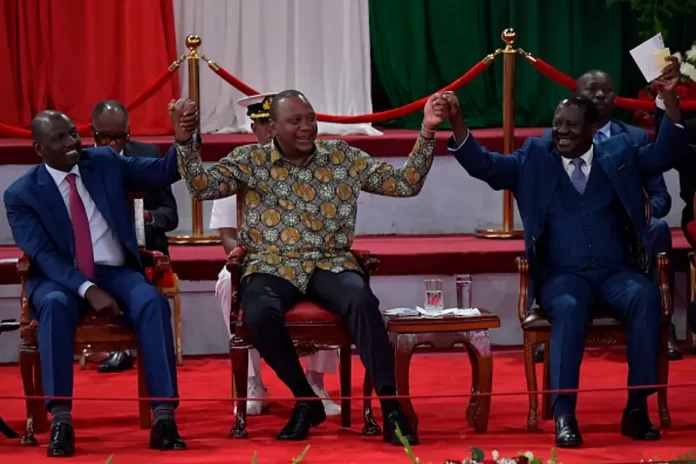
Deputy President William Ruto was overcome with emotion on Tuesday while hosting a prayer meeting in his Karen home.

Ruto is seen getting into a prayerful mood during praise and worship sessions, with tears streaming down his cheeks.

At one point, the DP is seen with his hands on his face, blinking with watery eyes, possibly fighting back tears.

Ruto was standing next to his wife, Rachel Ruto, as they both participated in a prayer meeting led by Bishop Mark Kariuki.

During the vote of thanks, the DP thanked God for the presidential journey he had begun.

Ruto expressed gratitude for seeing God’s hand throughout the journey. He stated that they had to endure and overcome numerous challenges along the way.

According to the DP, Kenya is fighting a spiritual battle that can only be won through the prayers of those who believe.

‘As a team, we are really grateful and we have seen God’s hand in this journey,” he said.

Furthermore, the Kenya Kwanza presidential candidate called for a peaceful election, urging Kenyans to pray for peace.

“We want every Kenyan to pray for peace because we want to cast our votes in peace and eventually the will of God will prevail,” he noted.

“We want to ask you to continue to pray for us and for the peace of the country… There are people who would want to disrupt the peace of our country,” he added.

Beiber Back On Stage After Face Paralysis Syndrome

Justin Bieber had to postpone his shows of ‘Justice Tour’ in the North American leg due to his Ramsay Hunt syndrome. He is coming back after the recovery.

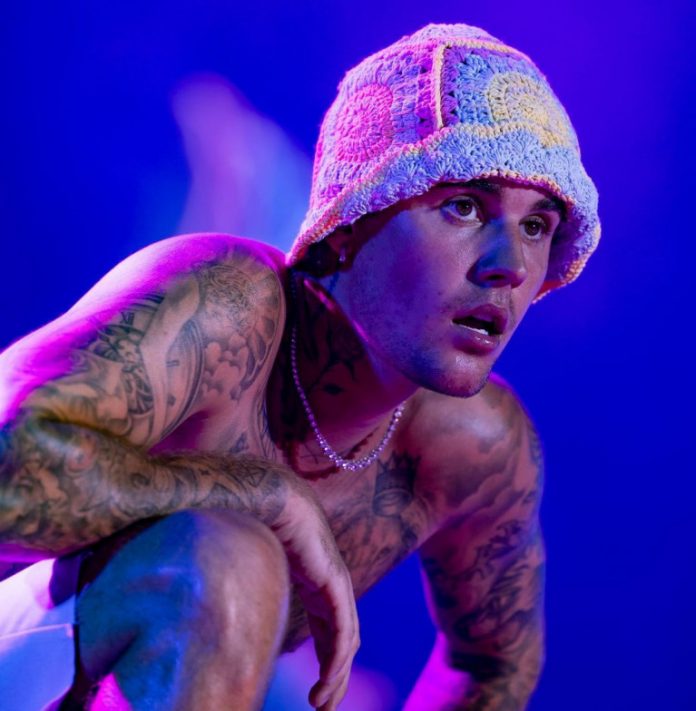
The pop icon Justin Bieber has come again back on stage after surviving the Ramsay Hunt syndrome. The artist was forced to take a break from his tour because the right side of his face was paralyzed due to the disease.

He had to take some time off in this period for the diagnosis. He was being cured from mid-June, and he canceled all the shows at this time.

After such a hard time, he came back with his enthralling performance on the stage of the Lucca Summer Festival in Italy. The show took place last Sunday, on 31st July. As of now, the artist is looking good and quite healthy.

In the show, he performed from all his albums. And everyone from the audience thoroughly enjoyed his performance.

The artist himself has shared some photos of the show and captioned it by saying ‘Luv u guys and I missed you.’

About the Ramsay Hunt syndrome, Mayo Clinic has said that it ‘occurs when a shingles outbreak affects the facial nerve near one of your ears’. In the video that he posted of his sickness, was visible that the artist was struggling to smile, blink, and move his nostril.

After a few days of treatment, Justin himself posted that ‘each day has gotten better’ and his faith in god has helped him to deal with the whole situation.

His ‘Justice Tour’ has been postponed for the North American leg and they are going to announce the new dates very soon. Currently, he has gone for his shows in Europe. Next, he is going to perform in Denmark on 3rd August.

He will perform in South Africa, the Middle East, Asia, Australia, New Zealand, and the UK. Audiences can pre-book the tickets from now.

Lilian Muli: I am Not Suing My Baby Daddies

Lillian Muli recently discussed the difficulties of co-parenting, claiming that it is the children who suffer the most when the parents are at odds. 

The Citizen TV news anchor has supposedly had her fair share of baby daddy drama as a single mother of two boys with different fathers. 

Muli informed Betty Kyallo on the Kyallo Culture reality show that most males fail to take parental obligations if their baby moms reject their advances.

“There is a tendency of men to renege on their responsibilities if they are not sharing a bed with you or if they are not on good terms. The child ultimately is the one who suffers,” she said.

“Children suffer the most in this situation,” she added.

Muli also revealed she is not the type to sue a baby daddy for child support saying she has left it to fate.

“I am not taking anybody to court for these things, by the way. I am like, if you want to sign a date with karma, you do it.

“I won’t make you do something you already know you should be doing. If you’re out buying champagne for slay queens, go ahead,” she said.

Noting that having two baby daddies is messy, Lillian said her breakups were tough to deal with.

“I grieve and mourn over a relationship breakup. I play love songs, take long drives and eat ice cream,” she said.

Waruinge Steps Down To Support UDA’s Francis Mureithi For Embakasi MP

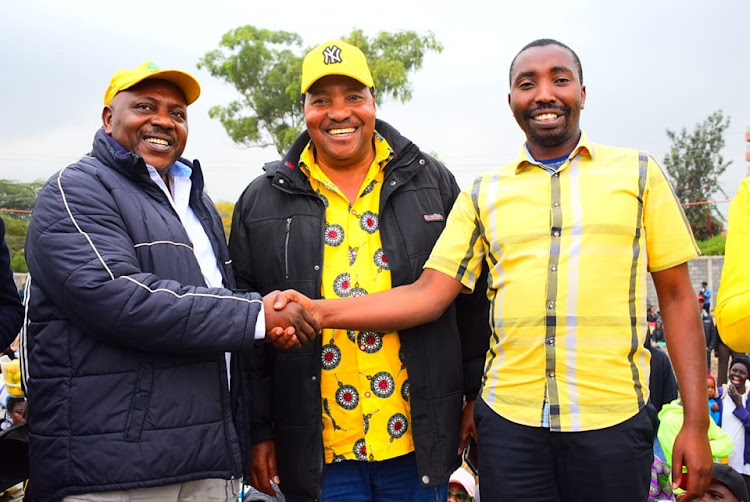
Maina Waruinge, the Jubilee candidate for Embakasi East, has stepped down, according to deputy president William Ruto.

According to the DP, Waruinge stepped down to support UDA candidate Francis Mureithi in his parliamentary bid.

Waruinge announced his resignation at a rally in the constituency on Tuesday, seven days before the August 9 general election.

“Embakasi East Jubilee MP aspirant Maina Waruinge quits the race and defects to UDA to support Francis Mureithi,” Ruto said.

Mureithi is seeking to oust incumbent MP Babu Owino.

Mureithi, who ran on a Jubilee ticket, narrowly lost to Babu Owino in 2017.

Others in the race include Paul Okumu, Joash Omwenga of Wiper party and Stephen Maina.

CBK Licences Egypt’s Banque Misr-S.A.E.

Egypt’s second-largest lender, Banque Misr-S.A.E., has obtained a license to operate a representative office in Kenya, with the goal of pursuing trade finance deals for Egyptian businesses looking to expand into the East African region.

The Central Bank of Kenya announced on Tuesday that it had granted the license to the State-owned lender, making it the second Egyptian bank with a presence in Nairobi, following Egypt’s largest private lender Commercial International Bank’s purchase of a controlling stake in Kenya’s Tier-III Mayfair Bank in 2020.

“The CBK announces the granting of authority to Banque Misr–S.A.E. of Egypt to establish a Representative Office in Kenya by the name Banque Misr – S.A.E.– Kenya Representative Office,” said the CBK in a statement.

Under the Banking Act, Representative Offices of foreign banks in Kenya serve as marketing and liaison offices for their parent banks and affiliates and are not permitted to undertake banking business.

The new license brings the total number of foreign bank representative offices in Nairobi to ten.

On behalf of their parent banks, these units conduct research, marketing, and liaison activities. They are, however, prohibited from providing commercial banking services, including deposit taking, unless they establish a full-fledged subsidiary or branch.

“The Representative Office is expected to play a catalytic role in strengthening the long-standing trade relationship between Egypt and Kenya.” 

Banque Misr – S.A.E. provides a wide range of retail and corporate banking services, as well as trade finance services in its home country and internationally.

Outside Egypt, it has operations in the Middle East, Europe, Russia, South Korea, and China.

Betty Kyallo Regrets Posting Ex

Betty Kyallo, a media celebrity turned businesswoman, has expressed regret for promoting her ex-boyfriend, Nick Ndeda, on social media.

After months of suspicion and keeping their relationship under wraps, the former K24 news anchor finally revealed Ndeda to the world. 

Kyallo stated that introducing Ndeda on her social media channels, which she refers to as her personal zone, was superfluous. 

Notably, during their partnership, the businesswoman did the most of the work, whilst Ndeda rarely uploaded Kyallo or made a big deal about their connection.

“In my last relationship, I put him out on social media and I am now like, I will never do that again. That is my space and we should stop overlapping each other when it comes to my social media space,” she said.

Kyallo confirmed her split with Ndeda in February, stating that she was focused on growing her business and caring for her daughter Ivanna.

Wife of Nigerian Man killed in Italy Calls For Justice

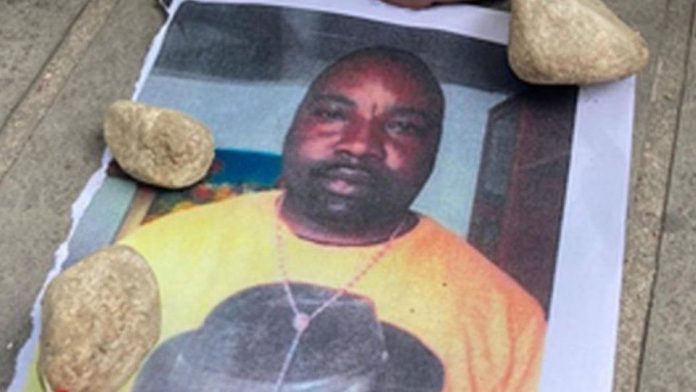
The wife of a Nigerian street seller killed in Italy has told the BBC that she is seeking justice for her husband’s “terrible death.” 

Aliku Ogorchukwu, 39, was allegedly peddling handkerchiefs in the beach resort of Civitanova Marche on Friday when he was tracked down and killed. 

An Italian man, 32, has been arrested on charges of murder and robbery. 

A video that has gone viral shows a man standing on top of Ogorchukwu and striking him with his bare fists.

None of those who witnessed the broad daylight attack appeared to intervene.

“This is a form of wickedness I don’t know,” Ogorchukwu’s wife, Charity Oriachi, told the BBC’s Focus on Africa.

Ms Oriachi said she had received help in coming to terms with her husband’s death but was tired of “talk”. Now, she was only interested in justice, she insisted.

Her family had lived in Italy for a long time, she said, stressing that her husband had never sought any trouble.

The killing has sparked outrage in the local community, including Nigerians, who took to the streets over the weekend and are planning another demonstration soon.

The Nigerian government has asked Italian authorities to quickly “bring the perpetrator of the heinous act” to justice.

The suspect – a white man named as Filippo Claudio Giuseppe Ferlazzo – has been ordered to remain in jail as the investigation continues.

His defence lawyer told the media the suspect had said he was sorry and that there was “no racial element” involved.

A police investigator said Ogorchukwu was attacked after the trader’s “insistent” requests to the suspect and his partner for spare change.

The partner, identified as Elena D, told Italian newspaper Corriere della Sera that Ogorchukwu had touched her arm, but that did not bother her.

Ms Oriachi now wants to see the suspect “face to face”, to understand why he killed her husband, the family’s lawyer told the Associated Press.

Create a free account, or log in.

Gain access to read this content, plus limited free content.

Yes! I would like to receive new content and updates.

Sponsored Ad

Ad 1
Ad 2
Ad 3
Ad 4
Ad 5
Ad 6