Sponsored Ad

Ad 1
Ad 2
Ad 3
Ad 4
Ad 5
Ad 6
27.3 C
Kenya
Sunday, April 26, 2026
Home Blog Page 6079

Woman pleads guilty of selling Bhang

BY PRUDENCE WANZA – A woman who was arrested at Koja Bus Stage has been arraigned in court over charges of trafficking Bhang. The accused, Beatrice Achieng, however has pleaded guilty to the offence.
The accused, Beatrice was found with 10 rolls of bhang selling at a street price of Ksh. 200.

Beatrice Achieng charged of trafficking 10 rolls of bang | PRUDENCE WANZA

She appeared before Senior Principal Magistrate, Kennedy Cheruiyot, at the Milimani Law Courts. 
She will be remanded in custody until tomorrow for the facts of her case to be read to the court. 

Six suspects arrested with 50 kgs of fake gold to be held for 3 days to allow investigations.

BY PRUDENCE WANZA – Six people who were arrested yesterday by Detectives from the Flying Squad unit with 50 kilograms of fake gold in Kilimani area have been arraigned in court.

The six who include four Rwandese nationals and two Kenyans will however spend three days in custody to allow police complete investigations against them over fake gold.
The six Grace Wairimu Machatha, Erasocs Katiku Josiah , Niyitegeka Sevelin, Dushimiriman aEgie , Zilimwabagabu Jacrries and Ngagagura Emmanue are being investigated in a case of being in possession of fake gold nuggets contrary to section 203 Mining Act 12 of 2016 Laws of Kenya.
According to the prosecution, on 15th April 2019 Flying Squad Officers acting on information from the members of the public went to Lenana 51 Apartments along Lenana Road within Kilimani area and managed to arrest all suspects. The suspects are aged between 26 years and 64 years.
According to a miscellaneous application presented before the court this morning ,the investigating officer intends to contact more witnesses who have probably been defrauded by the six suspects using the said fake gold nuggets.
The six will lead the investigating team to apprehend other suspects who are still at large and are believed to be hiding within Nairobi and other towns.

Two people arraigned in court for stealing property

BY PRUDENCE WANZA – Two people said to be employees of progressive credit limited, a microfinance company have been charged of stealing property worth Sh. 3m.
The two, Peter Rono and Dickson Aika told the court that they commited the offense in the process of a debt recovery from the complainant since they are incharge of the debt recovery unit.
However, according to the Senior Principal Magistrate Kennedy Cheruiyot at the Milimani Law Courts, the two are not auctioneers and they have no right under the law to proclaim goods and that what they committed is an offence against property.
According to the charge sheet, on 29th January, 2019 at Nairobi city centre they stole, 216 pieces of jegging, 24 pieces of official suits, 138 pieces of small size skaters, 34 pieces of big size skater dresses, 32 pieces of chut bags, 33 pieces of handbags, 75 pieces of jeans, 45 pieces of official dresses, 34 pieces of jackets, 20 pieces of chiffon tops, 18 pieces of dinner dresses, 15 pieces of official trouser suits and cash Ksh. 72600, all property valued at Ksh. 3,845,6000.The property if Arsanaidah Keruboh Bakare.
They pleaded not guilty to the charges and will be released upon payment of a bond of Sh. 1m and an alternative cash bail of sh. 500,000.
The case will be heard on 16th May, 2019 and mentioned on 30th April, 2019.

20 year old girl charged of kidnapping a baby

BY PRUDENCE WANZA – A 20yr old has been charged of kidnapping a 2yr and 4 months old baby at Ofis Investment Estate in Kawangware Nairobi.

The accused, Sharon Khasoa Mule on 8th April, 2019 at around 4.30pm, is alleged to have kidnapped the baby out of the keeping of its lawful mother, Damaris Moraa without her consent.
She appeared before Senior Principal Magistrate, Kennedy Cheruiyot at the Milimani Law Courts and pleaded not guilty to the charges.
She will be released upon payment of Ksh. 1m bond and an alternative cash bail of Sh. 1m.
The case will be mentioned on 30th April, 2019.

Magistrate questions 13 accused people on huduma number before making a decision to discharge them.

BY PRUDENCE WANZA – 13 people have been relieved of charges of gaming in public place contrary to the law. The thirteen were charged of taking part in gaming and lottery at Ronald Ngala street and Kenya National archives at the Nairobi CBD.
Appearing before Senior Principal Magistrate,  Kennedy Cheruiyot at the Milimani Law Courts, they pleaded guilty to the charges and asked for forgiveness from the court. 


However, the magistrate inquired whether they had registered for Huduma numbers which they had not yet done. Hon. Cheruiyot cited that, “If you are you are to be sentenced you will be out when the 45days of registration are over. “
The magistrate then decided to discharge them saying that gambling is a great concern in Kenya and thousands of Kenyans are doing such gaming and have not been caught therefore it will be inappropriate to punish the 13 accused people. 
He however told them to make sure they are given Huduma numbers so as get government services. 

Graffiti is an eye-catching way to create lively spaces in cities

Graffiti in Maboneng, Johannesburg provides a bright contrast to the spaces around it. Alexandra Parker Alexandra Parker, Gauteng City-Region Observatory

Whether it’s tagging (the stylised writing of an individual or crew’s name), posters, stickers, installations, murals or mosaics, graffiti has always been a contentious issue. Countries like the US, UK and Australia have adopted aggressive – and expensive – strategies to try and eradicate graffiti.

But not all cities view graffiti as a bad thing. Over the past few decades, it’s increasingly become part of mainstream culture. Some places have actively promoted graffiti and encouraged artists to work in public spaces. Others, like Bogota in Colombia, have introduced legislation that aims to promote the responsible and legal practice of graffiti. In Singapore, the state has designated specific surfaces for graffiti.

Johannesburg, South Africa’s most populous metro, takes a dim view of graffiti. In 2016, Mayor Herman Mashaba declared that he would eradicate graffiti through stricter bylaws to create an “investor-friendly environment” in the city. His stance is arguably at odds with the City of Johannesburg’s policies on urban redevelopment. These rely on programmes that support public art and promote tourism opportunities.

We and our colleagues at the Gauteng City-Region Observatory wanted to know the contribution made by graffiti to tourism and the public environment in the inner-city of Johannesburg. The Observatory is an independent research organisation which generates data and analysis to help inform development and decision making in the Gauteng City-region. So we undertook a study of graffiti in Maboneng, a precinct in Johannesburg’s inner city that’s undergoing urban renewal.

Using the case study of Maboneng, the research demonstrates that graffiti has been leveraged in nurturing urban development, creative economies and tourism in the inner-city. This means it has aesthetic value in the urban environment. The research shows that graffiti contributes to place-making by creating meaningful or identifiable spaces that tolerate public participation through the medium of graffiti.

Graffiti in Maboneng

The Maboneng precinct began in 2009 with the completion of the “Arts on Main” building, an artists’ space in a renovated industrial building. Over the last decade, Maboneng has become an iconic example of how investing in “creative spaces”, “creative industries” and “creative tourism” can be used to drive urban renewal of previously disused or derelict urban environments.

Maboneng’s developers have created a strong public and street art presence, both physically and digitally. In fact, graffiti forms part of the developers’ strategy for reinvigorating the area. The area now boasts several large-scale murals produced through street art festivals and artistic commissions. It’s also attracted significant attention from graffiti artists. All of this contributes to Maboneng’s aesthetic identity and is one of the elements that draws tourists to the area.

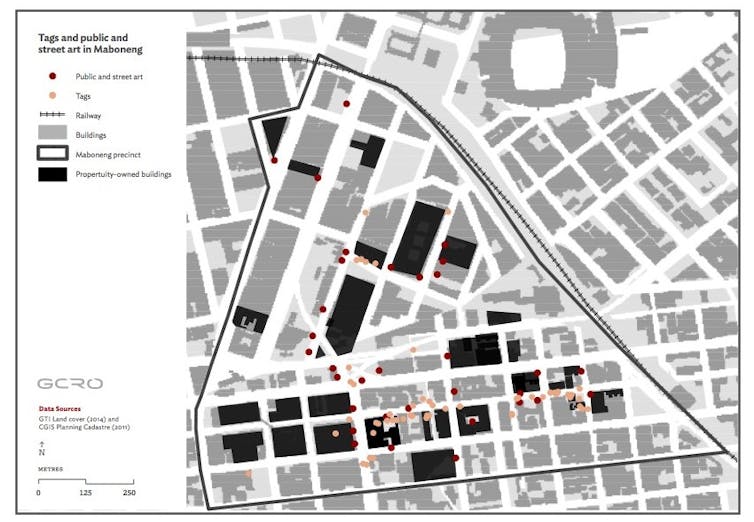
In our research we used photographs of graffiti to document, locate and map its presence within the precinct. Graffiti here refers to a spectrum, from tagging to elaborate pieces with a focus on stylised words and text.

Through visual and spatial analysis, we were able to demonstrate that graffiti has aesthetic value. It signifies the redevelopment of the neighbourhood, distinguishes the area from surrounding spaces, and projects a global aesthetic similar to that seen in places like Hell’s Kitchen, New York; the east end of London or Bogota, Colombia.

Notably, the mapping showed how tagging, accompanies both redevelopment and commissioned street art.

Tags and public art.

Large murals were incorporated into the architecture of renovated buildings. These murals were frequently accompanied by other forms of graffiti such as tagging, posters or stickers. Graffiti was present in the precinct even where buildings or public space had been upgraded. This reflects Maboneng’s tolerance for types of graffiti that are more frequently viewed as undesirable.

We also examined the visibility of graffiti murals in Maboneng. The location of a graffiti piece is a conscious decision: graffiti artists aim to express their views in the public realm and gain more recognition and respect based on the reach of their work.

We mapped the reach of the murals on high rise buildings in Maboneng, and found that many could be seen for several hundred metres down streets – and, in some cases, beyond the boundaries of Maboneng itself. The murals announce the branding and identity of the area for the public and thus aid in making the Maboneng precinct more visible and inviting.

Navigating the city

Our research shows that graffiti has been used to create a strong brand for Maboneng and is a form of advertising that extends beyond the immediate neighbourhood boundaries.

Graffiti has been used as a form of way-finding or navigation, where buildings become unique landmarks in the landscape. It is through these elements that the value of graffiti is being realised in Maboneng.

Graffiti is creating a distinctive precinct within Johannesburg and, simultaneously, a familiar global aesthetic of the creative neighbourhood. The presence of graffiti in Maboneng has not detracted from its value in terms of urban renewal. This means that Maboneng provides an alternative management approach, which should be further investigated.

Samkelisiwe Khanyile, a junior researcher with the GCRO, contributed to this article.The Conversation

Alexandra Parker, Researcher of urban & cultural studies, Gauteng City-Region Observatory

This article is republished from The Conversation under a Creative Commons license. Read the original article.

Al-Bashir: Why the ICC is between a rock and a hard place

The ICC has tried and failed – to prosecute deposed Sudanese president Omar al-Bashir. KHALED ELFIQI/EPA-EFE Mattia Cacciatori, University of Bath

A military coup d’etat in Sudan has ended Omar al-Bashir’s 30-year rule. In a widely publicised press conference, the country’s Defence Minister Awad Ibn Ouf announced

the toppling of the regime and detaining (of) its chief in a secure place.

Al-Bashir’s whereabouts is of interest because he’s wanted by the International Criminal Court (ICC) for crimes against humanity, war crimes, and genocide in Darfur.

The ICC’s case stretches back to 2005 with the publication of a UN report that accused the Sudanese government of systematic abuses in Darfur. The United Nations Security Council then referred the suspects to the ICC.

In the following years, the ICC would release two arrest warrants against al-Bashir – in 2009 and in 2010 – on several counts of genocide, war crimes, and crimes against humanity. In 2014, the ICC’s Chief Prosecutor Fatou Bensouda shelved the case due to a lack of cooperation in pushing for al-Bashir’s arrest. Many saw the shelving as emblematic of the court’s lack of power over powerful individuals, especially sitting heads of state.

The fact that al-Bashir has been deposed will again raise questions about whether there’s a possibility of seeing the former Sudanese president facing trial at the ICC. Commentators have already expressed different opinions on whether he will or won’t end up facing trial at The Hague. Views either highlight the fact that he’s likely to face trial because he no longer enjoys the privileges associated with his position. Or that he still has influence over the new government and, as such, bringing him to The Hague would be extremely complicated.

I believe the trickier question is whether the ICC should prosecute the former Sudanese president. This might seem like a redundant and even immoral question – if not him, then who? But it’s not that simple.

Let me be clear. I have no sympathy for al-Bashir – nor for any dictator whose policies harm, or aim to harm, civilians.

But I believe the particular circumstances of al-Bashir’s case mean that the court is between a rock and a hard place. That’s because two very difficult issues arise out of the present circumstances. Both have serious implications for the court and its work, as well as whether sitting heads of state believe they can act with impunity.

The conundrum

The idea behind attempted prosecutions of sitting heads of state is that they should be prosecuted – irrespective of their position – in instances when crimes of huge magnitude have been committed.

Originally, the idea was to discourage sitting heads of states from committing heinous crimes by putting in place limits to the exercise of sovereign statehood. In other words, knowing that your position of power is not going to prevent international prosecution, should ideally act as a deterrent.

Unfortunately, when the ICC attempted to turn this idea into pragmatic action, it met extraordinary resistance. In Kenya, for instance, the prosecution against the current sitting Head of State Uhuru Kenyatta, was dropped in 2014 after the Chief Prosecutor of the ICC, Fatou Bensouda, said it was impossible to investigate the crimes further. This was because witnesses were terrified to testify and the Kenyan government refused to cooperate.

In recent years the the African Union has gone as far as suggesting that in the future the court should rather focus on mid-level officials.

But if the ICC doesn’t prosecute al-Bashir, it will give credit to critics who think that the court is essentially powerless against the most powerful political figures in a country.

On the other hand, if it does, it would suggest that powerful individuals can only be prosecuted when they leave their positions of power.

And here lies my preoccupation.

If the Court prosecuted al-Bashir right now, it would be sending a worrying message to other dictators: do whatever you want, as long as you maintain power. Or, to be even more explicit, do whatever you can to maintain power.

This is a strikingly dangerous message to project for two reasons.

Dangerous message

The first problematic message that taking al-Bashir to court would send involves war-torn countries.

The fact that many of the cases in which the ICC is expected to act happen in regions and countries at war, the message is likely to hinder the resolution of a conflict by providing an extra incentive to those in power not to step down.

Syria provides an interesting example. In the context of the country’s civil war, an al-Bashir prosecution at this stage would warn Syrian leader Bashar Hafez al-Assad about what could happen if he stepped down. Given that recent diplomatic talks to end the Syrian conflict largely revolved around Assad renouncing his presidency, seeing al-Bashir facing trial could stiffen Assad’s position even more.

The second problem is one of perception. To see al-Bashir face trial at The Hague, the Court needs the cooperation of the newly installed military government. But, as academic and Sudan expert Alex de Waal points out, al-Bashir was a spider at the centre of an intricate web. And it’s almost certain that at least parts of the new government have been involved in the crimes for which al-Bashir is wanted. Cooperation has historically meant that the Court would need to implicitly agree with the new government that it wouldn’t prosecute its members.

There’s an uncomfortable precedent to this. The memory of Luis Moreno Ocampo, the former Chief Prosecutor of the ICC, posing for pictures with Uganda’s Yoweri Museveni’s government are still vivid. Back then, the major concern was about impartiality. As Mark Kersten has pointed out, this was seen as the ICC neglecting state-perpetrated crimes. The Court still needs [to recover from] this incident.

Where does this leave the ICC? The situation isn’t easy to solve. It seems that the power that states still retain over the Court is an insurmountable obstacle in the prosecution of sitting heads of state. I particular, their willingness, or not, to cooperate.

In this sense, I think that the ICC is in a lose/lose situation.

Unfortunately, developments around any case against al-Bashir aren’t likely to redress these problems. They’re more likely to highlight them even more.The Conversation

Mattia Cacciatori, Lecturer in International Relations and International Security, University of Bath

This article is republished from The Conversation under a Creative Commons license. Read the original article.


Court questions 13 accused people on huduma number before making a decision to discharge them

BY PRUDENCE WANZA – 13 people have been relieved of charges of gaming in public place contrary to the law. The thirteen were charged of taking part in gaming and lottery at Ronald Ngala street and Kenya National archives at the Nairobi CBD.
Appearing before Senior Principal Magistrate,  Kennedy Cheruiyot at the Milimani Law Courts, they pleaded guilty to the charges and asked for forgiveness from the court. 


However, the magistrate inquired whether they had registered for Huduma numbers which they had not yet done. Hon. Cheruiyot cited that, “If you are you are to be sentenced you will be out when the 45days of registration are over. “
The magistrate then decided to discharge them saying that gambling is a great concern in Kenya and thousands of Kenyans are doing such gaming and have not been caught therefore it will be inappropriate to punish the 13 accused people. 
He however told them to make sure they are given Huduma numbers so as get government services. 


Create a free account, or log in.

Gain access to read this content, plus limited free content.

Yes! I would like to receive new content and updates.

Sponsored Ad

Ad 1
Ad 2
Ad 3
Ad 4
Ad 5
Ad 6