Home Blog Page 6285

Kenyan avocados cleared to enter the expansive Chinese market

Kenyan farmers will now export their popular hass avocados to China following a trade deal signed when President Kenyatta met his Chinese counterpart Xi Jinping in Beijing today.

The signing of the agreement which makes Kenya the first African nation to export avocados to the Asian nation with a market of over 1.4 billion consumers comes after a long and comprehensive approval process that included Chinese experts visiting Kenyan farmers.

It is estimated that when the agreement is fully implemented, the Chinese market will absorb over 40 percent of Kenya’s avocado produce, making it one of the largest importers of the fruit. Other famous destinations of Kenyan avocado include Europe and the US.

The signing of the protocol on sanitary and phytosanitary (an agreement relating to the health of plants, especially with respect to the rules of international trade)requirements for the export of frozen avocado was the last major hurdle for the Kenyan crop to be accepted in the highly regulated but lucrative Chinese market.

Avocado becomes the second farm produce from Kenya to access the expansive Chinese horticultural market after Stevia and will be followed by 13 other priority farm produce among them flowers, mangoes, French beans, peanut, vegetables, meat, herbs, bixa and macadamia.

The meeting between Presidents Kenyatta and Xi Jinping and their delegations focused on promoting economic and trade exchange in 8 key initiatives identified during the Forum on China-Africa Cooperation (FOCAC) meeting held in Beijing last year. These initiatives include industrial promotion, trade facilitation, infrastructure connectivity, green development and people-to-people exchange. Others are capacity building, healthcare, and peace and security.

In addition to the avocado deal, President Kenyatta witnessed the signing of an agreement on Economic and Technical Cooperation covering all sectors of mutual interest and an MOU on joint promotion of the implementation of the 8 FOCAC priority areas.

President Kenyatta is in Beijing, China for a three-day working tour where he will also attend the Second Belt and Road Forum (BRF) for International Cooperation that will be officially opened by President Xi Jinping on Friday.

The President is accompanied by Cabinet Secretaries Peter Munya (Trade), Dr.Monica Juma (Foreign Affairs) and James Macharia (Infrastructure) among other senior government officials.

The BRF conference at the China National Convention Centre (CNCC) is being attended by world leaders from 37 countries, 5000 delegates drawn from 150 nations and representatives of 90 international organizations.

During the bilateral talks held at the Great Hall of the People in central Beijing, President Kenyatta applauded China’s continued readiness to open its market to Kenyan products.

He said the solid partnership between the two countries has brought great benefits to the people of Kenya especially in areas of poverty alleviation and economic development.

On his part, President Xi Jinping thanked President Kenyatta for attending both the first BRF conference held in May 2017 as well as the current summit saying the Kenyan leader is a witness and core participant of the globally transformative Belt and Road Initiative (BRI) which aims at promoting global growth and economy through policy coordination among participating economies, infrastructure connectivity, trade investment and industrial cooperation.

President Xi Jinping further congratulated President Kenyatta for pursuing national reconciliation after his re-election in 2017 which he said has created a conducive environment for the implementation of the Kenyan government’s big 4 development agenda.

Speaking to the media shortly after the signing of the agreement on the export of frozen avocadoes into the Chinese market, Trade CS Peter Munya welcomed the deal and assured that it will immensely benefit Kenyan farmers especially small-holder growers of the crop by not only expanding the market but also improving the prices.

CS Munya encouraged farmers in avocado growing counties to take advantage of the new market by increasing the volumes of production and enhancing quality standards to meet the stringent Chinese regulations.

The BRI, started by China in its efforts to boost people-to-people exchanges, brings together over 150 countries from Africa, Europe, Asia, the Middle East and Latin America. Kenya and South Africa are key participants of the BRI from the African continent.

In recent years, China has grown to become one of Kenya’s key development partners, a relationship that has among other successes led to the implementation of key infrastructure projects among them the Standard Gauge Railway (SGR) and several key roads.

In separate events, President Kenyatta met and held talks with the First Vice Premier of the Communist Party of China Han Zheng during which the two leaders discussed the strengthening relations between Kenya and China. 

The Head of State also met the Managing Director of the International Monetary Fund Christine Lagarde. 
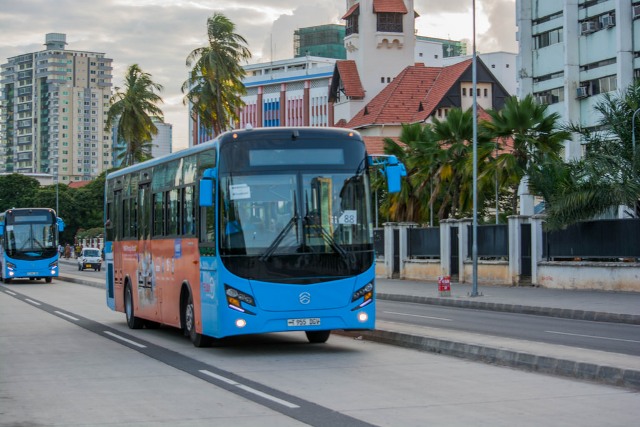
Where are the ambitious BRT buses promised to Nairobians?

Tanzania BRT Buses

Last Year in December, millions on Nairobi citizens woke up to a rude shock after the city county office moved to ban matatus from the CBD. this forced immense pressure on the already scanty pedestrian resources available such as footbridges and footpaths.

“We are in the process of acquiring the first batch of 64 BRT buses from South Africa. We are yet to establish the total amount of money we will spend on these buses but a BRT bus usually goes for Sh25 million,”

Said the Transport CS Macharia…. But that was a staggering 4 Months ago.

The Transport CS James Macharia announced the introduction of Bus Rapid Transit system where by high capacity buses would be ferrying citizens to ease congestion. 64 high capacity buses were to be acquired at a cost of 25 Million each.

Kenya Urban Roads Authority then went ahead to mark Thika Superhighway lanes that will accommodate the buses, giving Kenyans hope of the advent of the revolutionary BRT system

Fast forward 5 Months later, Nairobi is still congested with no sight of the much anticipated BRT buses. Local manufacturers who had initially pledged to have capacity to supply the buses, seem to have been sidelined with the CS claiming that they did not meet the standards to supply the High Capacity buses.

Moreover, the Transport CS has not updated Nairobians on the said BRT Buses, nor apologizing for the delay in the much needed implementation of the decongestion plans. This could lead to speculations of graft, inconsistency and false promises on the part of the Government of Kenya, being that the EU has already committed 5Billion shillings towards the project.

It is a pity to KENYANS that flagged projects are turning out to be stalled after all and only time will tell if the government is serious on keeping its promises of better costs of living.

Why Parliament’s ban on French firm could jeopardize Huduma Namba exercise

Members of Parliament have moved to ban french firm IDEMIA Securities Limited, formerly OT Morpho from doing business in Kenya, claiming that it has violated the Companies Act.

This move is a new blow likely to jeopardize government efforts in successfully registering Kenyans on the NIIMS platform therefore delaying the much hyped Huduma Namba.

Members of Parliament amended the report of the Public Accounts Committee (PAC) on accounts of the Independent Electoral and Boundaries Commission (IEBC) and concluded that the French firm be held accountable for monies it received for contracts related to the 2017 General Election.

Also according to the report, it is alleged that the company was awarded the contract whilst it was not legally registered , violating the Companies Act.

The French firm OT-Morpho was awarded a 6 billion shilling tender to supply the IEBC with voter identification kits before it rebranded to IDEMIA Securities Limited.

IDEMIA Securities Limited has however been awarded the tender to provide Huduma Namba bio-metric registration kits

However, The rate at which the company changes its names has sparked doubt and suspicion over its authenticity.

A Rwandese and Kenyan national released on Sh. 1m bond on gold fraud case

BY PRUDENCE WANZA – Two men a Rwandan and Kenyan national have been charged in court for obtaining Sh. 12m falsely to supply 100kgs of gold to one Mansour Aljabri Salem.

The two are alleged to have committed the crime between 19th March,2019 and 16th April, 2019 in Nairobi. According to the charge sheet they were paid the money in dollars, a total of 123500 US dollars and in turn supply Mr. Mansour with gold, a fact they knew to be false.

The accused, Emmanuel Ngaraguro(Rwandese) and Erasco Katiko Josiah pleaded not guilty before, Senior Resident Magistrate, Muthoni Nzibe at the Milimani Law Courts.

The prosecution however opposed the release of the first accused who is a Rwandese national sitting that he is a flight risk and might abscond court if granted bond.

In their defense led by Lawyer, Stanley Kangahi bail does not discriminate whether you are a Kenyan or foreign National and that the Rwandese national lives here in Kenya and is married to a Kenyan National and there are no chances of him absconding court.

The Magistrate ruled that the prosecution did not give reasons to deny the Rwandese national bond or bail and that every accused person has a right to be granted bond.

The two were released on a bond of Sh. 1m and an alternative cash bail of Sh. 500,000.

The case has been set for hearing on 17th July, 2019 and the mention on 8th May, 2019 for pretrial.

Mike Sonko appears before Senate for Operating without a Deputy Governor

Nairobi Governor Mike Sonko appeared before the senate committee to explain why he has no Deputy Governor.

Appearing before the senate, Mike Sonko seemed to be unbothered that he is on the wrong side of the constitution citing that the whole issue was a “non-issue”

“There is no legislation to compel me to nominate a deputy governor In the spirit of handshake I received 2 letters from NASA and communication from NASA leader when I was about to table my 2nd nominations for Deputy Governor I also received communication from Raphael Tuju”

Recently, talks had been brewing over the exclusion of Nairobi from the county government system, alleging that it is a “super-county” being a capital city.

According to the constitution of Kenya, Section 180, regarding The Election of a Governor and a Deputy Governor, The Independent Electoral and Boundaries Commission shall not conduct a separate election for the deputy governor but shall declare the candidate nominated by the person who is elected county governor to have been elected as the deputy governor.

Mike Sonko had initially nominated Miguna Miguna for the position, but was then allegedly rejected by the Senate, and later ridiculed by members of the public.

President Kenyatta mourns former KRA Commissioner General John Munge

President Uhuru Kenyatta has mourned Mr. John Paul Munge, describing him as a committed Kenyan who was always ready to use his professional skills to contribute to nation building.

Mr. Munge, a former Commissioner General of Kenya Revenue Authority (KRA), passed on while undergoing treatment in a Nairobi hospital.

In his condolence message to the family, relatives and friends of the late Munge, President Kenyatta said the country has lost a patriot who served Kenyans with integrity.

“John Munge was a great Kenyan who was committed to the betterment of the country through hard work and dedication,” said the President.

The President said Mr. Munge will be remembered as one of the pioneer Kenyan stockbrokers, having been a founding partner of the Shah Munge and Partners Stock Brokers, one of the original brokers at the Nairobi Securities Exchange (NSE).

President Kenyatta prayed to God to comfort the family at this difficult period of mourning.

Archbishop Muheria Cautions Youth Over Betting, Living Large

BY FAITH MUTETE – Archbishop Anthony Muheria of the Catholic Diocese of Nyeri leads worshippers during the way of the Cross last Friday. Muheria has said the Church will endeavour to walk with the youth as they grapple with the modern day challenges triggered by the social media emergence, alcoholism, drug abuse and joblessness.

He urged the youth to stop the notion of instant riches, adding that only hard work can guarantee financial success. The archbishop said he was appalled by the betting addiction which he says was destroying Kenyan youth. He urged university students to exercise caution in their social lives, saying many are getting entangled in dangerous cartels in pursuit of extravagant lives beyond the financial means of parents and guardians.

Muheria however said all was not lost, adding that there is time to deal with the youth challenges before they become a crisis.
“The youth problems transcend race, tribe, county, rich, poor. It’s a problem we must confront and deal with firmly” Muheria said.
He was speaking to Uzalendo News in a question and answer interview of various issues facing the youth especially University students.

Two weeks ago a medical student Ivy Wangechi was brutally murdered by an admirer turned stalker right outside Moi Referral Hospital in Eldoret.

Archbishop Anthony Muheria Speech on Easter Weekend

My dear Christians of Nyeri,
My dear Daughters and Sons in Christ,
Christ has Risen! Alleluia Alleluia!!

“And suddenly there was a violent earthquake, for an angel of the Lord, descending from heaven, came and rolled away the stone and sat on it. His face was like lightning, his robe white as snow. The guards were so shaken by fear of him that they were like dead men. But the angel spoke; and he said to the women, ‘There is no need for you to be afraid. I know you are looking for Jesus, who was crucified. He is not here, for he has risen, as he said he would. Come and see the place where he lay, then go quickly and tell his disciples…’ ” (Mat. 28, 2-7)

We have walked with Jesus these last forty days of Lent, making ready our souls, our
families and our Church to celebrate the Paschal mystery. We have denied ourselves and fasted, we have made efforts to perform works of mercy, we have especially tried to walk the path of repentance and conversion, in order to uproot the habits of sin in our lives.

The climax of all has been the Holy week which we lived even more intensely, constantly looking at the face of Jesus, watching his every gesture and listening to his voice, in the silence of our hearts.
Throughout this period, the Church invites us to contemplate the Face of Jesus. God the
Father wanted us to be able to see His face, in the human face of Jesus. We saw him in the little Child in Bethlehem, and even as a Child, his eyes and face spoke to us of “Love”. We were at the side of the path, as He rode to Jerusalem on a humble donkey, and there too, his eyes land on us as we watch him pass… Now we see him in his risen Glory. What word does he leave us?
“Seek His face! It is your face all Lord that I seek” (Ps. 27,8)

The Face of Jesus is beautiful to behold. But in the Holy week, that face is covered by the
evil of men. We have seen him slapped, spat on, and with the blood covering his face from the crown of thorns. Our world has covered the face of Jesus with its sins and man’s sinful acts. Today, the news we read or watch speaks mainly of the atrocious actions of the evil one. These last days especially have caused great sorrow to hear of so many cruel murders among couples, siblings, and even friends. The most cruel acts that we can only call beastly, where man has lost his humanity, and become worse than an animal. Yet God created man
in his image and likeness. His face is truly in the face of that person who has been killed or abused or mistreated. What has happened that we no longer recognize the face of Jesus?

Since we call ourselves Christian and God-fearing, we still come out to see him pass on his way to Jerusalem, singing “Hosanna”. But we really don’t want him to look at us, and when the moment comes when we are asked to choose, we cry out, ‘free “Barabbas” the thief’, and to Jesus we shout “Crucify him”. We refuse to recognize his face, as a Son of God and Messiah, because we choose evil in the place of good. Every time we involve ourselves with the evil actions of society, even when many people do it, we, like Judas, betray Jesus with a Kiss. We are pretenders and hypocrites. We have decided to recognize his face outwardly, but inwardly we have denied and betrayed him.

“Now the traitor had arranged a sign with them saying, ‘The one I kiss, he is the man.
Arrest him. So he went up to Jesus at once and said, “greetings, Rabbi, and kissed
him.” (Mat. 26, 48-49)
“Jesus said, ‘Judas are you betraying the Son of man with a kiss?’” (Lk. 22, 48)
We have seen the face of Jesus, the face of Christianity, the face of our Catholic Church
covered with the ugliness and dirt of our behavior. The terrible crimes are being done by us, Catholics and Christians; We are unfortunately deeply involved in dishonesty and corruption; we refuse to abide to the laws and always seek short cuts: Couldn’t we please try wipe this Face of Jesus like Veronica? We are involved in hideous crimes of abortion, and some of our Christian and even Catholic doctors are in the front line advocating to legalize the killing of babies: Couldn’t we make resolve to wash this face of Christ? We are the ones doing the business of betting and gambling, to feed the monster of greed, that leads
to theft and poverty; Couldn’t we try to wash this kind face of our Jesus? Our own children, our brothers and sisters, are involved in our homes and neighbors in many immoral plans, and we don’t have the courage to assist and correct them: Shouldn’t we decide to wash this
face of dear Lord that has been spat on so many times? This is Christ looking down at us from the Cross, with a Loving face, inviting us to change. His gaze and look, is one of Love and Mercy. For all these, our betrayals, our negligence and evil actions, we crucified him on good Friday. But we need not be discouraged. We should not lose hope because he is the one who comes again to seek us.

As we witnessed in Holy Thursday his love has no measure! He washes the feet of his
disciples, our feet. This is a way of revealing his merciful and loving face, in humility. His
face is hidden in humility.
“Although he was in the form of God, did not count equality to God as something to be
grasped. But he emptied himself taking the form of a slave… and he was humbler yet,
even to accepting death, death on a cross” (Phil 2, 6-8)

But the greatest news is that on Easter Sunday, He rises Glorious, full of Joy and beaming with Hope. His radiant face has replaced the disfigured face. No matter how much they try to distort the message of Christ, or seek to discredit the Church, the Glorious face of Christ will shine and overcome those who are determined to proclaim the failure of Christianity.
We must courageously proclaim the risen Lord, by showing that we can live every aspect of
our faith, and show his glorious face so needed by this rotten world. There is Hope of restoring the real Face of Christ to our world. There is Hope of sharing his Glory in heaven even if we must also pass through persecution, and have our face spat on by
others. Jesus rises with power and the soldiers tremble and fall. The evil will crumble before us, through our determination to live our Baptismal calling.

What we need is a firm Faith!
“There is no need for you to be afraid. I know you are looking for Jesus, who was
crucified. He is not here, for he has risen, as he said he would.” We must make him rise in our hearts, and in our attitudes. It is true we betrayed him. But
we must make him rise again, by washing his face and returning to his fold through a true conversion.

My dear Christians, we must decide to discover his face in the Sacraments especially the Eucharist. He waits for us to see him and experience his merciful gaze. He has humbled himself so much, so that we may not fear to approach him in the Eucharist. The Silent Face of Jesus in the Eucharist waits for you and me. Let us make time for Adoration in our parishes. Our families are the image of God. There too the face of Christ must be visible. That is why I
am insisting that we must come to the Sacrament of Matrimony to welcome Christ into our families. We can restore his face in the love and forgiveness within our families. You will manage to see the Face of Jesus in your wife or Husband, your son or daughter, your father or your mother, who deserves your love even if he or she is sinful. Wash their faces with love
and let Christ be seen.

The Church has encouraged us to reflect this year on the Theme of “Baptized and Sent”.
Pope Francis has asked us to commemorate in October the sense of Mission in the Church. What that means is that we must reveal the face of Christ to others, and teach them to listen to his voice. As Baptized persons, we have been given the mission to witness.

“He is risen, he is not here… Come and see the place where he lay, then go quickly and
tell his disciples…”
We are sent to witness with our word and with our life. That is why we must take our
Catholic faith seriously. It does not allow any holidays or moments of excuses. Often we
have really abused the name Christian and Catholic, by the things we have allowed
ourselves to be involved in. We cannot live only a part of the ten commandments, but all the commandments of the Lord. We cannot try only to live some virtues, but rather all virtues.

We cannot go back to betray Christ with a “Kiss” of deception and appearances. God knows our heart and sees our every intention. We must learn to forgive from our heart like Christ, without seeking revenge. Our people need new lessons on Gods mercy: “Be merciful as your heavenly Father is merciful”. Then we won’t witness these hate incidents…

This Easter, Christ wants the joyful “Alleluia” in the hearts of those who have realized their weaknesses like Peter, but now contrite, wish to follow him up to the end, with the risen Lord. We are sent first to our families, where we witness in Love, the joyful face of Christ.
We are sent to the society and those around us, especially the sick, poor and forgotten, so as to show the merciful face of Christ in our service. We are sent to those who still want to disfigure the face of Christ, those who don’t believe, to reveal to them, the Loving Face of our Saviour’s which looks for them: “Father forgive them for they do not know what they are doing”.

Our Mother Mary, is also the first messenger of the good news of the resurrection. She
awaited her Son’s resurrection. With faith, after the Pentecost, she confirmed and
encouraged the Apostles to go out and proclaim the Gospel of Christ, the Gospel of Love and Mercy. May she teach us to be true Apostles determined to live their Baptism. She will encourage us when we meet discouragement on our way, by proclaiming that, Christ has Conquered Sin, Evil and darkness.
“Queen of Heaven rejoice Alleluia… For the Lord is risen indeed alleluia!” I send you all my affectionate Easter Blessing.

Archbishop Anthony Muheria

Archbishop of Nyeri

Man arraigned in court for stealing from Central Police Station.

BY PRUDENCE WANZA – A man has been charged in court for stealing a motor vehicle from central police station which was being detained to be used as an exhibit.

The accused, Martin Maty Mutua pleaded not guilty to the charges claiming that the motor cycle belonged to him and the deputy OCS had authorized the release of the motor cycle.
He also faces charges resisting to be arrested and refusing to be taken finger prints.

He appeared before Chief Magistrate, Francis Andayi and was released on a bond of Ksh. 100,000 and an alternative cash bail Sh. 50,000.
The hearing of the case has been set on 4th April, 2019.

Why responsible sourcing of DRC minerals has major weak spots

Peer Schouten, Danish Institute for International Studies

The Democratic Republic of Congo (DRC) is rich in minerals such as coltan, tantalum, tin and gold. All are coveted for their widespread use in modern technologies, like semiconductors for cars and mobile phones.

These minerals are widely held to be at the heart of over two decades of conflict in eastern DRC, involving dozens of armed groups in shifting alliances. These ongoing tensions have cost the lives of over five million people. Congo’s abundant minerals are considered a root cause of the conflict because the mines out of which they come are believed to be controlled by armed groups who exploit the minerals and use the revenue to fuel their activities, earning them the label “conflict minerals”.

Because of this, responsible sourcing initiatives were born with the hope that they would increase oversight on mineral supply chains. The idea was that they would enable consumers to demand that companies account for where their minerals came from to ensure that they are conflict free.

But are minerals really at the heart of the conflict? And do responsible sourcing efforts help?

To address these questions, the Danish Institute for International Studies and the International Peace Information Service launched a report on lessons learnt from 10 years of our research on conflict minerals in the DRC.

We found that even though some armed groups rely on minerals for funding, they do not fuel conflict in eastern DRC. This is because most groups in the area fund themselves in other ways, like roadblocks. Also, responsible sourcing programmes have their flaws. They don’t always work, they have had a negative impact on artisanal miners and in some areas have led to increased insecurity.

Role of minerals

There are currently over 100 armed groups in eastern DR Congo.

About a dozen of them get significant revenue from mining. The NDC-Rénové, for instance, controls more than 100 gold mining sites in North Kivu. For such armed groups the profits involved can be a driver of their activities.

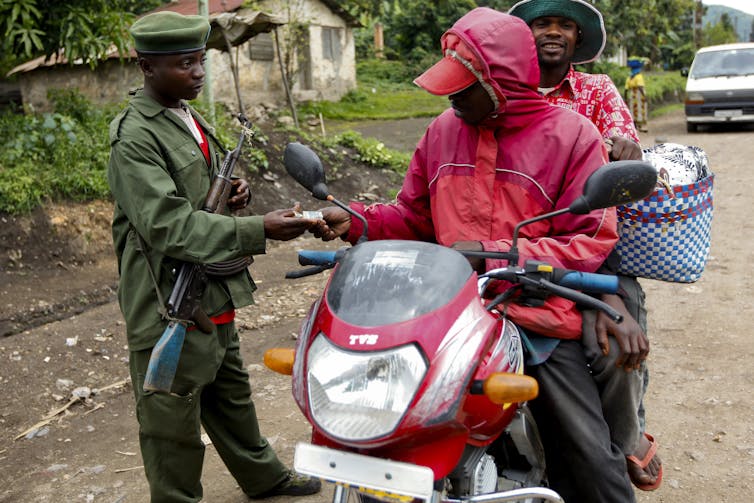
But this is a very small number of the armed groups operating in the DRC. Only a handful of them actively occupy mining sites. Instead, most rebel groups fund themselves in other ways, like taxing the local population, money from political patrons, or roadblocks on trade routes.

A soldier from a Mai Mai militia group extorts money from a passer-by at a checkpoint. EPA/DAI KUROKAWA

Our data also suggests that most armed confrontations are unrelated to control over mining sites and are instead related to other stakes – like revenge or control over strategic locations.

These findings suggest that it’s not minerals that drive the conflict, and that efforts to solve the conflict by acting on minerals fall dramatically short.

Responsible sourcing

The belief that minerals drove conflict has led to responsible sourcing programmes.

Guidelines and regulations – like the US’s Dodd Frank Act – target companies selling products which might contain “conflict minerals”. They pressure them to monitor their mineral supply chains to ensure that they don’t contribute to conflict or human rights violations.

Initiatives also target supply chains in the DRC, monitoring the origin of minerals and the human rights situation along the supply chain, to reassure downstream buyers.

These initiatives have secured an ongoing outlet for Congolese minerals. Mines covered by the programs also experienced considerably lower levels of armed interference. It seems that the higher level of scrutiny involved constitutes a deterrent for armed actors.

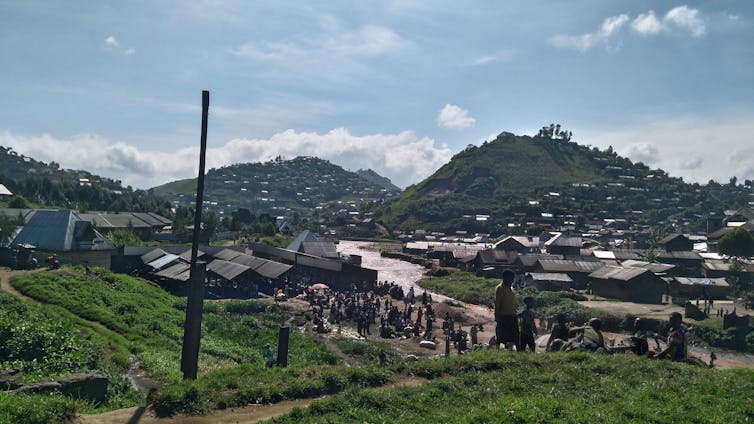
Rubaya village. Peer Schouten

But responsible sourcing – and the increased regulation it comes with – has also had unintended consequences.

One is that it’s had a negative effect on informal artisanal miners. Over one million Congolese rely on mining for their livelihood and they in turn support about five times as many people.

For instance in Rubaya, eastern Congo, after schemes were set up to trace the source and certify minerals, artisanal miners complained of rising poverty and unemployment. This is because traders – who purchase minerals from miners and sell them on – wait until they get paid for their certified minerals before paying out artisanal miners. This can take months and means that only miners who have a bit of capital can afford to keep on mining. This led to increased insecurity. Many of the artisanal miners who find themselves out of work, resort to banditry.

A second weakness is that it’s not even clear that the minerals subject to responsible sourcing or traceability programmes are actually conflict free.

Under current programmess, minerals extracted responsibly are supposed to receive a “tag” when they come out of the ground. This avoids them being mixed-up with minerals from elsewhere. But we found that this only happens in 58% of the mines covered by these programmes. In some cases, tagging only happens at a considerable distance from the mining site, because the site is difficult to access.

There’s also an issue with contamination as the very agents responsible for tagging sell tags to third parties.

These factors make it difficult to assess whether the minerals brought in are really “clean”.

This doesn’t mean we should abandon responsible sourcing initiatives. It’s a laudable idea. And although they are unlikely to resolve an armed conflict, they do rebuild consumer confidence in the DRC’s mineral production on which millions of people depend.

For responsible sourcing to be sustainable a way needs to be found to plug the loopholes, and to uplift artisanal miners.

Ken Matthysen, a researcher from the International Peace Information Service, contributed to this articleThe Conversation

Peer Schouten, Postdoctoral fellow, Danish Institute for International Studies

This article is republished from The Conversation under a Creative Commons license. Read the original article.