BY SHARON NYAWIRA – The accused,David Kombo Lucas was arraigned at the Makadara Law court for mention for being charged for causing actual bodily harm to Agnes Saumu Mbuvi .
On the 2nd of June 2019, at 2Am Agnes Saumu Mbuvi was attacked in a popular hotel called Memphis hotel near United States International University in Nairobi County,off thika road .
According to the report the gang attacked senator Loitiptip when Saumu had excused herself .
The trouble began while she was in the bathroom upon where David Kombo Lucas confronted her and pulling her blouse that allegedly tore holding her suggestively.
The gang escaped leaving the bleeding senator who was later rushed by Saumu and the cousin to Aga Khan hospital .
Saumu claims to have been hurt on her right hand as the senator gets treatment .
BY PRUDENCE WANZA – The two are alleged to have unlawfully copied and transferred privileged Safaricom subscriber’s data information from Safaricom company database to unauthorized person to one Charles Njuguna Kimani.
They also face a charge of demanding money by menace where being employees of Safaricom they demanded Sh. 300 Million from Safaricom Kenya limited with intent to steal.
They are alleged to have committed the offences between 1st May, 2019 and 7th June, 2019 at Safaricom offices in westlands, Nairobi.
The two, Simon Billy Kinuthia and Brian Njoroge Wamatu denied the charges before Chief Magistrate Francis Andayi at Milimani Law Courts.
The prosecution made an application for the accused persons to be reporting to DCI serious crimes unit two times a week.
However according to their lawyer reporting twice a week is not necessary but once a week will enable the completion of investigations. He also cited that they are employees of Safaricom and their jobs will be at stake if they do not report to work in the next 48 hours.
Chief Magistrate Francis Andayi ruled that they report to DCI once a week and be held at Muthaiga Police Station for six hours.
They will however be released upon payment of Sh. 1million cash bail.
The hearing of the case will be on 16 th July 2019
Over the recent days, deputy president William Ruto has intensified his ‘campaign’ (though he never really likes to say he is campaigning) all around the country, by engaging with the common mwananchi, doing ‘common’ things
The deputy president has so far eaten roast maize with his hustling Kenyans, bought Ngoma shoes from his fellow hustlers and most recently seen eating chai, mandazi with fellow Kenyans.
Although this may be seen by most Kenyans as a normal gesture of a deputy president interacting with his fellow citizens, pundits have insisted that this humble gestures may just be what the leader is after, to ensure that he secures the common mwananchi vote cum 2022.
“I think what the Deputy president is doing is trying to win back the common Mwananchi that is utterly intrigued by any political figure reaching out to the grass root level,” Paul, A business man in Nairobi
Or maybe he is just being a non official deputy president warming up to his fellow hustlers. Who knows…
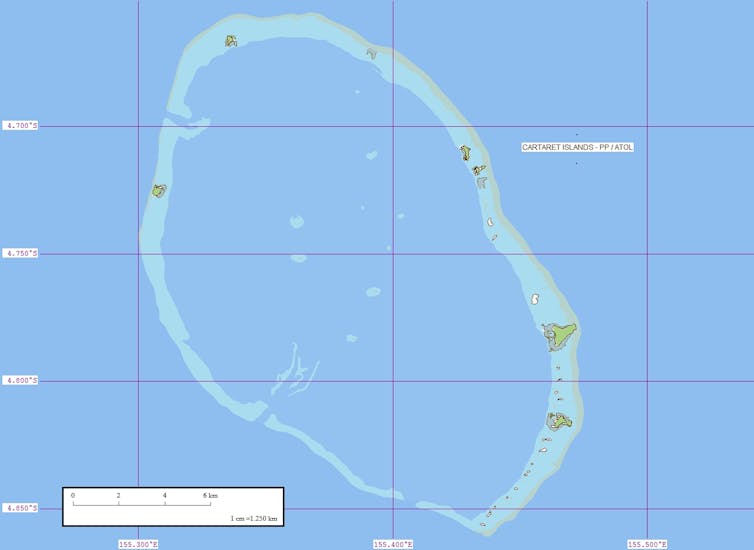
Climate change is expected to have a striking impact on vulnerable communities, especially in coastal regions where sea-level rise and increased climatic events will make it impossible for some people to remain on their land.
Since 1994, the islanders of the seven atolls, lying only 1.2 metres above sea level, have already lost about 50 per cent of their land. Traditional food sources have become scarce, regularly placing the islanders in situations of near famine. The communities also face severe water shortages due to prolonged droughts and sea-level rises that affect their freshwater supply.
The Carteret Islands make up a low-lying atoll in the South Pacific Ocean.Mr Minton/flickr, CC BY
Fourteen years later, the islanders are still struggling, and their struggles have become emblematic of the international community’s lack of consideration for climate injustice. My research and recording of their story informs us on the realities of climate change, the consequences of our way of life and the political construction of climate vulnerability.
Political struggles
The Carteret islanders’ situation can be partly explained by political struggles. The recent civil war (1988-1998) has blurred the separation of powers between the Autonomous Region of Bougainville, which governs the islands, and the Papua New Guinea central government. With the country’s complex societal structure — based on clans, tribes and ethnic links — and rampant corruption, the provincial and national states have been incapable of addressing the plight of Carteret islanders.
The political and social structures are sources of conflict among civil servants in Papua New Guinea, generating friction and “malfeasance” in the administrations and ultimately hindering the relocation process because of poor governance.
In a 2018 interview, Tracy Mann, director of the international NGO Climate Wise Women, said: “There has never been, nor do I expect in the near future, any government will to support real relocation for the Carteret Islands.”
The autonomous government did make a few relocation attempts in 1984 and 1997, but poor planning and a lack of resources contributed to their failure. Local communities now have little trust in their governments, which they perceive as an “alien external force.” Most political authority lies with the Council of Elders, an official local governing authority in Papua New Guinea.
Fed up with waiting, the Council of Elders created a local NGO, Tulele Peisa (“Sailing the waves on our own”), in 2007 with the aim to overcome the state’s inability to protect them.
Overcoming political marginalisation
In 2009, Tulele Peisa released a plan to relocate 1,700 islanders to Bougainville Island, some 83 kilometres from the Carteret Islands. But political, financial and land-related issues have hindered their progress. The project could cost an estimated US$5.3 million, and with limited help from the provincial and federal governments, Tulele Peisa is struggling.
“You have a bunch of Melanesian politicians who don’t really care all that much about the islanders, with a culture of corruption, a limited land base, and you see that it’s a lot of obstacles in the way of viable resettlement,” Scott Leckie, founder and director of the Geneva-based NGO Displacement Solutions and one of Tulele Peisa’s international partners, told me in 2018.
“The sad brutal truth of this situation: it is hard, it is expensive and it is daunting,” he said.
Ursula Rakova, leader of Tulele Peisa, speaks about the disruption of climate change and the Carteret Islands resettlement program.
Adding to a difficult political situation is the challenge of finding land in the Pacific Ocean. Not only is it limited, but customary ownership is prominent in the region — up to 97 per cent of the land in Papua New Guinea can’t be bought or sold.
Tulele Peisa has secured 81 hectares (0.81 square kilometres), a gift of four abandoned plantations from the Catholic Church of Bougainville, but it still needs another 1,400 hectares (14 square kilometres). As of 2018, Tulele Peisa has built eight houses on Bougainville Island, and rehabilitated 14 family parcels with cocoa and coconuts trees.
As they race against the climate change clock, the question now is: Will they be able to finish their planned relocation in time?
Better climate change governance
This story of resilience and determination highlights the specific challenges facing Pacific nations in their fight against climate change and their possible migrations. As this case illustrates, the difficulties arising from political struggles and state weakness have a real impact on the unfolding of planned relocation.
Before speaking of climate refugees, it is important we understand the challenges these vulnerable communities are facing. Far from wishing to seek asylum elsewhere, they are fighting for their land.
We need to question the efficacy of the international system and of domestic governance in granting them the level of dignity and resilience they deserve. Decision-makers and organizations must learn that the consequences of climate change are deeply human.
Mindfulness, it seems everybody’s doing it. You might have even tried it yourself – or have a regular practice. Thanks to the help of an app on your phone that speaks to you in dulcet tones, you are reminded to “let go” and to “observe your breath”. From the public education to healthcare, the corporate world to the criminal justice system, parliament to the military, mindfulness is promoted as a cure all for modern ills.
Yet the evidence for the efficacy of mindfulness is not strong. In an article published in Perspectives on Psychological Science, a number of psychologists and cognitive scientists warn that despite the hype, scientific data on mindfulness is limited. They caution:
Misinformation and poor methodology associated with past studies of mindfulness may lead public consumers to be harmed, misled, and disappointed.
Studies on mindfulness are known for their numerous methodological and conceptual problems. This includes small sample sizes, lack of control groups, and insufficient use of valid measures.
To this list, the possibility of competing interests can also be added. In a recent example, the mega-journal PLOS ONE retracted a meta-analysis on mindfulness after concerns were raised over the methodology behind the results, including “double counting” and “incorrect effect estimates”. The PLOS retraction also cited undeclared financial conflicts of interest by the authors. The journal noted that none of the authors agreed with the retraction.
Despite these issues, mindfulness has never been more popular and its influence in mainstream culture is massive, as can be seen in the creation of a new professorship in mindfulness and psychological science at the University of Oxford.
The position was created by the Oxford Mindfulness Centre, which became affiliated with the university’s Department of Psychiatry in 2011, after initially establishing as a private company in 2007 and later registering as a charity. It has since become a key player in shaping both the academic studies of mindfulness and the public’s perception of the practice.
A brief history of mindfulness
Mindfulness is a type of meditation derived from the Buddhist tradition. It encourages the observation of present thoughts, emotions and bodily sensations in a non-judgemental way. But how did it gain such prominence in Western mainstream culture?
For a start, the modern concept of Buddhism that Westerners relate to today did not exist a century ago. This new style of Buddhism is known as “Buddhist Modernism”, or “Protestant Buddhism” – a reform movement of the late 19th century.
This form of Buddhism was developed as a result of the influence of Christian missionaries and to the colonialism and imperialism of South-East Asia by European nations. To respond to their colonial situation, the elite of the movement reshaped Buddhism by aligning it to Western science and philosophy. This was done by representing Buddhism as rational, universal and compatible with science – with an emphasis placed upon meditation and personal reflection.
The advocates of this reform projected modern Western values onto Buddhist teachings who claimed to teach the “pure” Buddhism as taught by the historical Buddha himself.
Mindfulness is being sold to us and we are buying it.Shutterstock
Contemporary meditation teachers, including Jon Kabat-Zinn (JKZ), the founder of Mindfulness-based Stress Reduction(MBSR) – an eight-week programme that offers mindfulness training to help people with stress and pain – inherited and popularised this version of Buddhism.
When pressed about the Buddhist elements of their courses, teachers such as JKZ argue the technique is not Buddhist, but the “essence” of the Buddha’s teachings. These are said to be “universal” and compatible with science. Or as JKZ has put it, “the Buddha himself was not a Buddhist”.
These associations with Buddhism allows advocates of mindfulness to relish the legitimacy associated with the historical Buddha – yet at the same time avoid any undesired “religious” connotations. Likewise, when mindfulness is declared as “universal” then it seems to be less about Buddhism and more about a “basic human ability”.
The idea that mindfulness is secular because it is scientifically tested is a common strategy used by advocates of mindfulness to disassociate the practice from its religious foundation and to promote it in clinical and educational settings.
It is well documented that JKZ intentionally downplayed the Buddhist roots of mindfulness to introduce it in clinical settings. In JKZ’s own words, he “bent over backward to structure it [MBSR] and find ways to speak about it that avoided as much as possible the risk of it being seen as Buddhist”. In essence then he translated Buddhist ideas into scientific and secular language.
This approach takes advantage of the authority of science in modern Western cultures as well as the perceived opposition of “science” with “religion”. And by aligning mindfulness with science, its opposition to “religion” is implicitly conveyed.
Legitimatising mindfulness
Appealing to science and empirical studies are not the only methods that mindfulness leaders have used to lend explicit legitimacy to mindfulness.
The flourish of MA and PhD programmes, specific journals, conferences, university affiliated research centres – and now the professorship – demonstrate the movement’s efforts to legitimise and secure the future of mindfulness as an academic enterprise.
But although mindfulness claims to offer a staggering collection of possible health benefits – and aligns itself with science and academia to be seen as credible – as yet there is remarkably little scientific evidence backing it up.
That’s not to say a lot of people don’t find it beneficial. Indeed, many people practice mindfulness everyday and feel it helps them in their lives. The problem is though that there is still a lot researchers do not know about mindfulness – and ultimately the field needs a much more systematic and rigorous approach to be able to support such claims.
BY UZALENDO NEWS TEAM – Veteran Journalist Mohammed Juma Njuguna became an instant hit in the Kenya during the Presidential elections of 2002.
Then, Mwai Kibaki of NARC and Uhuru Kenyatta of KANU were squaring it out for the Presidency.
The challenge then was that there were wide spread fears that KANU planned to rig the election in favour of Uhuru.
And so NARC used the Citizen Media group and specifically Juma to collate and announce unofficial results.
Historians agree that Kibaki won the election hands down… but the armtwisting tactics utilised by NARC bordered on an election offence.
The Late Mohammed Juma in his earlier days | Photo Courtesy
The Media siege on KANU and Uhuru forced him to accept defeat long before the final tally was known.
When Kibaki was sworn in as President, Juma Njuguna became an instant celebrity, with uninterrupted access to State House and Parliament.
Give it to him. Juma Njuguna was a talented Radio man who horned his skills at the Kenya Broadcasting Corporation(KBC).
As he was interred on Sunday at Kariokor Cemetary, non of those artificial political friends attended his funeral.
BY ABEDNEGO MBUA – Hawk eyed DCI detectives yesterday busted a counterfeit syndicate involving at least ten foreigners.
The crooks are led by two Pakistani nationals; a notorious 26-year-old Abas Mazammil and 24-year-old Ali Sheraz. The duo were nabbed on Friday afternoon arrested along Westlands Road by a joint team of DCI detectives from Parklands and Anti Counterfeit Agency Inspectors.
The operation was made possible by spot, intelligence…provided by anti cover detectives. The suspects were found in possession of several assorted counterfeits; HP Laser Jet toner cartridges, Samsung toner cartridges and Canon cartridges, all valued at over Kshs. 75 Million. Also confiscated were; Pedal plastic sealing machine compressor, Printing machine cartridge body label, Hot melt glue gun, Counterfeit HP security seals, Empty flat boxes labeled ‘HP laser jets’ and Empty bubble bags. The suspects have been placed in lawful custody awaiting arraignment in court on Monday. All the confiscated goods kept as exhibits.
BY PRUDENCE WANZA – A nominated Member of County Assembly from Nyandarua County has sued nominated MP Maina Kamanda over a one year child upkeep.
Under a certificate of urgency filed at Children’s Court in Milimani Law Courts, the woman is seeking for Maina Kamanda to provide maintenance of the child by paying Sh. 220,000 per month.
She says the nominated MP is the biological father of the baby. The woman claims she has been providing for the minor without the assistance of Kamanda. She says she is financially constraint by the cost of maintaining the minor.
The woman has filed a supporting affidavit listing the monthly expenditure she wants the MP to provide. She accuses the MP of neglecting his parental responsibility and she caters for the minor’s needs single-handedly without his assistance.
PRESS STATEMENT – As you are aware the State Department of Labour is one of the implementing agencies of Kenya Youth Employment and Opportunities Project (KYEOP). The SDL is implementing Component 3- which aims at ‘Improving Labour Market Information’. To enable informed decisions pertaining to the labour market by all stakeholders.
This Component responds to the problem of obtaining timely information about labor demand and supply, as well as career prospects in Kenya. According to the Kenya National Bureau of Statistics(KNBS), the informal sector is currently generating most of the employment opportunities in the economy at over 80 per cent of the total job opening.
The Informal Sector Skills and Occupations Survey (ISSOS) is being undertaken to obtain data about the profile of skills and occupations prevalent in the informal sector. This information is aimed at assisting the project achieve its objective of improving employment opportunities for the targeted youth in the short term and to provide data that can career paths and also inform policy making in the long term.
As you all know, today we are now embarking on the final and critical phase which is data collection. This has been preceded by several preparatory activities that took place from 2017 to date between State Department of Labour and The KNBS of which Listing activity you had just completed almost two months ago. The Listing exercise provided a ground on which sampled Households and Establishments to be visited after this training were drawn
Allow me congratulate you for being chosen to be part of the data collection team. This opportunity comes with responsibility and a lot of expectation from you in terms of upholding the integrity of the data. Quality data will provide quality information upon analysis and this is what we expect from your teams.
This survey is a national activity and is being carried out in all the forty seven counties. As you embark on the exercise, you and the research assistants that you will be supervising represent not only the Ministry of Labour and Social Protection but the government of Kenya at large. Your conduct during the survey is of paramount importance and should reflect the contents of Chapter Six of the Constitution of Kenya on how Public Officers should conduct themselves.
I have been fully briefed on the instruments of the survey on which you will be collecting data which are:-
The Household member listing form;
Household business listing form;
Enterprise Questionnaire; and
Employee Questionnaire
I take note of the challenges of an exercise of this scale but I have the confidence that to have been chosen and been involved to this point in the life of the activity, you can measure up to these challenges and will be able to deliver.
Last but not least, I wish to thank the KNBS especially members of the technical design team for their continued support during the design and implementation of the Survey.
Finally, may I take this opportunity to officially kick start the exercise.
Curious Kids is a series for children in which we ask experts to answer questions from kids.
How big is the Milky Way? (Storm, 6, Kenya)
The Milky Way is the galaxy we live in. A galaxy is a system of millions or billions of stars. They’re all mixed together with gas and dust, and the whole lot is held together by gravity. As far as astronomers like me can tell, there are about one hundred billion galaxies in our Universe. There may be more that we just haven’t been able to observe yet.
The Milky Way contains between 100 and 400 billion stars. One of these is our Sun, which looks huge to us here on the ground, but is not even one of the biggest in the Milky Way.
And the Milky Way is also nowhere near being the largest of the galaxies we know about. But before I tell you how we know that, I need to explain a bit more about the Milky Way itself and how we measure something that’s just so incredibly big.
Shaped like a Frisbee
The Milky Way is shaped a bit like a Frisbee, with a bulge in the middle. This “space Frisbee” is really big: the diameter – the distance from one edge to the other – is a billion billion kilometres.
Our galaxy is the same shape as this dog’s Frisbee.Shutterstock
It’s hard to deal with numbers that big. So astronomers often use “light years” instead of kilometres to measure really big distances like the size of galaxies. A light year is the distance light would travel in a year. Light zips through space at 300 000 kilometres per second, so this makes the Milky Way just over 100 000 light years across.
But it’s also tough to imagine something that big. So let’s think about it another way to help put it in perspective.
If we shrank our whole solar system down to the size of a grain of sand, the diameter of the Milky Way would be about 50 kilometres.
This image shows the star-studded centre of the Milky Way towards the constellation of Sagittarius.NASA, ESA, and G. Brammer
The thickness of the Milky Way’s disk depends on where you are in the galaxy. It’s thicker nearer the centre and gets thinner as you move out towards the edge. But on average it is 1000 light years thick.
The stars in the Milky Way aren’t uniformly distributed in the disk, instead they are arranged in spiral arms stretched out from the bulge in the centre. The Earth is found in one of these spiral arms, about two thirds of the way out from the middle of the galaxy.
Big, but not the biggest
Now that you know all of these things, you’ll probably be wondering about the answer to your original question: just how big is the Milky Way?
Well, it’s actually quite hard to measure the exact size of the Milky Way from within it (which is where we are!) and scientists are always trying to improve these measurements. In fact a new study last year found that the stars at the edge of the Milky Way disk might be twice as far from the centre as we’d previously thought.
And, as I said earlier, while the Milky Way is big, it’s far from being the largest galaxy in space. Our nearest neighbour is the Andromeda Galaxy, which spans 220 000 light years. That makes it over twice as big as the Milky Way.
But they would both be dwarfed by the galaxy IC 1101, one of the largest known galaxies. It stretches across 4 million light years.
So our galaxy is big. But it’s still tiny compared with our neighbouring galaxies. There’s also lots and lots and lots we still don’t know about, which is why life as an astronomer is so exciting.
Hello, curious kids! Have you got a question you’d like an expert to answer? Ask an adult to send your question to africa-curiouskids@theconversation.com. Please tell us your name, age, and which city you live in. We won’t be able to answer every question but we will do our best.




















How Mohammed Juma Njuguna bullied KANU to concede defeat in 2002
BY UZALENDO NEWS TEAM – Veteran Journalist Mohammed Juma Njuguna became an instant hit in the Kenya during the Presidential elections of 2002.
Then, Mwai Kibaki of NARC and Uhuru Kenyatta of KANU were squaring it out for the Presidency.
The challenge then was that there were wide spread fears that KANU planned to rig the election in favour of Uhuru.
And so NARC used the Citizen Media group and specifically Juma to collate and announce unofficial results.
Historians agree that Kibaki won the election hands down… but the armtwisting tactics utilised by NARC bordered on an election offence.
The Media siege on KANU and Uhuru forced him to accept defeat long before the final tally was known.
When Kibaki was sworn in as President, Juma Njuguna became an instant celebrity, with uninterrupted access to State House and Parliament.
Give it to him. Juma Njuguna was a talented Radio man who horned his skills at the Kenya Broadcasting Corporation(KBC).
As he was interred on Sunday at Kariokor Cemetary, non of those artificial political friends attended his funeral.