Sponsored Ad

Ad 1
Ad 2
Ad 3
Ad 4
Ad 5
Ad 6
30.8 C
Kenya
Sunday, April 26, 2026
Home Blog Page 6087

Fives ways that reading with children helps their education

Story time. Moneky Business Images/Shutterstock Emma Vardy, Coventry University

For book lovers, reading to their children may seem obvious. Why would they not want to pass on their love of literature? However, researchers have shown there are more benefits for both adult and child that come with reading than just building a bond – particularly when it comes to education.

A lot of research has been done into the effects of children engaging with literacy related activities at home. Much of this focuses on the early years, and how the literacy environment helps to develop emergent literacy skills. Shared book reading early on stimulates language and reading development, for example.

But the home literacy environment doesn’t stop being important once children have learnt to read. The opportunities that a child has to read at the home, and parental beliefs and behaviours, continue to impact on children’s reading throughout the school years. Here are just five ways that reading with your child can help their general education.

1. It opens up new worlds

Reading together as a family can instil a love of books from an early age. By taking the time to turn the pages together, adults can help children see that reading is something to enjoy and not a chore. Some schoolchildren read because they like it but others do it because they will be rewarded – with stickers in a school reading diary for example. Those children who read because they enjoy it read more books, and read more widely too. So giving your child a love of books helps expand their horizons.

2. It can build confidence

Children judge their own ability to read from observing their classroom peers, and from conversations with parents and teachers. When sharing a book, and giving positive feedback, parents can help children develop what is known as self-efficacy – a perceived ability to complete the specific activity at hand. Self-efficacy has been shown to be important for word reading. Children who think they cannot read will be less inclined to try, but by using targeted praise while reading together, parents can help children develop belief in their own skills.

3. It can build positive reading attitudes

Studies have shown that the more opportunities a child has to engage with literacy based activities at home, the more positive their reading attitudes tend to be. Children are more likely to read in their leisure time if there is another member of the family that reads, creating a reading community the child feels they belong to. Parental beliefs and actions are related to children’s own motivations to read, though of course it is likely that this relationship is bidirectional –- parents are more likely to suggest reading activities if they know that their child has enjoyed them in the past.

Sharing an old favourite. VGstockstudio/Shutterstock

4. It expands their language

When reading a book together, children are exposed to a wide range of language. In the early stages of literacy development this is extremely important. Good language development is the foundation to literacy development after all, and increased language exposure is one of the fundamental benefits of shared book reading.

Shared book reading early on can have a long-term benefit by increasing vocabulary skills. And if they encounter a word they don’t understand, they have a grown up on hand to explain it to them in a way that makes sense to them. When children are taught to read while sharing a book, it can improve alphabet knowledge, decoding skills, spelling, and other book-related knowledge (such as how to actually read a book). Doing something as simple as sounding out the letters of a word they do not understand can vastly improve a child’s skills.

5. It can help their speech and language awareness

Formal shared reading can also involve the use of intonation, rhythm and pauses to model what is known as prosody. This is not a skill that is directly taught, but by simply pausing when needed or changing the tone of your voice can help children develop fluency when reading aloud. This is one of the reasons that shared book reading is not just for pre-schoolers. Demonstrating what is involved in reading complex text aloud fluently is very valuable for children of all ages.

You don’t need a lot of money, or even hours of spare time to read with children. Even small efforts can have big benefits. Nor does it have to be just at bedtime. Sharing a book, a magazine or a comic can take place any time of the day.

The most important thing to remember is to have fun. Interest in reading emerges from enjoying it with a parent. If you’re interested and make an effort, it can have a huge impact on a child’s engagement with reading.The Conversation

Emma Vardy, Research Associate, Psychology of Education, Coventry University

This article is republished from The Conversation under a Creative Commons license. Read the original article.

Uganda President jets in the country to inspect Lamu Port

Ugandan President Yoweri Kaguta Museveni was accorded an elaborate State reception by his host President Uhuru Kenyatta who received him at the Moi International Airport in the Coastal City of Mombasa at the start of his two-day State Visit.

The visiting Ugandan President received a 21-gun salute, a ceremony traditionally reserved for Heads of State and Government, which was preceded by the national anthems of Uganda, Kenya and the East African Community played by the Kenya Navy band.

Also at the airport to receive President Museveni were Deputy President William Ruto, Mombasa Governor Ali Hassan Joho and Foreign Affairs Cabinet Secretary Monica Juma among other senior officials of the Government of Kenya.

Uganda President Yoweri Museveni and Uhuru Kenyatta at Moi International Airport | PSCU


Thereafter, President Museveni inspected a colourful guard of honour mounted by a detachment of the Kenya Navy before heading to State House, Mombasa, for a tête-à-tête with his host President Kenyatta followed by bilateral talks.

After the bilateral talks, the two Heads of State will then attend a business forum before President Kenyatta hosts his visitor at State Banquet later in the afternoon.

President Kenyatta and President Museveni will tour the Port of Mombasa which is a major gateway for Uganda, Rwanda, Burundi and DRC imports and exports.

Poor coverage of floods in southern Africa? Blame the media bosses

A woman searches for materials to rebuild her home after the passage of Cyclone Idai, in Beira City, central Mozambique. EPA-EFE/Tiago Petinga Glenda Daniels, University of the Witwatersrand

South African media has been criticised on social media for its initially superficial and underwhelming coverage of the massive floods in Mozambique, Zimbabwe and Malawi in the wake of the devastating Tropical Cyclone Idai. Serious news consumers had to rely on foreign news sources instead of local media as the grim picture of the destruction – which included hundreds of deaths, flooding, disease and havoc to resources and infrastructure – started emerging.

In my view the criticism is valid. The coverage of the floods by South African media has been poor. In fact, I’ve hardly seen a local journalist’s face from on the scene coverage.

Based on my experience of newsrooms, plus my research and as former co-ordinator/author of the annual State of the Newsroom report as well as presently co-ordinator of the Job Losses/New Beats project in South Africa – its clear that this is due to the fact that local newsrooms have been depleted of journalists. This, in turn, is because the media companies have not handled the transition to digitisation well.

But are journalists to blame? I would argue that people should scrutinise media companies rather than blame the profession. Those who criticise journalists tend to conflate media companies and the individuals who are the work horses in the newsroom. They are not the same thing.

This is happening all over the world where companies are clumsy in how they are handling the transition to digital. It’s a disaster for democracy because the experience of trained journalists is lost and we have little context in reporting on events such as natural disasters as well as elections. You find that younger journalists don’t have mentors to help them through reporting. Media companies are looking for profits by cutting the experienced journalists salaries and employing those who they can pay less.

What this shows is that traditional media is dying. It is also not fulfilling its mandate to be informative, to provide the facts and serve the public.

What’s gone wrong

Newsrooms have mainly “content producers” who know techy stuff like video uploads and mobile journalism. Podcasts are good, but even there you need journalists who can ask the pertinent questions and do good intros and angles with context.

Editors are increasingly demanding that journalists stay indoors in the newsrooms so that they can do desk work to fill pages with content rather than to travel out on a breaking story. The main reason cited for this is that there isn’t budget set aside for travel, which would include flights to Mozambique, Zimbabwe and Malawi as well as accommodation and food.

Another factor is that newsrooms have turned into “content producers”, made up of people who have technical capabilities such as producing videos and podcasts.

The third factor is that newsrooms have been shrinking at an alarming rate. Conservative estimates in research to be published later this year show that South African newsrooms have shrunk by about half in the past decade. In 2007 there were about 10 000 journalists. Now there are about 5 000.

South Africa fits very much with the developed world global pattern of job losses in the traditional media sector. The losses are mainly in the senior category of journalists (40-60 year olds). In other words, those who are experienced.

The age-old practice of having journalists who are specialists – they write about specific fields such as science and education, also known as beat reporters – have all but disappeared. Other layers that have been removed from newsrooms included those responsible for editing articles and fact checking for accuracy. This explains the spike in mistakes in newspapers as well as online publications.

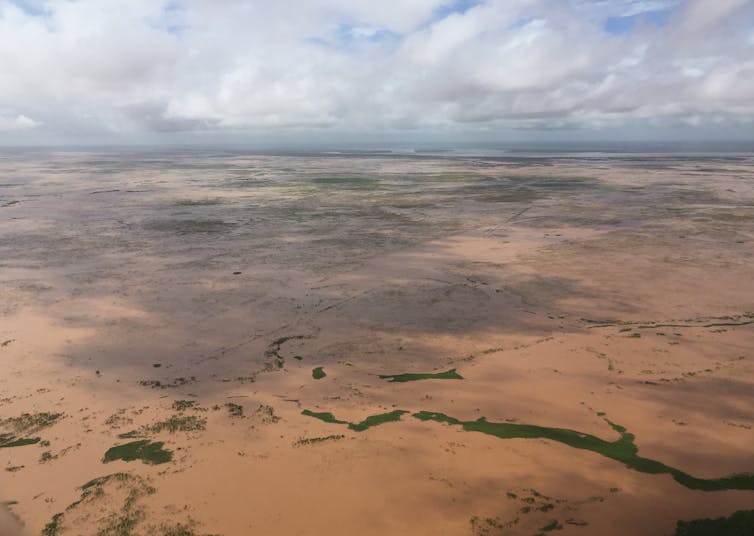
An aerial view shows damage from the flood waters after cyclone Idai made landfall in Sofala Province, Central Mozambique, 21 March 2019. EPA-EFE/Emidio Jozine

The issue of resources is a particularly big challenge when disasters are being covered. For example, it’s also not possible simply to send one person. At the very least a team of two is needed – a camera person or photographer and a journalist. And resources and backup are needed for natural disasters, especially of this scale – and journalists just do not get this support.

The role of social media

Social media is partly filling the gap left by traditional media. But not completely. It’s also an arena for misinformation, malinformation (disinformation with malicious intent) propaganda and general falsehoods.

On top of this there’s a great deal of hatred on social media. The latest and most worrying is cyber misogyny and the trolling and vilification of women, especially women journalists who are prominent, those who speak out and investigate corruption.

There are no checks and verification on social media. Anyone can post anything – unfiltered. Anyone can believe anything. Right wing movements and populism are growing – enabled by social media. Not because of social media but enabled by – these types are able to connect with each other and discuss strategies on how to kill, for example.

It’s contrary to what we all thought 10 years ago, that social media would act as the equaliser, the leveller – everyone would have access. In fact, what has happened is that the promise of cheap broadband has not been rolled out, nor does everyone have a smart phone to be engaging in debates and discussions.

Social media has become more of a divider between rich and poor than ever. It’s also a platform for great divisiveness.

This is a disaster for democracy. The government needs to act swiftly to roll out cheap data, and regulate social media. Trolls need to be eliminated and finally, if media companies don’t press the pause button to reflect on what they are doing, especially their bull in a china shop retrenchments, this is going to cost South Africa’s democracy dearly.

The New Beats is an international research project based in Melbourne.The Conversation

Glenda Daniels, Associate Professor in Media Studies, University of the Witwatersrand

This article is republished from The Conversation under a Creative Commons license. Read the original article.

The death rate for mothers having C-sections is 50 times higher in Africa

Maternal mortality is much higher in Africa than in high-income countries. Shutterstock Bruce M Biccard, University of Cape Town

The in-hospital maternal mortality rate following a Caesarean delivery in Africa may be 50 times higher than in high-income countries. These were the findings of the African Surgical Outcomes Study that followed more than 3500 mothers from 22 African countries during a week of surgery in 2016.

The study found that maternal mortality rate was 5.43 per 1 000 operations, compared to 0.1 per 1000 operations in the UK. And one in six women developed complications following Caesarean delivery, which is nearly three times the rate in the US. Bleeding in the period shortly before, during, and immediately after giving birth, was the most common complication. And it had the highest attributable risk for maternal mortality.

Although the complication rate was three times that of a high-income country, mortality was 50 times that of a high-income country. This suggests that a lot more complications result in death in Africa. When a complication results in death, this is known as “failure to rescue”. Mothers in Africa appear to be particularly susceptible to it, when compared to high-income countries.

Unfortunately, it isn’t only the mothers who are suffering in Africa. The in-hospital mortality of babies after Caesarean delivery was double that of high-income countries. There were indicators that the risk of subsequent cerebral palsy or epilepsy for the babies who survived Caesarean delivery, are between two and 11 times higher in Africa when compared to a high-income country.

These findings tell a sad story of life in Africa. Many families are incomplete, as a result of either a mother or child who died in childbirth, and for those children who survive a Caesarean delivery, a number of them will have long-term morbidity.

So what can be done to improve this situation? Unfortunately, there will be no “quick-fix”, as this is a complex, multifactorial problem. It speaks to a number of problems that need to addressed in Africa, if we are to improve outcomes for mothers and their children.

Where the problems lie

The first problem is poor access to Caesarean deliveries. In Africa, the Caesarean section rate is too low. There is a minimum threshold of the number of Caesarean sections per population to ensure optimal obstetric care. Most countries in Africa don’t reach this threshold. The result is that many mothers who would benefit from Caesarean section don’t have this option.

Secondly, access to surgical care is limited. This is reflected in the observation that 3 out of 4 mothers presenting for Caesarean deliveries present as emergencies. This may partly reflect the limitations in the current antenatal services available.

The role of antenatal care is to monitor and identify both mothers and babies at risk. Early identification of those at risk could result in an elective Caesarean section in a more controlled environment. This, in turn, would lead to better outcomes for the mother and the baby.

But it appears that in the current antenatal environment in Africa a number of mothers at risk aren’t identified early enough in the community.

Another contributing factor is that there are limited skilled human resources to provide safe obstetric care in Africa. It’s generally accepted that to provide a safe Caesarean section, at least 20 specialists (obstetricians, surgeons and anaesthetists) are required per 100 000 population. In the African cohort it was found to be <1 specialist per 100 000 population.

This creates a stressful and dangerous working environment. The majority of mothers are sick and present as emergencies, yet there is insufficient skilled staff to deal with the workload.

Finally, it’s clear that mothers are dying predominantly secondary to bleeding around the time of delivery. This may be for many reasons; bleeding may not be identified early enough (both before and after surgery) due to limited human resources (resulting in “failure to rescue”). This could also be due to insufficient resources, such as limited drugs to stop bleeding or limited access to blood products.

Reason for hope

Is there reason for hope? I believe there is. The African Surgical Outcomes Study network, which produced the study, is a group of over 1000 clinician investigators who now span over 30 African countries. They are committed to improving surgical outcomes in Africa.

The group is looking towards large pragmatic trials of simple interventions designed to improve outcomes in resource constrained environments. To this end it will be running a large trial across the continent this year that will focus on identifying and managing high-risk patients in the perioperative period with the aim of preventing the progression of complications. The trial hopes to decrease “failure to rescue” in African surgical patients.

Next year, the group hopes to conduct another large trial across Africa which will aim to decrease maternal bleeding. The hope is that this will also help bring down the numbers of mothers dying at a result of childbirth.

The network aims to extend its footprint into the community to ensure that “at-risk” patients are identified early, and high-risk patients are followed adequately after surgery. Improving maternal and surgical outcomes in Africa certainly demands a large collaborative effort.The Conversation

Bruce M Biccard, Professor and Second Chair at Groote Schuur Hospital , University of Cape Town

This article is republished from The Conversation under a Creative Commons license. Read the original article.
President Kenyatta announces measures to boost coffee sub-sector

President Uhuru Kenyatta announced a raft of measures aimed at boosting the coffee sub-sector.

Beginning July, coffee farmers from across the country will be able to access payments from a Shs 3 billion cherry advance revolving fund, a move aimed at resolving the problem of delays in coffee payment cycles.

“All coffee farmers across the country will be able to access the cherry advance at a modest interest rate of three per cent,” said the President when he opened the  124th session of the International Coffee Council at the Kenyatta International Convention Centre (KICC).

124th session of the International Coffee Council at KICC | PSCU


The coffee meeting is being attended by delegates from coffee growing and consuming countries from across the world.

The President announced that under a new regulatory framework, the coffee sector will be liberalized to usher in a new era of direct marketing by co-operative societies. 

Other interventions announced by President Kenyatta include a requirement for all coffee co-operatives to present  audited annual reports to the agriculture cabinet secretary within six months of every calendar year, with a simultaneous release to the entire membership of the respective society and the public.

“The inaugural audits under the forthcoming enhanced regulatory framework will cover the calendar year 2019, and shall be submitted by all co-operatives on or before 31 December, 2019,” said the Head of State.

The President said the new interventions are in line with the aspirations of members of co-operative societies and are aimed at having well managed, financially stable and efficient saccos  that are able to deliver on their mandate of enhancing benefits accruing to individual members through strengthened resource mobilization and economies of scale.

“To protect the sweat of the brow of coffee farmers, my administration has embarked on a programme to entrench the principles of good corporate governance within the internal management of co-operatives,” the President said

Another key intervention announced by President Kenyatta include an ambitious rehabilitation of 500 pulping factories in 31 coffee growing counties, the rehabilitation of planting materials and more investments in research and extension services.

President Kenyatta said the reforms he announced today are designed to boost production, reduce the cost of processing and milling as well as transaction costs at the auction market.

He said the new institutional, legal and support services interventions are intended to reverse the negative trends facing the coffee sub-sector and safeguard the future of coffee farming in the country. 

President Kenyatta said Kenya produces some of the best coffee in the world but regretted that the premium prices the Kenyan coffee fetches in the global market does not trickle down to the farmer.

“Paradoxically, these premium prices do not trickle down to the farmers,who by and large, are small-scale producers. This phenomenon, though not unique to Kenya, represents the single greatest challenge to the continued prominence of the coffee industry,” he said.

Besides encouraging the youth and women to participate in the coffee value chain to both increase consumption and create jobs, President Kenyatta said  the government is also aggressively marketing Kenyan coffee brands to the international markets.

“As part of this strategy, we are aggressively marketing globally to increase Kenya’s market shares in Europe, the US and in the emerging Asian markets,” he said as he expressed optimism that the status of coffee in Kenya is strong and its future outlook remains positive.

Others who addressed the forum included the Executive Director of the International Coffee Organization Jose Sette, Agriculture CS Mwangi Kiunjuri and Nairobi Governor Mike Sonko. 

Suspects of Barclays bank 2billion fake currency released on bond.

BY PRUDENCE WANZA – Four suspects of arrested with 2billion fake currency at Barclays bank Queens way branch have been charged in court after being detained for five days. 


The four Eric Adede, Mohamed Ejaz alias Ahmed Shah, Mary Wanjiru and Irene Wairimu have been jointly charged of carrying an illegal business as investors in Nairobi with one Murimi Materi Mbuthia who they would in turn remit to them Ksh. 20,000,000.
Eric Adede is accused of having in custody 2billion fake currency at Barclays bank and being in possession of 41.373kg of Brass which contrary to the mining Act. 


The four pleaded not guilty to the charges before, Chief Magistrate, Francis Andayi at the Milimani Law Court. 
The prosecution however opposed to giving of bond to the accused persons citing that it needed two days to file reasons as to why they should not be released on bond. 
Lawyers of the accused persons argued that their clients have a right to be released on bond 


Eric Adede who is facing two charges separately, will be released on a bond of Ksh. 2M and an alternative cash bail of Ksh. 1M. 
The rest will be released on bond of Ksh. 500,000 and an alternative cash bail of  Ksh.300,000

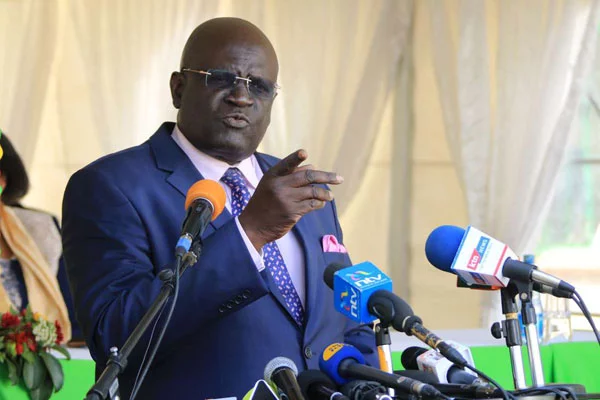
Magoha sworn in as new Education CS

President Uhuru Kenyatta today at State House Nairobi, witnessed the swearing-in of the new Education Cabinet Secretary Professor George Albert Omore Magoha and the new Commissioner General of the Kenya Prisons Service Mr. Wycliffe Ogalo.

The swearing in ceremony was conducted by the Head of Public Service Joseph Kinyua.

Commending the new Education CS for his appointment, President Kenyatta said he looks forward to working with him and other stakeholders in implementing the new curriculum and ensuring the country achieves 100% transition from primary to secondary schools.

The President noted that Professor Magoha is an experienced public servant whose wealth of experience will be relied on in the prudent management of resources in the education sector.

“We have worked with you in delivering credible exams. I am now counting on you on the 100% transition from primary to secondary schools, good management of resources and in implementing the new curriculum,” said the President.

The President commended the new Commissioner General of Kenya Prisons Service Mr. Ogalo saying being a long standing career civil servant, his management acumen will be key in the ongoing reforms to ensure prisons fully serve their  rehabilitation role.

“We want to see you  continue with the ongoing reforms . We believe that there is that ability for you and your fellow officers as well as men and women who serve under you to see how the reformed prisoners can positively contribute to the development of Kenya” said the President.

Present during the swearing-in ceremony were Interior CS Fred Matiang’i, Chief of Staff and Head of Delivery Nzioka Waita among other senior government officials.

Man jailed over alcohol blow bribe

BY PRUDENCE WANZA – A man has been charged a fine of 600,000 for giving bribes to public officers. 
The accused, Morris Logedi Shaban, offered a bribe of Ksh. 8,000 to Florence Apondi a public officer with National Transport and Safety Authority so as as not to be tested the level of alcohol in his body. 
He also offered a bribe of Ksh. 7,000 to Rogers Akoki of Ethics and Anti-corruption Commission to the same effect. 

Appearing before Honor. Ogoti at the Anti-corruption court in Milimani Law Courts,  he was sentenced to a three year imprisonment or pay a fine of Ksh. 600,000.
He however has 14 days to appeal the case. 

Collaboration or coalition? Tshisekedi’s tough choices as leader of the DRC

Former DRC President Joseph Kabila congratulates President Felix Tshisekedi at his inauguration. EPA-EFE/Hugh Kinsella Cunningham Albert Kasanda, Czech Academy of Sciences

It has been a little over a month since Felix Tshisekedi became the Democratic Republic of the Congo’s (DRC’s) head of state.

Protests that followed the presidential election seem to be dwindling. And internationally the African Union and Western countries, including France and Belgium, have recognised his takeover.

But Tshisekedi faces an uphill struggle to establish his legitimacy. The poll was contested by the platform that supported Martin Fayulu in the presidential election. The coalition, called Lamuka, seems to have come round to accepting that it failed to win power. Fayulu is seeking to fit into the current political scheme. But it’s clear that he’s called on his supporters to remain vigilant to make sure Tshisekedi doesn’t renege on promises he’s made.

Other aspirant presidential candidates have also fallen into line. The political parties associated with Fayulu in the coalition have made it clear that they recognise the current authority of the country. This includes the National Union of Federalists of the Congo party under the leadership of Gabriel Kyungu, Mouvement social pour le renouveau under Pierre Lumbi and a wide range of members of Ensemble under Moïse Katumbi.

The Catholic Church, which was first to contest the result of the poll, has also recognised the new head of state.

All this suggests that the race for the presidential chair is over. The question now is to identify where the real power lies. And what capacity the new president has to run the country. The hard truth is that Tshisekedi can’t set up a government to fulfil his political project unless he takes one of two options – cohabitation or forming a coalition.

A difficult and complex beginning

For the first time, a peaceful and civilised handover of power took place in the country, between Joseph Kabila and Tshisekedi. But these stories are quiet about one fact: that the old regime remains firmly in place.

Tshisekedi’s power is being undermined by the outgoing regime in a number of ways. Firstly, Kabila loyalists were put in key positions to run essential state services. Examples include the army, police and intelligence services.

Secondly, Kabila’s cabal has made sure that it retains power through institutions like the national assembly and provincial governments. This is clear from the fact Tshisekedi has lower representation in the national assembly.

There are already signs of tension. One was Tshisekedi’s recent decision to suspend the process of installing senators and electing provincial governors, amid allegations of procedural irregularities and corruption.

Kabila’s camp considers these decisions a violation of the country’s laws, while Tshisekedi’s supporters view his decision as part of the president’s duty as the guarantor of the constitution and stability of the republic.

Difficult choices

The option of cohabitation would see him poach members of the Common Front for Congo, which has the largest number of parliamentarians.

This approach would be interesting because it would allow him to infiltrate the majority parliamentary group and get it to support his political project as head of state.

If that doesn’t work, he’d be forced to form a coalition with other minority parties to counterbalance the weight of Common Front for Congo. This option is rather complicated because he would have a weak hold on both the parliament and the government. He would be a president without power. In other words a puppet.

Yet another option is to form an alliance with Common Front for Congo. If this happens, some thorny questions will be raised about the control of the parliamentary leadership. For example, who would lead such a coalition – Kabila, who holds the the moral authority of the Front Commun pour le Congo, or Tshisekedi?

Another tricky question would be which political programmes or projects should be given precedence.

And lastly, will it be possible to take the country in a new direction while there’s a continued reliance on people who for almost 18 years plundered the country?

To eat with the devil, you need a long fork

Tshisekedi doesn’t seem to have many options to set up his first government as head of state. Initially, he will probably have to deal with the current parliamentary majority which is held by Kabila’s supporters, the Common Front for Congo.

Hopefully, he can reshape it during his term in power. In the meantime, he should not lose sight of the popular wisdom that eating with the devil requires a long fork. Despite the apparent cordiality between himself and Kabila, he should not forget that the former head of state remains a political opponent.

If, following Nelson Mandela’s example after his release from prison, Tshisekedi calls all Congolese to reconcile and to work together for the good of the nation, he must not lose sight of the need for justice (for all) as the basis of the rule of law.

Only then will he be able to claim an alternative rule and new perspectives for the Congolese people.The Conversation

Albert Kasanda, Researcher in Political Philosophy and social sciences, Czech Academy of Sciences

This article is republished from The Conversation under a Creative Commons license. Read the original article.

Man charged for possessing videos linked to terrorism


A man has been charged at the Milimani Law Courts for being in possession of four videos that could be used to facilitate a terrorist act.
The accused, Hussein Chai Mbui was arrested at the Jomo Kenyatta International Airport with a Samsung phone containing videos with information for use in carrying out a terror attack which is contrary to the law. 
He pleaded not guilty before the Chief Magistrate Francis Andayi. 
He will be released upon payment of bond of Ksh. 1,000,000 or an alternative cash bail of Ksh. 500,000.
The mention has been set for 8th April 2019 and the hearing will be on 7th May, 2019.

Create a free account, or log in.

Gain access to read this content, plus limited free content.

Yes! I would like to receive new content and updates.

Sponsored Ad

Ad 1
Ad 2
Ad 3
Ad 4
Ad 5
Ad 6