BY PRUDENCE WANZA – A 20yr old has been charged of kidnapping a 2yr and 4 months old baby at Ofis Investment Estate in Kawangware Nairobi.
20 year old girl charged of kidnapping a baby
Magistrate questions 13 accused people on huduma number before making a decision to discharge them.
BY PRUDENCE WANZA – 13 people have been relieved of charges of gaming in public place contrary to the law. The thirteen were charged of taking part in gaming and lottery at Ronald Ngala street and Kenya National archives at the Nairobi CBD.
Appearing before Senior Principal Magistrate, Kennedy Cheruiyot at the Milimani Law Courts, they pleaded guilty to the charges and asked for forgiveness from the court.
However, the magistrate inquired whether they had registered for Huduma numbers which they had not yet done. Hon. Cheruiyot cited that, “If you are you are to be sentenced you will be out when the 45days of registration are over. “
The magistrate then decided to discharge them saying that gambling is a great concern in Kenya and thousands of Kenyans are doing such gaming and have not been caught therefore it will be inappropriate to punish the 13 accused people.
He however told them to make sure they are given Huduma numbers so as get government services.
Graffiti is an eye-catching way to create lively spaces in cities
Whether it’s tagging (the stylised writing of an individual or crew’s name), posters, stickers, installations, murals or mosaics, graffiti has always been a contentious issue. Countries like the US, UK and Australia have adopted aggressive – and expensive – strategies to try and eradicate graffiti.
But not all cities view graffiti as a bad thing. Over the past few decades, it’s increasingly become part of mainstream culture. Some places have actively promoted graffiti and encouraged artists to work in public spaces. Others, like Bogota in Colombia, have introduced legislation that aims to promote the responsible and legal practice of graffiti. In Singapore, the state has designated specific surfaces for graffiti.
Johannesburg, South Africa’s most populous metro, takes a dim view of graffiti. In 2016, Mayor Herman Mashaba declared that he would eradicate graffiti through stricter bylaws to create an “investor-friendly environment” in the city. His stance is arguably at odds with the City of Johannesburg’s policies on urban redevelopment. These rely on programmes that support public art and promote tourism opportunities.
We and our colleagues at the Gauteng City-Region Observatory wanted to know the contribution made by graffiti to tourism and the public environment in the inner-city of Johannesburg. The Observatory is an independent research organisation which generates data and analysis to help inform development and decision making in the Gauteng City-region. So we undertook a study of graffiti in Maboneng, a precinct in Johannesburg’s inner city that’s undergoing urban renewal.
Using the case study of Maboneng, the research demonstrates that graffiti has been leveraged in nurturing urban development, creative economies and tourism in the inner-city. This means it has aesthetic value in the urban environment. The research shows that graffiti contributes to place-making by creating meaningful or identifiable spaces that tolerate public participation through the medium of graffiti.
Graffiti in Maboneng
The Maboneng precinct began in 2009 with the completion of the “Arts on Main” building, an artists’ space in a renovated industrial building. Over the last decade, Maboneng has become an iconic example of how investing in “creative spaces”, “creative industries” and “creative tourism” can be used to drive urban renewal of previously disused or derelict urban environments.
Maboneng’s developers have created a strong public and street art presence, both physically and digitally. In fact, graffiti forms part of the developers’ strategy for reinvigorating the area. The area now boasts several large-scale murals produced through street art festivals and artistic commissions. It’s also attracted significant attention from graffiti artists. All of this contributes to Maboneng’s aesthetic identity and is one of the elements that draws tourists to the area.
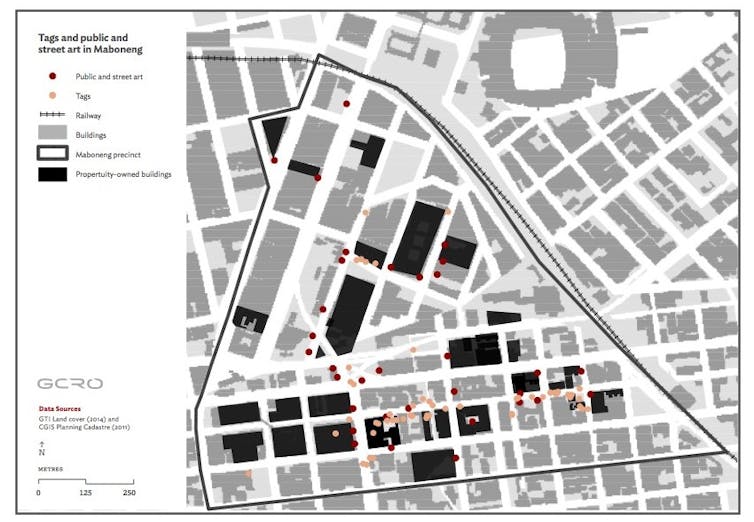
In our research we used photographs of graffiti to document, locate and map its presence within the precinct. Graffiti here refers to a spectrum, from tagging to elaborate pieces with a focus on stylised words and text.
Through visual and spatial analysis, we were able to demonstrate that graffiti has aesthetic value. It signifies the redevelopment of the neighbourhood, distinguishes the area from surrounding spaces, and projects a global aesthetic similar to that seen in places like Hell’s Kitchen, New York; the east end of London or Bogota, Colombia.
Notably, the mapping showed how tagging, accompanies both redevelopment and commissioned street art.
Large murals were incorporated into the architecture of renovated buildings. These murals were frequently accompanied by other forms of graffiti such as tagging, posters or stickers. Graffiti was present in the precinct even where buildings or public space had been upgraded. This reflects Maboneng’s tolerance for types of graffiti that are more frequently viewed as undesirable.
We also examined the visibility of graffiti murals in Maboneng. The location of a graffiti piece is a conscious decision: graffiti artists aim to express their views in the public realm and gain more recognition and respect based on the reach of their work.
We mapped the reach of the murals on high rise buildings in Maboneng, and found that many could be seen for several hundred metres down streets – and, in some cases, beyond the boundaries of Maboneng itself. The murals announce the branding and identity of the area for the public and thus aid in making the Maboneng precinct more visible and inviting.
Navigating the city
Our research shows that graffiti has been used to create a strong brand for Maboneng and is a form of advertising that extends beyond the immediate neighbourhood boundaries.
Graffiti has been used as a form of way-finding or navigation, where buildings become unique landmarks in the landscape. It is through these elements that the value of graffiti is being realised in Maboneng.
Graffiti is creating a distinctive precinct within Johannesburg and, simultaneously, a familiar global aesthetic of the creative neighbourhood. The presence of graffiti in Maboneng has not detracted from its value in terms of urban renewal. This means that Maboneng provides an alternative management approach, which should be further investigated.
Samkelisiwe Khanyile, a junior researcher with the GCRO, contributed to this article.![]()
Alexandra Parker, Researcher of urban & cultural studies, Gauteng City-Region Observatory
This article is republished from The Conversation under a Creative Commons license. Read the original article.
Al-Bashir: Why the ICC is between a rock and a hard place
A military coup d’etat in Sudan has ended Omar al-Bashir’s 30-year rule. In a widely publicised press conference, the country’s Defence Minister Awad Ibn Ouf announced
the toppling of the regime and detaining (of) its chief in a secure place.
Al-Bashir’s whereabouts is of interest because he’s wanted by the International Criminal Court (ICC) for crimes against humanity, war crimes, and genocide in Darfur.
The ICC’s case stretches back to 2005 with the publication of a UN report that accused the Sudanese government of systematic abuses in Darfur. The United Nations Security Council then referred the suspects to the ICC.
In the following years, the ICC would release two arrest warrants against al-Bashir – in 2009 and in 2010 – on several counts of genocide, war crimes, and crimes against humanity. In 2014, the ICC’s Chief Prosecutor Fatou Bensouda shelved the case due to a lack of cooperation in pushing for al-Bashir’s arrest. Many saw the shelving as emblematic of the court’s lack of power over powerful individuals, especially sitting heads of state.
The fact that al-Bashir has been deposed will again raise questions about whether there’s a possibility of seeing the former Sudanese president facing trial at the ICC. Commentators have already expressed different opinions on whether he will or won’t end up facing trial at The Hague. Views either highlight the fact that he’s likely to face trial because he no longer enjoys the privileges associated with his position. Or that he still has influence over the new government and, as such, bringing him to The Hague would be extremely complicated.
I believe the trickier question is whether the ICC should prosecute the former Sudanese president. This might seem like a redundant and even immoral question – if not him, then who? But it’s not that simple.
Let me be clear. I have no sympathy for al-Bashir – nor for any dictator whose policies harm, or aim to harm, civilians.
But I believe the particular circumstances of al-Bashir’s case mean that the court is between a rock and a hard place. That’s because two very difficult issues arise out of the present circumstances. Both have serious implications for the court and its work, as well as whether sitting heads of state believe they can act with impunity.
The conundrum
The idea behind attempted prosecutions of sitting heads of state is that they should be prosecuted – irrespective of their position – in instances when crimes of huge magnitude have been committed.
Originally, the idea was to discourage sitting heads of states from committing heinous crimes by putting in place limits to the exercise of sovereign statehood. In other words, knowing that your position of power is not going to prevent international prosecution, should ideally act as a deterrent.
Unfortunately, when the ICC attempted to turn this idea into pragmatic action, it met extraordinary resistance. In Kenya, for instance, the prosecution against the current sitting Head of State Uhuru Kenyatta, was dropped in 2014 after the Chief Prosecutor of the ICC, Fatou Bensouda, said it was impossible to investigate the crimes further. This was because witnesses were terrified to testify and the Kenyan government refused to cooperate.
In recent years the the African Union has gone as far as suggesting that in the future the court should rather focus on mid-level officials.
But if the ICC doesn’t prosecute al-Bashir, it will give credit to critics who think that the court is essentially powerless against the most powerful political figures in a country.
On the other hand, if it does, it would suggest that powerful individuals can only be prosecuted when they leave their positions of power.
And here lies my preoccupation.
If the Court prosecuted al-Bashir right now, it would be sending a worrying message to other dictators: do whatever you want, as long as you maintain power. Or, to be even more explicit, do whatever you can to maintain power.
This is a strikingly dangerous message to project for two reasons.
Dangerous message
The first problematic message that taking al-Bashir to court would send involves war-torn countries.
The fact that many of the cases in which the ICC is expected to act happen in regions and countries at war, the message is likely to hinder the resolution of a conflict by providing an extra incentive to those in power not to step down.
Syria provides an interesting example. In the context of the country’s civil war, an al-Bashir prosecution at this stage would warn Syrian leader Bashar Hafez al-Assad about what could happen if he stepped down. Given that recent diplomatic talks to end the Syrian conflict largely revolved around Assad renouncing his presidency, seeing al-Bashir facing trial could stiffen Assad’s position even more.
The second problem is one of perception. To see al-Bashir face trial at The Hague, the Court needs the cooperation of the newly installed military government. But, as academic and Sudan expert Alex de Waal points out, al-Bashir was a spider at the centre of an intricate web. And it’s almost certain that at least parts of the new government have been involved in the crimes for which al-Bashir is wanted. Cooperation has historically meant that the Court would need to implicitly agree with the new government that it wouldn’t prosecute its members.
There’s an uncomfortable precedent to this. The memory of Luis Moreno Ocampo, the former Chief Prosecutor of the ICC, posing for pictures with Uganda’s Yoweri Museveni’s government are still vivid. Back then, the major concern was about impartiality. As Mark Kersten has pointed out, this was seen as the ICC neglecting state-perpetrated crimes. The Court still needs [to recover from] this incident.
Where does this leave the ICC? The situation isn’t easy to solve. It seems that the power that states still retain over the Court is an insurmountable obstacle in the prosecution of sitting heads of state. I particular, their willingness, or not, to cooperate.
In this sense, I think that the ICC is in a lose/lose situation.
Unfortunately, developments around any case against al-Bashir aren’t likely to redress these problems. They’re more likely to highlight them even more.![]()
Mattia Cacciatori, Lecturer in International Relations and International Security, University of Bath
This article is republished from The Conversation under a Creative Commons license. Read the original article.

Court questions 13 accused people on huduma number before making a decision to discharge them
BY PRUDENCE WANZA – 13 people have been relieved of charges of gaming in public place contrary to the law. The thirteen were charged of taking part in gaming and lottery at Ronald Ngala street and Kenya National archives at the Nairobi CBD.
Appearing before Senior Principal Magistrate, Kennedy Cheruiyot at the Milimani Law Courts, they pleaded guilty to the charges and asked for forgiveness from the court.
However, the magistrate inquired whether they had registered for Huduma numbers which they had not yet done. Hon. Cheruiyot cited that, “If you are you are to be sentenced you will be out when the 45days of registration are over. “
The magistrate then decided to discharge them saying that gambling is a great concern in Kenya and thousands of Kenyans are doing such gaming and have not been caught therefore it will be inappropriate to punish the 13 accused people.
He however told them to make sure they are given Huduma numbers so as get government services.
Kenyatta meets Standing Committee Vice of China
President Uhuru Kenyatta held talks with Mr. Cao Jianming, the Vice Chairman of the Standing Committee of the National People’s Congress (NPC) of China, who paid him a courtesy call at State House, Nairobi.
The meeting focused on cementing the existing enhanced bilateral ties between Kenya and China for the benefit of the people of the two countries.
President Kenyatta said the visit by the Vice Chairman of the Standing Committee of the NPC, the national legislature of the People’s Republic of China, affirmed the solid relations between the two countries.
“We have shared values that make our relationship stronger by the day. We value China as a close development partner,” President Kenyatta said.
The President pointed out that the close partnership between the two countries has seen implementation of Key infrastructure projects including the Standard Gauge Railway (SGR) and several key roads that have greatly improved the transport network, a key ingredient for growing industries and creating jobs.
The President said construction work is ongoing to take the SGR to Naivasha onwards to Kisumu and into the East African hinterland, a move that will open up the region and boost trade between Kenya and her neighbours.
President Kenyatta added that the cooperation in infrastructure development is in line with Chinese President Xi Jinping’s Belt and Road Initiative (BRI) that involves infrastructure development and investments in 152 countries in Africa, Europe, Asia, Middle East and Latin America.

“The ultimate objective of our two countries is to see mutual benefit and prosperity for the people of Kenya and China,” President Kenyatta said.
The Head of State said that Kenya is now looking at how to partner with China on the next level where the fruits of the infrastructure built can be enjoyed more by the people.
The President also noted that trade levels between the two countries have been low with exports from Kenya to China being less than those from China to Kenya.
At the multilateral level, President Kenyatta requested China to support Kenya’s bid for a non-permanent seat in the United Nations Security Council (UNSC) for the 2021 to 2022 period at the elections to be held this year.
Responding to President Kenyatta’s concerns over trade imbalance in favour of China, Mr. Cao assured that the relevant offices are working hard to ensure that China imports more goods from Kenya.
Mr. Cao, who is also President Xi’s special envoy, reiterated China’s continued support to Kenya’s development initiatives, particularly the Big 4 Agenda.
“We will continue to explore new ways of enhancing our cooperation even as we support the Big 4 Agenda that heralds great things for the people of Kenya,” said the Vice Chairman of the Standing Committee of the National People’s Congress of China.
He also delivered a special message to President Kenyatta from President Xi and said his visit to Kenya at the invitation of the Kenyan Parliament has been fruitful in elevating cooperation between the parliaments of the two countries.
The meeting was attended by Head of Public Service Joseph Kinyua, Transport and Infrastructure Cabinet Secretary James Macharia and Principal Secretaries Amb. Macharia Kamau (Foreign Affairs), Esther Koimett (Transport) and Kamau Thugge (Treasury).
First Lady Margaret Kenyatta calls for special protection of Elephants and Rhinos
First Lady Margaret Kenyatta today said our unique wildlife heritage sets the country apart from the rest of the world and should be accorded special protection for the sake of the economy and future generations.
She described Kenya’s expansive wildlife species, notably elephants and the rhinos, as a special gift from God to the country.
The First Lady said Kenyans will have failed their country and future generations in a big way if they won’t be able to secure their elephant and rhino population from extinction.
“If we fail and find the environmentalists’ predictions of extinction of our precious wildlife, especially the elephant and rhinos to be true, we shall have truly failed our future generation – our children and children’s children,” said the First Lady.
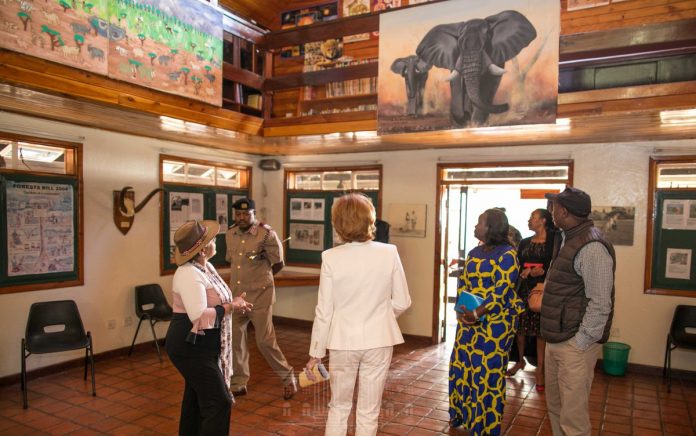
She spoke in Nanyuki , during celebrations to mark the 35th anniversary of the William Holden Wildlife Foundation (WHWF).
The Late William Holden, one of America’s biggest Box Office Film and TV actors and celebrated Academy Award Winners of the 1950s and 1960s, was one of the leading conservationists in Kenya.
He visited Kenya as a hunter in 1954, fell in love with the country’s wildlife, and decided to dedicate his life to conservation through the Mount Kenya Game Reserve.
Upon his death in 1981, his partner and former actress Stefanie Powers founded the William Holden Wildlife Foundation to continue the work of the renown conservationist. She is currently the president of the foundation.
WHWF is a not-for-profit organization whose principal project is the William Holden Education Centre in Nanyuki which is dedicated to wildlife conservation and environmental studies for local people and occasional visits from international groups.
The centre focuses on the educational component of wildlife and environmental protection and habitat protection. It lays great emphasis on practical methods of sustainable accessibility to all.
Besides protection of the endangered animal species including the mountain bongo, the centre undertakes research in animal reproduction using captive breeding programs. The centre also runs an animal rescue centre to care for orphaned animals.
“I applaud the work of the Foundation in its innovative Wildlife Education program that has served over one million people, mostly Kenyans to learn about the importance of protection and conservation,” said the First Lady who took time to familiarize herself with the work of the foundation.

Over 11,000 students from all over the world visit the centre each year.
The First Lady said the centre, along with the activities it supports is an exemplary demonstration of the sustainable utilisation concept that helps communities to protect a resource besides reaping huge benefits from the asset.
“This program has been very impactful to educate and equip communities living with wildlife to participate in wildlife protection,” said the First Lady.
The centre supports local schools through infrastructural development and distribution of books and other learning materials and equipment.
First Lady Margaret Kenyatta paid tribute to the late Holden whom she described as a great champion of conservation work and praised Ms Powers (who was the host) for protecting Holden’s legacy through the work of the WHWF.
“I congratulate Stephanie Powers, for your remarkable vision to protect William’s legacy, his vision, and his passion, through the William Holden Wildlife Foundation,” the First Lady said adding that the late Holden remains a great inspiration to those who knew him and his contributions in conservation.
She said Holden’s initiatives were a good example of what citizen activism means, environmental stewardship and making a difference.
The First Lady who is a great champion of wildlife conservation, is the patron of the “Hands Off Our Elephants” campaign that brings together government agencies, the civil society and other conservation organization in a unified approach towards ending the poaching crisis in Kenya.
Since 2013 when the campaign was launched, it has succeeded in generating unprecedented public and political awareness and support for wildlife conservation.
Others who spoke at the ceremony included Ms Powers, Principal Secretary for Wildlife Dr. Susan Koech, Laikipia Governor Nderitu Mureithi, Nyeri Deputy Governor Caroline Karugu, Laikipia County MP Catherine Waruguru, Laikipia North MP Sarah Korere and National Environment Management Authority (NEMA) Director General Prof. Geoffrey Wakhungu
Songs of freedom: The soundtracks of political change in Sudan
The uprising in Sudan has been vocal – and musical. “Tasqut bas!” – just fall, that’s all – was a commonly-used slogan by Sudanese as they revolted against military dictator Omar al-Bashir’s 30-year rule. The uprising, which began in December 2018, intensified over the following weeks, forcing Al-Bashir to step down on 11 April 2019.
Sudanese played a crucial role as they camped in front of the compound housing the military and security services in central Khartoum. For five days, the protesters refused to budge until the army removed the president from power.
During the days in early April, when the revolution gathered steam, the government expelled most international media outlets. So it was up to the citizens to capture the uprising on cellphones. These cellphone images and videos were soon circulated on social media platforms to Sudanese in the diaspora and to a global audience. Local media outlets continued with regular programming despite the government’s efforts to impose a media blackout.
Cellphone footage from the heart of the revolution all contained one thing in common: the familiar beat of music. This was to be expected. Sudanese music has always been heavily laden with political rhetoric.
The saying goes that everyone in Sudan is a politician, in reference to how politics creeps into everyday conversation. Sudanese also tend to be musically savvy and are inclined to know the lyrics to many popular songs by heart.
Previous revolutions in the country have been marked by particular songs. That hasn’t been the case this time, although the protesters chanted slogans to music that was accompanied by the persistent beat of drums.
Politics and music
The link between music and politics is not new to Sudan.
One of the earliest examples of how powerful lyrics drove political change was a poem entitled “Umm Dhafayir” – The Lady with Pleated Hair – by Obeid Abdul Nur, an educator and a poet.
Written in 1924, the poem urged Sudanese to rise up and fight against British occupation. The eloquently-articulated words highlighted the importance of the nation and urged the youth to fight for their homeland. Perhaps Abdul Nur’s rousing words provided inspiration to others to integrate political content in their lyrics.
“October Al Akhdar” (Green October) was famously performed by the revered singer Mohammed Wardi during the 1964 revolution that overthrew a military government and ushered in a civilian one. The song’s lyrics applaud the power of the people to bring about political change. The use of the word “green” in the title was a direct reference to agriculture and its importance to Sudan’s economy.
In 1985 Sudan again underwent change in its leadership through a popular uprising. Again the people took to the streets to oust a military government. Again elections ushered in a civilian government. And again, songs played a central role in the revolution.
Wardi’s lyrics played a powerful role this time too. His song “Ya Sha’aban Lahabak Thouritak” – which loosely translates to “Oh People Your Flame is Your Revolution” – referred to the immense pride and confidence Sudanese people have in their abilities. In the song Wardi yearns for Sudan’s population to stand up and to speak up for itself and to control its own destiny. The words empowered Sudanese to realise their ability to work for the good of the country with resolve and purpose.
Wardi died in 2012. The legendary singer is still celebrated as “The Last King of Nubia”.
Using songs
Sudan has endured a total of almost five decades of military dictatorship since its independence in 1956. Its people yearn for political freedom.
Democratic civilian governments have never been allowed to serve out their time in office. Songs are therefore used to instil belief in the population. Music seems to lessen the pain and suffering during difficult times.
What the revolutions of 1964, 1985 and 2019 have demonstrated is that political and economic hardships push people to defy the government.
But songs also have a unifying power. The 2019 uprising is a testament to that. Shouts of “hurriyya” (freedom), “shaabun wahid jayshun wahid” (one people, one army) and “al shaab yurid ‘isqat al nizam” (the people want to overthrow the regime) were repeatedly heard.
These slogans and lyrics were often accompanied by the beat of drums, the shuffling of feet and the swaying of hips. On the day that al-Bashir was expelled, a video circulated of a group of protesters playing music. One was playing a saxophone while another beat on a drum. Those around joined in the festivities.
In 2019, songs provided motivation and guidance. Protesters in Sudan could easily have been dissuaded from pursuing their goal of instigating regime change. Al-Bashir’s three decades in power made him a cunning and wily power broker and the fear was that another uprising could be crushed like many before it. The removal of al-Bashir from power to be replaced by his defence minister isn’t the kind of democratic change that the protesters were looking for and it remains to be seen how the scenario will unfold in the coming days.
But whatever happens, the protesters have persevered, united by a common goal and guided by nationalist songs of freedom – songs that will ultimately be etched in Sudan’s history records.![]()
Mohamed A. Satti, Assistant Professor of Communication and Media, American University of Kuwait
This article is republished from The Conversation under a Creative Commons license. Read the original article.