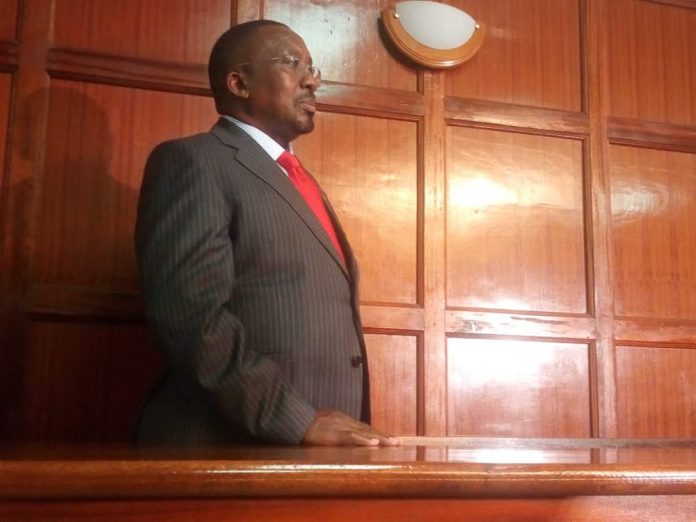
BY PRUDENCE WANZA – Two men have been charged in court for obtaining 1530g of gold worth Ksh. 5m from one Zainabeshi Hassan.
Two charged of obtaining gold worth Ksh. 5m falsely.
Woman charged for obtaining money from a supplier falsely
BY PRUDENCE WANZA – A woman has been arraigned at the Milimani Law Courts for obtaining sh. 200,000 from one Patrick Muli Wambua.
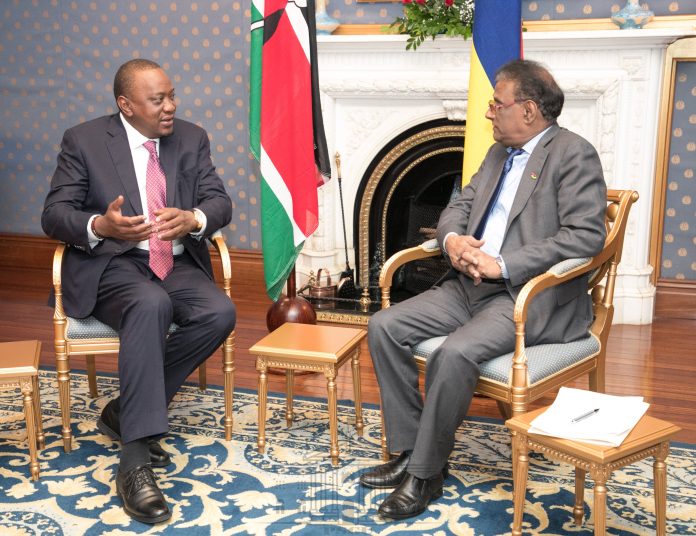
President Kenyatta’s visit pays off as Mauritius lifts ban on Kenyan farm produce
The government of Mauritius has lifted a ban on several Kenyan farm produce as the two countries signed agreements to enhance trade between them.
The ban on avocadoes, baby carrots, baby beans and broccoli was lifted during bilateral talks between President Uhuru Kenyatta and his host Prime Minister Pravind Jugnauth.
The move by Mauritius comes less than six months after the Chinese government opened its doors to the Kenya’s fresh produce.
President Kenyatta said the lifting of the ban by Mauritius will help improve Kenya’s export to the Indian Ocean Island country and is a major boost for horticultural farmers in the country especially women who are the majority in the sector.
During the bilateral talks, President Kenyatta and PM Jugnauth witnessed the signing of several agreements including the Double Taxation Avoidance Agreement (DTAA); an Investment Promotion and Protection Agreement (IPPA); and an MOU on Cooperation for the Development of Special Economic Zones (SEZs) and Export Processing Zone in Kenya.
Other agreements were an MOU in the field of Tourism; an MOU in the field of Higher Education and Scientific Research and an MOU in the field of Arts and Culture.
President Kenyatta said Kenya is bound to benefit immensely from the signed agreements and MOU’s as they would help the country achieve its development goals particularly in manufacturing and job creation.
“Both countries can benefit from the proximity of each other to foster closer cooperation across many areas. I welcome the conclusion and signing of agreements in six areas during this state visit,” the President said.
He pointed out that more bilateral engagements between Kenya and Mauritius will enhance existing cordial relations thereby increasing trade and investment opportunities.
The President said, several opportunities exist in trade and investment, financial services, agriculture, transport and communication, and in culture, education, tourism and research.
He expressed gratitude that the inaugural Session of the Joint Commission for Cooperation (JCC) which was held in August 2018, has helped the two countries to deepen and enhance the scope of bilateral engagements.
President Kenyatta pointed out that Kenya and Mauritius are well placed to collaborate in championing the development of the blue economy since both countries are littoral states with long coastlines.

The Kenyan Head of State said there is need for the two countries to explore ways of enhancing cooperation in maritime transport by linking Port Louis to the Port of Mombasa as a catalyst for growing business and trade between Kenya and Mauritius.
“Kenya is making good progress in developing the Port of Lamu as part of the Lamu Port South Sudan Ethiopia Transport Corridor (LAPSSET) project, I look forward to Mauritius sharing in the dividends that will accrue from the transport infrastructure once it is complete,” President Kenyatta said.
He invited Mauritian investors to participate in the Special Economic Zones which the government has set up at the Port of Mombasa and within the Export Processing Zones.
The President said collaboration in this area will be enhanced through sharing of best practices and in the development of an integrated regional value chain in the textile sector.
President Kenyatta has arrived in Mauritius for a four-day State Visit
President Uhuru Kenyatta this evening arrived in Port Louis, Mauritius for a four-day State Visit.
The plane carrying President Kenyatta and his entourage touched down at the Sir Seewoosagur Ramgoolam International Airport shortly before 7pm local time.
On arrival, the President who was received by Prime Minister Pravind Jugnauth, inspected a guard of honour mounted by a detachment of the special mobile force of the Mauritius Police Service followed by a 21-gun salute.
After the arrival ceremonies, President Kenyatta paid a courtesy call on the Acting President of Mauritius Paramasivum Pillay Vyapoory at State House, Le Reduit.
President Kenyatta’s visit to Mauritius is largely aimed at boosting the economic, cultural and social ties between the two nations.

During his visit, President Kenyatta will attend a business forum organised by the Mauritius Economic Development Board in collaboration with the Mauritius Chamber of Commerce and Industry, the Kenya Private Sector Alliance (KEPSA) and the Kenya Investment Authority which will be used to showcase trade and investment opportunities in Mauritius and Kenya.
President Kenyatta is accompanied by Cabinet Secretaries Monica Juma (Foreign Affairs) and Prof. George Magoha (Education) among other senior government officials.
India elections: who are Narendra Modi’s main rivals – and can they beat him?
India is heading to the polls in the world’s biggest democratic election and a number of different figures could emerge as India’s next prime minister in May.
The incumbent, Narendra Modi, and his main opponent, the Congress Party president, Rahul Gandhi, are obviously the most likely candidates. But if they both fail to gain sufficient seats to form a government, they could be displaced from within their own parties. It is also possible that, in a fragmented parliament, another politician from one of the regional parties could stitch together a coalition.
In 2014, the electorate delivered Modi’s Bharatiya Janata Party (BJP) the first absolute majority gained by any party since 1984. Tired of a Congress Party-led government mired in corruption scandals and rampant inflation, voters embraced Modi’s promise to clean up politics, cut red tape, create jobs, and restore confidence. They also embraced Modi himself, despite his controversial past as a Hindu nationalist firebrand, responding positively to his claim that he had matured into a selfless vikas purush (“development man”).
But the Modi government’s failure to deliver what it promised has tarnished that image. Anti-corruption efforts have caused pain, with small businesses hit by the sudden decision in late 2016 to withdraw large denomination banknotes from circulation. Economic growth has flagged, and jobs are scarce.
Despite this, in February, a terrorist attack in disputed Kashmir and a retaliatory Indian air strike on Pakistan have made national security the salient election issue, handing Modi another chance to reinvent himself. In response, he has assumed the mantle of a chowkidar (“watchman”), asserting in a slick media campaign that in these troubled times, he and his supporters are best suited to defend India from its enemies both inside and outside the country.
Click here to listen to India Tomorrow
The dynasty
Modi’s principal opponent, Gandhi, has been caught flatfooted by this shift. The scion of the Nehru-Gandhi dynasty, related to three of India’s former prime ministers, Gandhi is 20 years Modi’s junior, and ought to be more in tune with India’s youthful voters. But he struggled to connect with the electorate, including first time voters, in 2014, when his Congress Party secured just 44 out of 543 contestable parliamentary seats. Since then, he has also struggled to capitalise on the Modi government’s apparent failures to boost economic growth, create jobs, and address rural poverty.
In 2019, the Congress Party should nevertheless do better, if opinion polls and seat projections are any guide. Gandhi will be supported by his popular, if enigmatic, sister, Priyanka Gandhi Vadra. Her striking resemblance to her former prime minister grandmother, Indira Gandhi, appeals to some Congress voters, and her apparent savvy to party officials. She has not yet announced that she will stand for a seat, however, and the allegedly murky real estate dealings of her husband, Robert Vadra, makes her vulnerable to BJP attacks.
The Gandhis have considerable assets – instant name recognition and an established, nationwide party organisation – but also significant weaknesses. Rahul Gandhi’s abilities and commitment remain in doubt.
The Congress campaign has been often negative, summed up in its slogan “Chowkidar Chor Hai” (“The watchman is a thief”). And the fact that the Congress Party is still run by a dynasty – however distinguished – alienates some voters.
Powerbrokers and rivals
It is unlikely that either the BJP or the Congress Party will come close to winning a majority in parliament. To rule, they will need the support of a number of regional allies, especially from the states of Uttar Pradesh, Bihar, Maharashtra, West Bengal, and Tamil Nadu, which account for almost half the seats. This may hand power to regional powerbrokers, such as West Bengal’s mercurial chief minister, Mamata Banerjee, who will be able to direct their MPs to support one or other leader.
These powerbrokers could deliver either main party into government, albeit it at a price, in terms of both cabinet positions and modified policies. Alternatively – in an admittedly improbable scenario – they could even come together to form a Mahagathbandhan or “grand alliance”, with one of their number as prime minister, should either Modi or Gandhi fail.
It is also possible that the BJP could emerge as the largest party and in a position to form government, but with a disappointingly low number of seats, leading to a challenge to Modi’s position. So far, he has been fortunate that some of his potential rivals within the BJP, such as external affairs minister Sushma Swaraj, have been unwell or unwilling to challenge his leadership.
Recently, however, the names of potential successors have been canvassed more openly, including that of roads and railway minister Nitin Gadkari. Should the BJP lose more than a 100 seats, some speculate that an alternative leader, with a less autocratic style better suited to managing a delicate coalition, could well be sought out by the party.
You can listen to the trailer for India Tomorrow here, and also sign up to The Anthill newsletter to get an email about each new episode. Get in touch with any questions about the Indian elections via podcast@theconversation.com or reach out on Twitter @anthillpod.
Ian Hall, Deputy Director (Research), Griffith Asia Institute, Griffith University
This article is republished from The Conversation under a Creative Commons license. Read the original article.
Woman linked to controversial Riara Land sale denies charges
BY PRUDENCE WANZA – A mother of four and a resident of Nairobi county has denied charges of sh. 300m fraud charges concerning a parcel of land along Riara road, Nairobi County.
Pastor Ng’ang’a arraigned in court over 3.6 Million shilling plot
BY PRUDENCE WANZA – Controversial apostle Ng’ang’a of Neno Evangelism has been charged of obtaining 3.6m from one Wickson Njoroge Mwathi.
Mobile banking is taking queues out of bank halls
BY PETER WAFULA – Bank customers are deserting banking halls as preference to mobile and online banking platforms continue to take root in the banking sector, causing a major shift in how customers are accessing banking services.
A report by Equity bank reveals four out of five transactions are processed on digital platform. The bank’s digitization strategy began in 2016 and has seen the creation of digital products tailor made to meet its more than 12.6 Million customer base.93% of digital loans given by the bank are disbursed through Equitel and EazzyBanking app.
Eazzy loan is a digital loan product that enables Equity bank’s customers to borrow up to Ksh.3 Million payable in 12 months. The loan can be processed anywhere, anytime through Equitel lines or the EazzyBanking app.Furthermore, the loans do not require a guarantor, or need to fill forms and credit is immediately advanced. For convenience, customers can monitor loan balances and make repayments through their Equitel lines and the EazzyBanking app.

Equity Group CEO James Mwangi (R) in this file photo leads other top officials during official launch of Equitel
Mobile banking has emerged as a handy powerful tool for entrepreneurs to quickly seize opportunities whether in quick cash to meet supply orders, restock supplies or cash for overheads.
Equity Bank is currently the largest bank in Eastern and Central Africa region with over 12.6 million customers, the largest in market capitalization and second largest in balance sheet. It is listed at the Nairobi Securities Exchange and cross listed at Uganda and Rwanda Stock Exchange. It has banking subsidiaries in Kenya, Uganda, Tanzania, Rwanda, South Sudan and DRC.
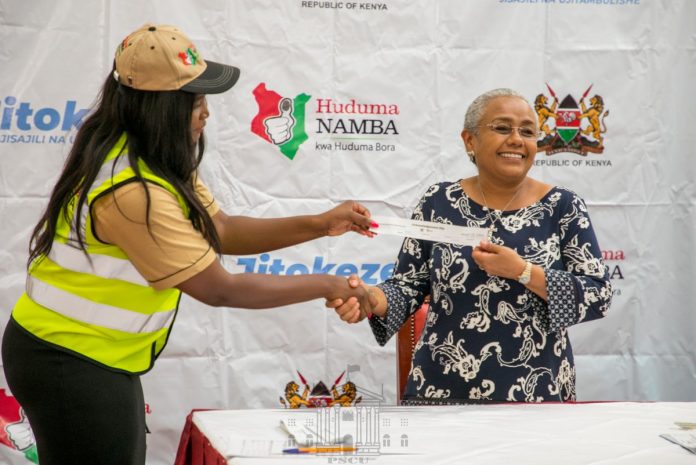
First Lady Margaret Kenyatta leads State House staff in registering for Huduma Namba
Among the first to register for number after the First Lady were State House Comptroller Kinuthia Mbugua, the Chief of Staff in the First Lady’s Office Constance Gakonyo and Deputy Comptroller George Kariuki.
Others included President Kenyatta’s Private Secretary Jomo Gecaga and Aide-De-Camp Lieutenant Colonel Timothy Stelu Lekolol.
The exercise was conducted at State House, Nairobi by a team of registration clerks from the Ministry of Interior and Coordination of National Government under the supervision of Faith Onyango, the officer-in-charge of the National Integrated Identity Management System (NIIMS) in Nairobi.
President Kenyatta launched the national exercise of issuance of the Huduma Namba last Tuesday at Masii in Machakos County by signing up for his own number and flagging off the registration kits to all the 47 counties.
The NIIMS project seeks to identify all Kenyan residents and registered foreigners through a unique primary identifier using biometric (fingerprints and facials only), demographic and physical details in an exercise that also aims at enhancing national security.
The new Huduma Namba will not invalidate but instead harmonize other national registration processes like the signing up for Identity Cards, National Hospital Insurance Fund (NHIF), National Social Security Fund (NSSF), Birth and Death certificates or the Personal Identification Number (PIN) among others.

Huduma Namba which is also aimed at enhancing the speed and efficiency of service delivery to all residents of Kenya will consolidate the other registration numbers in one digital wallet. The other numbers will become secondary identifiers.
Speaking during the launch of the national exercise, President Kenyatta said NIIMS will not only transform civil registration and data management in the country but also tame corruption and fast-track the implementation of the Big 4 development agenda.
People are taking a huge toll on the plains of the Serengeti-Mara
The 40,000 sq km Serengeti-Mara plain that straddles the border of Kenya and Tanzania is famous for its abundant and diverse wildlife. It is also home to one of the wonders of the world: the Serengeti-Mara wildebeest migration. Each year about two million wildebeest, zebra and gazelles migrate from Tanzania to Kenya’s Maasai Mara in search of food and water.
The Serengeti-Mara is made up of pastoral community lands and 12 major protected areas, including the world famous Maasai Mara national reserve and the Serengeti national park. These make up, what we call, the “core protected area”.
But despite its vast protected areas, the Serengeti-Mara is being threatened.
In our new research we show how activities by people – like farming, erecting fences and settlements – are proliferating around the borders of the core protected areas. This is putting huge pressure on the area’s environment, natural resources and wildlife.
This is the first time that a large team of scientists, from seven countries, pooled together various lines of evidence – like ground vegetation monitoring, aerial surveys of animals and GPS tracked animals – to show the impact of human activity on the Serengeti-Mara. The data covers a period of 40 years.
We found that the activities of people have caused extreme changes to the habitat. It has significantly reduced the amount of grass and, because of farms, settlements and fences, the landscape has become fragmented – this means animals can’t move freely to find resources or mate. Key ecological functions have also changed. There are less man-made or wild fires which means that trees and shrubs are able to take root, soils are damaged – and so the land produces less plants – and the area becomes more sensitive to climate change.
Findings
We used 62 aerial surveys, from 1977 to 2016, to examine changes to wildlife, livestock and settlements around the area. For human population figures, we used data collected by the Kenyan and Tanzanian governments.
We found that, within a 60km radius of the core protected area boundary, there were 26% more people. An increase from 4.6 million to 5.8 million in 13 years. The population growth rate was even higher within a 15km radius.
With more people come more livestock, settlements and fences.
The number of fenced plots has increased by more than 20% since 2010 outside of the core protected area, in the Mara Region of Kenya. We found a high density of bomas (settlements), and the number was rising in parts of the Mara by up to three new bomas per square kilometre per year. There was also a substantial increase in the number of sheep and goats (276.2%) and a slight decrease in the number of cattle (9.4%) in the Narok region in Kenya.
But the livestock don’t just stay on the boundaries of the protected areas. They’re going in. Livestock paths were prevalent and visible up to 5km, often even further, inside. This flags that illegal grazing is happening which reduces the quantity and quality of food available for wildlife.
For instance we found that, from 1977 to 2016, illegal incursions into the Maasai Mara national reserve by cattle increased by 1053% and by sheep and goats by 1174%.
We also found that the numbers of resident wildlife species declined by between 40% and 87%. In addition, 63.5% fewer migratory wildebeest used the reserve.
Another threat is agriculture. Over 34 years the amount of agriculture happening around the border went up by 17%. It now covers 54% of the land around the protected area and has destroyed large natural habitats close by. Coupled with high livestock densities, this has intensified the pressure to graze livestock inside protected areas.
The biggest impact has been on migratory animals – like wildebeest.
Using data gathered from GPS radio-collared wildebeest, we found that they were coming together in dense groups at specific locations inside core protected areas as opposed to ranging widely inside and outside.
This reduces the amount of grass each animal has to eat and, because of over-grazing, weakens the capacity of soil to store nutrients and carbon. This means the land is less productive and it increases the area’s sensitivity to weather changes.
There are also less natural or wild fires which are key to maintaining grasslands. When livestock grazing removes grass, young trees and shrubs take root. This turns grasslands into shrublands or woodlands. Wild grazers, like hartebeest, are then likely to be replaced by animals that eat leaves and twigs, like giraffes.
The most troubling changes have taken place in an area called Narok County, located in southwestern Kenya. This area of about 17,933 sq km includes the protected Masai Mara Reserve, wildlife conservancies and community land.
Wildlife numbers here have dramatically declined. This is a big worry because the Maasai Mara is where migratory wildlife go to eat and drink water in the dry season. In its protected areas, over about 40 years, the number of cattle (40%), sheep and goats (189.6%) all increased and virtually all the large wildlife species such as giraffe, eland and topi decreased by between 54% and 93%. The number of migratory wildebeest declined by about 80% and zebra by 75%.
The impact
These intense and extensive changes mean that the Serengeti-Mara area’s wildlife has an unsure future.
The findings call for an immediate and robust response to save the future of the region’s wildlife populations, their habitats and the tourism revenue they bring from imminent jeopardy.
The migration and dispersal corridors along the edges of the Serengeti-Mara should be better protected. Livestock numbers, fences, charcoal trade, cultivation and settlements should be regulated. And illegal livestock grazing and poaching must be controlled in protected areas. Also, conservation benefits should be fairly distributed to communities living around the Serengeti-Mara.![]()
Joseph Ogutu, Senior Statistician, University of Hohenheim
This article is republished from The Conversation under a Creative Commons license. Read the original article.