Sponsored Ad

Ad 1
Ad 2
Ad 3
Ad 4
Ad 5
Ad 6
26.4 C
Kenya
Thursday, June 11, 2026
Home Blog Page 6289

Suspects of Barclays bank 2billion fake currency released on bond.

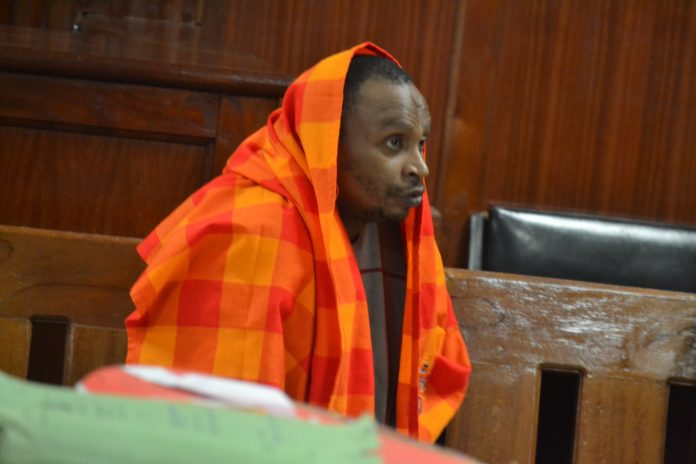
BY PRUDENCE WANZA – Four suspects of arrested with 2billion fake currency at Barclays bank Queens way branch have been charged in court after being detained for five days. 


The four Eric Adede, Mohamed Ejaz alias Ahmed Shah, Mary Wanjiru and Irene Wairimu have been jointly charged of carrying an illegal business as investors in Nairobi with one Murimi Materi Mbuthia who they would in turn remit to them Ksh. 20,000,000.
Eric Adede is accused of having in custody 2billion fake currency at Barclays bank and being in possession of 41.373kg of Brass which contrary to the mining Act. 


The four pleaded not guilty to the charges before, Chief Magistrate, Francis Andayi at the Milimani Law Court. 
The prosecution however opposed to giving of bond to the accused persons citing that it needed two days to file reasons as to why they should not be released on bond. 
Lawyers of the accused persons argued that their clients have a right to be released on bond 


Eric Adede who is facing two charges separately, will be released on a bond of Ksh. 2M and an alternative cash bail of Ksh. 1M. 
The rest will be released on bond of Ksh. 500,000 and an alternative cash bail of  Ksh.300,000

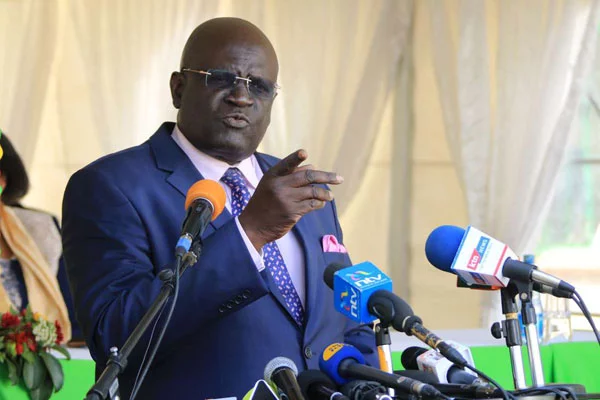
Magoha sworn in as new Education CS

President Uhuru Kenyatta today at State House Nairobi, witnessed the swearing-in of the new Education Cabinet Secretary Professor George Albert Omore Magoha and the new Commissioner General of the Kenya Prisons Service Mr. Wycliffe Ogalo.

The swearing in ceremony was conducted by the Head of Public Service Joseph Kinyua.

Commending the new Education CS for his appointment, President Kenyatta said he looks forward to working with him and other stakeholders in implementing the new curriculum and ensuring the country achieves 100% transition from primary to secondary schools.

The President noted that Professor Magoha is an experienced public servant whose wealth of experience will be relied on in the prudent management of resources in the education sector.

“We have worked with you in delivering credible exams. I am now counting on you on the 100% transition from primary to secondary schools, good management of resources and in implementing the new curriculum,” said the President.

The President commended the new Commissioner General of Kenya Prisons Service Mr. Ogalo saying being a long standing career civil servant, his management acumen will be key in the ongoing reforms to ensure prisons fully serve their  rehabilitation role.

“We want to see you  continue with the ongoing reforms . We believe that there is that ability for you and your fellow officers as well as men and women who serve under you to see how the reformed prisoners can positively contribute to the development of Kenya” said the President.

Present during the swearing-in ceremony were Interior CS Fred Matiang’i, Chief of Staff and Head of Delivery Nzioka Waita among other senior government officials.

Man jailed over alcohol blow bribe

BY PRUDENCE WANZA – A man has been charged a fine of 600,000 for giving bribes to public officers. 
The accused, Morris Logedi Shaban, offered a bribe of Ksh. 8,000 to Florence Apondi a public officer with National Transport and Safety Authority so as as not to be tested the level of alcohol in his body. 
He also offered a bribe of Ksh. 7,000 to Rogers Akoki of Ethics and Anti-corruption Commission to the same effect. 

Appearing before Honor. Ogoti at the Anti-corruption court in Milimani Law Courts,  he was sentenced to a three year imprisonment or pay a fine of Ksh. 600,000.
He however has 14 days to appeal the case. 

Collaboration or coalition? Tshisekedi’s tough choices as leader of the DRC

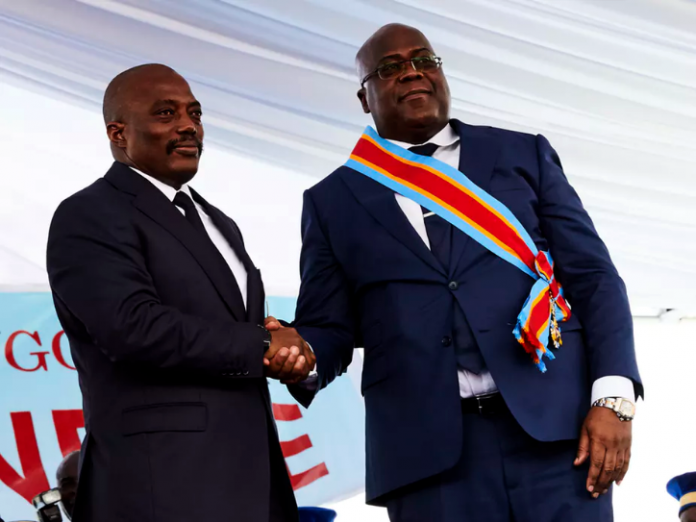
Former DRC President Joseph Kabila congratulates President Felix Tshisekedi at his inauguration. EPA-EFE/Hugh Kinsella Cunningham Albert Kasanda, Czech Academy of Sciences

It has been a little over a month since Felix Tshisekedi became the Democratic Republic of the Congo’s (DRC’s) head of state.

Protests that followed the presidential election seem to be dwindling. And internationally the African Union and Western countries, including France and Belgium, have recognised his takeover.

But Tshisekedi faces an uphill struggle to establish his legitimacy. The poll was contested by the platform that supported Martin Fayulu in the presidential election. The coalition, called Lamuka, seems to have come round to accepting that it failed to win power. Fayulu is seeking to fit into the current political scheme. But it’s clear that he’s called on his supporters to remain vigilant to make sure Tshisekedi doesn’t renege on promises he’s made.

Other aspirant presidential candidates have also fallen into line. The political parties associated with Fayulu in the coalition have made it clear that they recognise the current authority of the country. This includes the National Union of Federalists of the Congo party under the leadership of Gabriel Kyungu, Mouvement social pour le renouveau under Pierre Lumbi and a wide range of members of Ensemble under Moïse Katumbi.

The Catholic Church, which was first to contest the result of the poll, has also recognised the new head of state.

All this suggests that the race for the presidential chair is over. The question now is to identify where the real power lies. And what capacity the new president has to run the country. The hard truth is that Tshisekedi can’t set up a government to fulfil his political project unless he takes one of two options – cohabitation or forming a coalition.

A difficult and complex beginning

For the first time, a peaceful and civilised handover of power took place in the country, between Joseph Kabila and Tshisekedi. But these stories are quiet about one fact: that the old regime remains firmly in place.

Tshisekedi’s power is being undermined by the outgoing regime in a number of ways. Firstly, Kabila loyalists were put in key positions to run essential state services. Examples include the army, police and intelligence services.

Secondly, Kabila’s cabal has made sure that it retains power through institutions like the national assembly and provincial governments. This is clear from the fact Tshisekedi has lower representation in the national assembly.

There are already signs of tension. One was Tshisekedi’s recent decision to suspend the process of installing senators and electing provincial governors, amid allegations of procedural irregularities and corruption.

Kabila’s camp considers these decisions a violation of the country’s laws, while Tshisekedi’s supporters view his decision as part of the president’s duty as the guarantor of the constitution and stability of the republic.

Difficult choices

The option of cohabitation would see him poach members of the Common Front for Congo, which has the largest number of parliamentarians.

This approach would be interesting because it would allow him to infiltrate the majority parliamentary group and get it to support his political project as head of state.

If that doesn’t work, he’d be forced to form a coalition with other minority parties to counterbalance the weight of Common Front for Congo. This option is rather complicated because he would have a weak hold on both the parliament and the government. He would be a president without power. In other words a puppet.

Yet another option is to form an alliance with Common Front for Congo. If this happens, some thorny questions will be raised about the control of the parliamentary leadership. For example, who would lead such a coalition – Kabila, who holds the the moral authority of the Front Commun pour le Congo, or Tshisekedi?

Another tricky question would be which political programmes or projects should be given precedence.

And lastly, will it be possible to take the country in a new direction while there’s a continued reliance on people who for almost 18 years plundered the country?

To eat with the devil, you need a long fork

Tshisekedi doesn’t seem to have many options to set up his first government as head of state. Initially, he will probably have to deal with the current parliamentary majority which is held by Kabila’s supporters, the Common Front for Congo.

Hopefully, he can reshape it during his term in power. In the meantime, he should not lose sight of the popular wisdom that eating with the devil requires a long fork. Despite the apparent cordiality between himself and Kabila, he should not forget that the former head of state remains a political opponent.

If, following Nelson Mandela’s example after his release from prison, Tshisekedi calls all Congolese to reconcile and to work together for the good of the nation, he must not lose sight of the need for justice (for all) as the basis of the rule of law.

Only then will he be able to claim an alternative rule and new perspectives for the Congolese people.The Conversation

Albert Kasanda, Researcher in Political Philosophy and social sciences, Czech Academy of Sciences

This article is republished from The Conversation under a Creative Commons license. Read the original article.


Man charged for possessing videos linked to terrorism


A man has been charged at the Milimani Law Courts for being in possession of four videos that could be used to facilitate a terrorist act.
The accused, Hussein Chai Mbui was arrested at the Jomo Kenyatta International Airport with a Samsung phone containing videos with information for use in carrying out a terror attack which is contrary to the law. 
He pleaded not guilty before the Chief Magistrate Francis Andayi. 
He will be released upon payment of bond of Ksh. 1,000,000 or an alternative cash bail of Ksh. 500,000.
The mention has been set for 8th April 2019 and the hearing will be on 7th May, 2019.

Fraudster behind bars for stealing 2 Million shillings

By PRUDENCE WANZA – A man has been arraigned in court  for defrauding one Mr. Omar Haji Hassan a total of Ksh. 2 Million. 
The accused, Izzudin Haji Ali, pretended to be in a position to transact a joint business of operating  a petrol station and selling foodstuffs in Eastleigh together with Mr.Omar a fact he knew to be false. 

Appearing before Chief Magistrate, Francis Andayi, at the Milimani Law Courts, he pleaded not guilty. 
He has been released on a bond of Ksh. 750,000 and an alternative cash bail of Ksh. 500,000.
The case will be mentioned on 8th April, 2019 and heard on 7th  May, 2019.

Con man released on 2M bond for swindling money.

Stephen Mbugua, Arraigned at milimani Courts | Prudence Wanza

A man has been arraigned in court for obtaining a total of 162,000 US dollars from one Joseph Gitau Kibuchi. 
The accused, Stephen Njoroge Mbugua lied to be in position to sale half an acre of land at Karen to Mr Joseph Gitau, a fact he knew to be false. 
He pleaded not guilty to the charge before the Chief Magistrate, Francis Andayi at the Milimani Law Courts. 
He will remanded at Kilimani Police Station and released upon payment of bond of Ksh. 2,000,000 and an alternative cash bail of Ksh. 1,000,000.
The case will be mentioned on 8th April, 2019 and heard on 7th May, 2019.

Did competition for political interests in the country fuel the 1982 coup

The serialization of the Seasons of Hope by the Daily Nation has brought to light yet another controversial exposé.
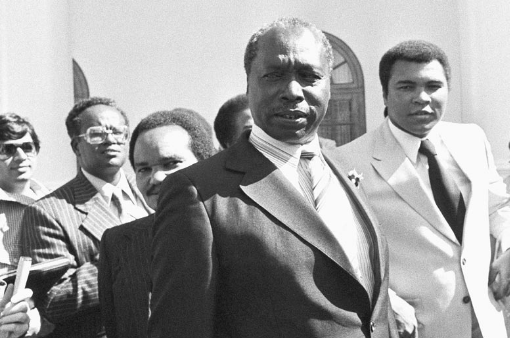
According to the book by David Musila, then President Moi refused to speak on phone to His Vice President Mwai Kibaki. The earlier narrative during the opening of the 1982 coup indicated that a tensed up President refused to sleep in Nyeri and appeared to trust Musila, a mere PC to his substantive assistant.

Fast forward to the post coup snap elections of 1983 and the subsequent purge on all politicians hitherto thought to have been close to Kibaki and Charles Njonjo and the emergence of the “Total Man” Nicholas Biwott, Professor George Saitoti and you see a choreographed political plot meant to tame political careers.

The coup, if Musila is to be believed, becomes the excuse to clip the political wings of established Central Kenya politicians.
Later in 1988, Moi used the Mlolongo rigged elections to humiliate Kibaki before demoting him to the Ministry of Health and appointing Professor Karanja as Kenya’s” Vice President.

David Musila: An MP refused to fund my studies

An MP from the then Kitui North refused to lend the family of David Musila Sh.2000 to able the former Senator pursue further studies in the US.
The narrative, published in his autobiography Seasons of Hope says that the MP took Musila round in circles, even suggesting that Musila was likely to become a scavenger in the US, or even become a beggar after dropping out of school.


The MP then a cabinet minister refered them to Kenya Commercial for assistance. Musila and his Dad, Nathan Muli got a shock of their lifetime when bank officials laughed off the joke. This was in May 1965.
With a dream shattered, a tearful Musila boarded the next available bus to Maingi.
Investigations by Uzalendo have established that the then Kitui North MP was the Late Ngala Mwendwa. He is now deceased and was also a cabinet Minister.

Uhuru takes notes from Africa’s biggest fish freezing factory visit

President Uhuru Kenyatta said African countries must take stronger steps to benefit from their immense marine resources.

He said many nations inlcuding Kenya gain almost nothing from their sea resources including fish.

The President said it was disappointing that foreign nations are benefiting more from the abundant fish in the territorial waters of many African countries.

He said African nations should work together and learn from the examples of countries like Namibia which has implemented progressive measures to develop its fisheries sector.

The Kenyan leader spoke when he toured Seaflower Pelagic Processing factory in Walvis Bay, Namibia, which has the distinction of being the biggest fish freezing factory in Africa.

The factory was set up recently at the cost of 40 million US dollars (about KSH 4 billion) through a partnership between the Namibian Government and a private investor.

The factory freezes 600 tonnes of fish on a daily basis and has created jobs for 700 people.

President Kenyatta instructed Agriculture Cabinet Secretary Mwangi Kiunjuri and Trade and Industry CS Peter Munya to immediately take steps to learn from the Namibian experience so that Kenya can have a similar factory.

Namibia’s Vice President Dr Nangolo Mbumba and Fisheries Minister Bernhardt Esau said the Government embarked on strengthening fishing in order to give Namibia a food security guarantee.

Vice President Mbumba said Namibia and Kenya are united by true freindship that started when Namibians were fighting for freedom.

“When SWAPO was fighting for freedom, the first vehicle it ever owned was bought by Kenya. We will also never forget the role played by the Kenyan contingent of UNTAG which remained behind at the cost of Kenya to protect Namibians until the country was stable,” said Vice President Mbumba.

President Kenyatta toured the fish factory after visiting the headquarters of Namibia port authority, Namport, also in Walvis Bay.

“We are here to learn from how Namibia is benefiting from its blue economy even as we continue to support and partner with them in various other fields,” said President Kenyatta.

The port of Mombasa and Walvis Bay are similar because they serve many nations in the interior of Africa.

The President was taken on a tour of the port and shown how the Government is reclaiming land from the sea to enable the port to handle ships with bigger capacity.

To enhance its efficiency in serving neighbouring landlocked countries, Namport has assigned dry ports to the different nations so that they can manage their own cargo.

President Kenyatta said Kenya will study the idea of dry ports for neighbouring countries that depend on the Port of Mombasa for their imports and exports.

“That kind of arrangement can let them manage their own cargo and our job will be to be efficient port owners,” said President Kenyatta.

He said the port of Mombasa and Namport will partner in the areas of efficiency enhancement, and the bridging of management and administration gaps that lead to corruption with the aim of improving service delivery.

The President said mismanagement and other malpractices at the ports create inefficiencies which in turn affect economies of many countries that depend on these ports as gateways into their countries.

The Namibian Government has already requested guidance from Kenya in the setting up of a single window system for processing and clearing transit cargo across many borders. The system allows importers to input data once which is then used by all countries through which the goods pass on their way to their destinations.

President Kenyatta said Africa will only succeed when all nations agree to collaborate to achieve progress.

“If Africa succeeds Namibia has succeeded and if Africa succeeds Kenya will also have succeeded,” said President Kenyatta.

President Kenyatta is on a State Visit to Namibia and was yesterday hosted at State House, Windhoek, where he held bilateral talks with President Hage Geingob.

On Thursday, President Kenyatta was the Chief Guest at the 29th Namibia Independence Day celebrations.

Create a free account, or log in.

Gain access to read this content, plus limited free content.

Yes! I would like to receive new content and updates.

Sponsored Ad

Ad 1
Ad 2
Ad 3
Ad 4
Ad 5
Ad 6