








President Uhuru Kenyatta has been lauded for his transformative
leadership which has continued to change Kenya for the prosperity of her
people.
Speaking last night when he hosted a State Banquet in honour of
President Kenyatta who is in Mauritius on a four-day state visit, Prime
Minister Pravind Jugnauth termed the Kenyan leader as the ‘architect of a
new Kenya’.
The Mauritius Prime Minister said President Kenyatta’s Big 4 development
agenda is in many ways similar to the development goals being pursued
by his government in order to achieve economic growth, shared prosperity
and improved quality of life for Mauritians.
“I’m pleased to note the convergence of our vision and the Big 4 agenda
in particular as it focuses on innovation, accelerating growth of the
service sector, creating affordable housing and addressing
infrastructural deficits” said PM Jugnauth.
He said President Kenyatta’s zeal to transform the lives of Kenyans and
Africans as a whole is an inheritance from his father, Mzee Jomo
Kenyatta who cherished and was at the forefront in the struggle for the
freedom and liberty of Africans.
“Excellency, I would like from the very onset to pay homage to the
founder of the Kenyan nation, Jomo Kenyatta, your father. He was the
living embodiment of African nationalism and his love for freedom
inspired many to take up arms against colonialism,” the Prime Minister
said.
Prime Minister Jugnauth thanked President Kenyatta for coming out
strongly to support Mauritius in its efforts to decolonize the Changos
Archipelango from the British.
“I wish to recall here Kenya’s prompt acceptance to participate in the
public hearings before the International Court of Justice in September
2018 on the request for an advisory opening regarding the legal
consequences of the separation of Changos Archipelango from Mauritius in
1965,” he said.
He pointed out that the Mauritius-Kenya relationship is sustained by a
common interest of entrenching the rule of law and a deep desire to
transform the two countries into engines of growth in Africa.
“The Mauritius-Kenya partnership is premised on the common will of the
two countries to evolve rule based systems at national and international
levels, to reinforce the rule of law, fight corruption and make this
part of Africa an engine of growth for the continent,” the Mauritius
leader said.
The Prime Minister pledged his government’s support for Kenya in its bid
for a non-permanent seat in the United Nations Security Council for the
term 2021 to 2022 at the elections slated for this year.
He said the six trade agreements and MOU’s signed between the two
countries would facilitate economic cooperation, investments and trade,
and remove non-tariff barriers to trade.
“A number of Mauritius firms are already present in Nairobi and there is
a keen interest from manufacturers to establish joint partnerships or
pursue single investments in Kenya,” he said.
President Kenyatta welcomed Mauritian investors to take advantage of the
many opportunities in Kenya saying the newly signed bilateral
frameworks create an even better platform for trade and investment.
“I wish to take this opportunity to welcome Mauritian investors to
explore the numerous trade and investment opportunities in Kenya. I
assure you of Kenya’s full support, and give my guarantee that you will
find a conducive investment environment in Kenya,” President Kenyatta
said.
The Kenyan leader encouraged the Mauritius business community to take
advantage of his 2017 directive, which enables all Africans to receive
visas upon arrival in Kenya. Mauritius citizens don’t need visa to visit
Kenya.
President Kenyatta pointed out that his visit to Mauritius is an
excellent opportunity to expand the scope of the two countries bilateral
cooperation with a view of deepening the people-to-people interactions.
You are the architect of a new Kenya, Mauritius Prime Minister tells President Kenyatta

Housing with buyer protection and no serious faults – is that too much to ask of builders and regulators?

Regulation of the Australian building industry is broken, according to the Shergold-Weir report to the Building Ministers’ Forum (BMF).
[…] we have concluded that [the] nature and extent [of problems] are significant and concerning. The problems have led to diminishing public confidence that the building and construction industry can deliver compliant, safe buildings which will perform to the expected standards over the long term.
You can say that again.
Just one of the issues identified in the report, combustible cladding, could affect over 1,000 buildings across Australia. An unknown proportion of these are tall (four storey and above) residential strata buildings. Fears of rectification costs are starting to have severe impacts on the apartment market.
The cost of replacing combustible panels at the Lacrosse Apartments in Melbourne, which caught fire in 2014, will be at least A$5.7 million, plus A$6 million or so in consequential damages. The total cost of replacing combustible panels across Australia is unknown at this point, but is likely to run to billions of dollars.
Read more: Lacrosse fire ruling sends shudders through building industry consultants and governments
The Shergold-Weir report identifies a catalogue of other problems, including water leaks, structurally unsound roof construction and poorly constructed fire-resisting elements. Faults appear to be widespread.
A 2012 study by UNSW City Futures surveyed 1,020 strata owners across New South Wales and found 72% of respondents (85% in buildings built since 2000) knew of at least one significant defect in their complex. Fixing these problems will cost billions more.
Regulatory failures are not only “diminishing public confidence”, they have a direct impact on the hip pockets of many Australians who own a residential apartment. In short, building defects resulting from lax regulation are a multi-billion dollar disaster.
How could authorities let this happen?
A web of regulations and standards enacted by governments cover construction in Australia, but this regulation is centred on the National Construction Code (NCC). The Australian Building Codes Board (ABCB), a body controlled by the Building Ministers’ Forum, manages the NCC. The ABCB board comprises appointed representatives from the Commonwealth plus all the states and territories and a few industry groups.
It is such a complicated system that it is hard to identify any government, organisation or person that is directly responsible for its performance.
Read more: Australia has a new National Construction Code, but it’s still not good enough
The NCC is supposed to create “benefits to society that outweigh costs” but it appears the ABCB may have been more focused on the need to “consider the competitive effects of regulation” and “not be unnecessarily restrictive” (Introduction to NCC Volume 1).
The BMF’s February 8 communique, issued after the fire in the Neo200 building in Melbourne, is straight out of the Yes Minister playbook:
Ministers agreed in principle to a national ban on the unsafe use of combustible ACPs (aluminium composite panels) in new construction, subject to a cost/benefit analysis being undertaken on the proposed ban, including impacts on the supply chain, potential impacts on the building industry, any unintended consequences, and a proposed timeline for implementation. Ministers will further consider this at their next meeting [in May this year].
This suggests the ministers are more concerned about possible impacts on the panel suppliers and the building industry than the consumer. The earliest a ban can take effect is in May. In the meantime, anecdotal evidence suggests buildings are still being clad in combustible ACP.
Thanks to the journalist Michael Bleby, we know governments and the ABCB failed to act in 2010 when presented with evidence that combustible ACP was not only a danger, but was also being widely used on tall residential buildings.
Bleby quoted ABCB general manager Neil Savery as saying neither his organisation, nor any of the states, was aware that builders were using the product incorrectly.
We also know that panel manufacturers, including the Australian supplier of Alucobond, actively lobbied building ministers. At the July 2011 BMF meeting, the ACT representative effectively vetoed an ABCB proposal to issue an advisory note on the use of combustible ACP.
We are entitled to ask why the ABCB and its staff, or the downstream regulators and their staff, did not know about serious fire problems with ACP that the technical press identified as long ago as 2000. The answer will be of particular interest to residents of tall apartment buildings clad in these panels, all of whom are now living with an active threat to their safety.
Read more: Cladding fire risks have been known for years. Lives depend on acting now, with no more delays
Consumers are owed better protection
While both Labor and Coalition governments have worked to improve consumer protection for people buying consumer goods, their record on housing, particularly apartments, is awful. While a consumer can be reasonably sure of getting restitution if they buy a faulty fridge, no such certainty exists if they buy a faulty house or apartment.
At the moment, the NCC does not have any focus on providing protection for buyers of houses or apartments. There are few requirements for the durability of components and astonishingly weak requirements for waterproofing. Under the NCC and its attached Australian Standards, particularly AS 4654.1 and 2-2012, a waterproof membrane could last, in practice, five minutes or 50 years.
Given the magnitude of the economic loss, it would be appropriate for the BMF and ABCB board to publicly admit they have failed. Since their appointments in November 2017 and January 2013 respectively, neither ABCB chair John Fahey nor Savery as general manager has remedied the situation. The Shergold-Weir report has not been implemented and the combustible cladding issues remain unresolved. It would be reasonable for Fahey to step down and for Savery to consider his future.
The next federal government should consider what further action should be taken, particularly in relation to individuals on the BMF and within the ABCB involved in the 2010-2011 decision not to issue the proposed advisory note on the use of ACP. Since the ABCB does not publish minutes and none of its deliberations are in the public domain no one knows what actually happened or who did what.
The new board should consider moving residential apartment buildings (Class 2 buildings in the NCC classification) from Volume 1 of the NCC to Volume 2, which controls detached and semi-detached housing. Volume 2 should then have as its overriding objective the protection of consumers.
The downstream regulators should focus on requiring builders to deliver residential buildings with no serious faults and providing simple mechanisms for redress if they don’t.
Surely this is not too much to ask.
This article has been updated to correct a reference to NCC volumes 1 and 2 – the latter controls detached and semi-detached housing.
Geoff Hanmer, Adjunct Lecturer in Architecture, UNSW
This article is republished from The Conversation under a Creative Commons license. Read the original article.
Police Officer charged of loosing a firearm

BY PRUDENCE WANZA – A police officer has been charged of loosing a firearm entrusted to him.
The particulars of his charge are that on diverse dates between 7th April, 2019 at an unknown place in Nairobi CBD, willfully lost a firearm make Jericho body no. 44338714.
He is also charged with a second count of willfully loosing ammunition of 15 rounds of 9mm calibre entrusted to him.
The accused Josphat Kahura Ndungu pleaded not guilty to the charges before Chief Magistrate, Martha Mutuku at the Milimani Law courts.
He will be released on a bond of Sh. 500K and an alternative Cash bail of Sh. 200,000.

The case will be heard on 14th May, 2019 and the mention on 24th April, 2019.
Two charged of obtaining gold worth Ksh. 5m falsely.
BY PRUDENCE WANZA – Two men have been charged in court for obtaining 1530g of gold worth Ksh. 5m from one Zainabeshi Hassan.
Woman charged for obtaining money from a supplier falsely
BY PRUDENCE WANZA – A woman has been arraigned at the Milimani Law Courts for obtaining sh. 200,000 from one Patrick Muli Wambua.
President Kenyatta’s visit pays off as Mauritius lifts ban on Kenyan farm produce
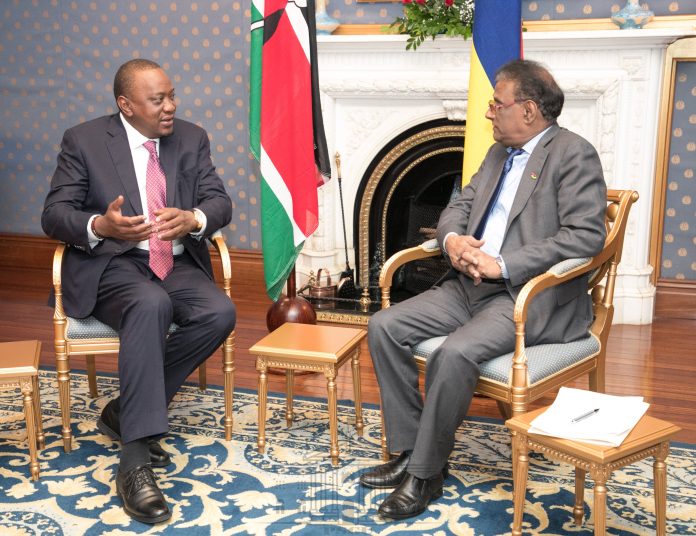
The government of Mauritius has lifted a ban on several Kenyan farm produce as the two countries signed agreements to enhance trade between them.
The ban on avocadoes, baby carrots, baby beans and broccoli was lifted during bilateral talks between President Uhuru Kenyatta and his host Prime Minister Pravind Jugnauth.
The move by Mauritius comes less than six months after the Chinese government opened its doors to the Kenya’s fresh produce.
President Kenyatta said the lifting of the ban by Mauritius will help improve Kenya’s export to the Indian Ocean Island country and is a major boost for horticultural farmers in the country especially women who are the majority in the sector.
During the bilateral talks, President Kenyatta and PM Jugnauth witnessed the signing of several agreements including the Double Taxation Avoidance Agreement (DTAA); an Investment Promotion and Protection Agreement (IPPA); and an MOU on Cooperation for the Development of Special Economic Zones (SEZs) and Export Processing Zone in Kenya.
Other agreements were an MOU in the field of Tourism; an MOU in the field of Higher Education and Scientific Research and an MOU in the field of Arts and Culture.
President Kenyatta said Kenya is bound to benefit immensely from the signed agreements and MOU’s as they would help the country achieve its development goals particularly in manufacturing and job creation.
“Both countries can benefit from the proximity of each other to foster closer cooperation across many areas. I welcome the conclusion and signing of agreements in six areas during this state visit,” the President said.
He pointed out that more bilateral engagements between Kenya and Mauritius will enhance existing cordial relations thereby increasing trade and investment opportunities.
The President said, several opportunities exist in trade and investment, financial services, agriculture, transport and communication, and in culture, education, tourism and research.
He expressed gratitude that the inaugural Session of the Joint Commission for Cooperation (JCC) which was held in August 2018, has helped the two countries to deepen and enhance the scope of bilateral engagements.
President Kenyatta pointed out that Kenya and Mauritius are well placed to collaborate in championing the development of the blue economy since both countries are littoral states with long coastlines.

The Kenyan Head of State said there is need for the two countries to explore ways of enhancing cooperation in maritime transport by linking Port Louis to the Port of Mombasa as a catalyst for growing business and trade between Kenya and Mauritius.
“Kenya is making good progress in developing the Port of Lamu as part of the Lamu Port South Sudan Ethiopia Transport Corridor (LAPSSET) project, I look forward to Mauritius sharing in the dividends that will accrue from the transport infrastructure once it is complete,” President Kenyatta said.
He invited Mauritian investors to participate in the Special Economic Zones which the government has set up at the Port of Mombasa and within the Export Processing Zones.
The President said collaboration in this area will be enhanced through sharing of best practices and in the development of an integrated regional value chain in the textile sector.
President Kenyatta has arrived in Mauritius for a four-day State Visit
President Uhuru Kenyatta this evening arrived in Port Louis, Mauritius for a four-day State Visit.
The plane carrying President Kenyatta and his entourage touched down at the Sir Seewoosagur Ramgoolam International Airport shortly before 7pm local time.
On arrival, the President who was received by Prime Minister Pravind Jugnauth, inspected a guard of honour mounted by a detachment of the special mobile force of the Mauritius Police Service followed by a 21-gun salute.
After the arrival ceremonies, President Kenyatta paid a courtesy call on the Acting President of Mauritius Paramasivum Pillay Vyapoory at State House, Le Reduit.
President Kenyatta’s visit to Mauritius is largely aimed at boosting the economic, cultural and social ties between the two nations.

 During his visit, President Kenyatta will attend a business forum organised by the Mauritius Economic Development Board in collaboration with the Mauritius Chamber of Commerce and Industry, the Kenya Private Sector Alliance (KEPSA) and the Kenya Investment Authority which will be used to showcase trade and investment opportunities in Mauritius and Kenya.
President Kenyatta is accompanied by Cabinet Secretaries Monica Juma (Foreign Affairs) and Prof. George Magoha (Education) among other senior government officials.
India elections: who are Narendra Modi’s main rivals – and can they beat him?

India is heading to the polls in the world’s biggest democratic election and a number of different figures could emerge as India’s next prime minister in May.
The incumbent, Narendra Modi, and his main opponent, the Congress Party president, Rahul Gandhi, are obviously the most likely candidates. But if they both fail to gain sufficient seats to form a government, they could be displaced from within their own parties. It is also possible that, in a fragmented parliament, another politician from one of the regional parties could stitch together a coalition.
In 2014, the electorate delivered Modi’s Bharatiya Janata Party (BJP) the first absolute majority gained by any party since 1984. Tired of a Congress Party-led government mired in corruption scandals and rampant inflation, voters embraced Modi’s promise to clean up politics, cut red tape, create jobs, and restore confidence. They also embraced Modi himself, despite his controversial past as a Hindu nationalist firebrand, responding positively to his claim that he had matured into a selfless vikas purush (“development man”).
But the Modi government’s failure to deliver what it promised has tarnished that image. Anti-corruption efforts have caused pain, with small businesses hit by the sudden decision in late 2016 to withdraw large denomination banknotes from circulation. Economic growth has flagged, and jobs are scarce.
Despite this, in February, a terrorist attack in disputed Kashmir and a retaliatory Indian air strike on Pakistan have made national security the salient election issue, handing Modi another chance to reinvent himself. In response, he has assumed the mantle of a chowkidar (“watchman”), asserting in a slick media campaign that in these troubled times, he and his supporters are best suited to defend India from its enemies both inside and outside the country.

Click here to listen to India Tomorrow
The dynasty
Modi’s principal opponent, Gandhi, has been caught flatfooted by this shift. The scion of the Nehru-Gandhi dynasty, related to three of India’s former prime ministers, Gandhi is 20 years Modi’s junior, and ought to be more in tune with India’s youthful voters. But he struggled to connect with the electorate, including first time voters, in 2014, when his Congress Party secured just 44 out of 543 contestable parliamentary seats. Since then, he has also struggled to capitalise on the Modi government’s apparent failures to boost economic growth, create jobs, and address rural poverty.
In 2019, the Congress Party should nevertheless do better, if opinion polls and seat projections are any guide. Gandhi will be supported by his popular, if enigmatic, sister, Priyanka Gandhi Vadra. Her striking resemblance to her former prime minister grandmother, Indira Gandhi, appeals to some Congress voters, and her apparent savvy to party officials. She has not yet announced that she will stand for a seat, however, and the allegedly murky real estate dealings of her husband, Robert Vadra, makes her vulnerable to BJP attacks.
The Gandhis have considerable assets – instant name recognition and an established, nationwide party organisation – but also significant weaknesses. Rahul Gandhi’s abilities and commitment remain in doubt.
The Congress campaign has been often negative, summed up in its slogan “Chowkidar Chor Hai” (“The watchman is a thief”). And the fact that the Congress Party is still run by a dynasty – however distinguished – alienates some voters.
Powerbrokers and rivals
It is unlikely that either the BJP or the Congress Party will come close to winning a majority in parliament. To rule, they will need the support of a number of regional allies, especially from the states of Uttar Pradesh, Bihar, Maharashtra, West Bengal, and Tamil Nadu, which account for almost half the seats. This may hand power to regional powerbrokers, such as West Bengal’s mercurial chief minister, Mamata Banerjee, who will be able to direct their MPs to support one or other leader.
These powerbrokers could deliver either main party into government, albeit it at a price, in terms of both cabinet positions and modified policies. Alternatively – in an admittedly improbable scenario – they could even come together to form a Mahagathbandhan or “grand alliance”, with one of their number as prime minister, should either Modi or Gandhi fail.
It is also possible that the BJP could emerge as the largest party and in a position to form government, but with a disappointingly low number of seats, leading to a challenge to Modi’s position. So far, he has been fortunate that some of his potential rivals within the BJP, such as external affairs minister Sushma Swaraj, have been unwell or unwilling to challenge his leadership.
Recently, however, the names of potential successors have been canvassed more openly, including that of roads and railway minister Nitin Gadkari. Should the BJP lose more than a 100 seats, some speculate that an alternative leader, with a less autocratic style better suited to managing a delicate coalition, could well be sought out by the party.
You can listen to the trailer for India Tomorrow here, and also sign up to The Anthill newsletter to get an email about each new episode. Get in touch with any questions about the Indian elections via podcast@theconversation.com or reach out on Twitter @anthillpod.


Ian Hall, Deputy Director (Research), Griffith Asia Institute, Griffith University
This article is republished from The Conversation under a Creative Commons license. Read the original article.
Woman linked to controversial Riara Land sale denies charges
BY PRUDENCE WANZA – A mother of four and a resident of Nairobi county has denied charges of sh. 300m fraud charges concerning a parcel of land along Riara road, Nairobi County.
Pastor Ng’ang’a arraigned in court over 3.6 Million shilling plot

BY PRUDENCE WANZA – Controversial apostle Ng’ang’a of Neno Evangelism has been charged of obtaining 3.6m from one Wickson Njoroge Mwathi.