Sponsored Ad

Ad 1
Ad 2
Ad 3
Ad 4
Ad 5
Ad 6
32.5 C
Kenya
Sunday, April 26, 2026
Home Blog Page 6088

Fraudster behind bars for stealing 2 Million shillings

By PRUDENCE WANZA – A man has been arraigned in court  for defrauding one Mr. Omar Haji Hassan a total of Ksh. 2 Million. 
The accused, Izzudin Haji Ali, pretended to be in a position to transact a joint business of operating  a petrol station and selling foodstuffs in Eastleigh together with Mr.Omar a fact he knew to be false. 

Appearing before Chief Magistrate, Francis Andayi, at the Milimani Law Courts, he pleaded not guilty. 
He has been released on a bond of Ksh. 750,000 and an alternative cash bail of Ksh. 500,000.
The case will be mentioned on 8th April, 2019 and heard on 7th  May, 2019.

Con man released on 2M bond for swindling money.

Stephen Mbugua, Arraigned at milimani Courts | Prudence Wanza

A man has been arraigned in court for obtaining a total of 162,000 US dollars from one Joseph Gitau Kibuchi. 
The accused, Stephen Njoroge Mbugua lied to be in position to sale half an acre of land at Karen to Mr Joseph Gitau, a fact he knew to be false. 
He pleaded not guilty to the charge before the Chief Magistrate, Francis Andayi at the Milimani Law Courts. 
He will remanded at Kilimani Police Station and released upon payment of bond of Ksh. 2,000,000 and an alternative cash bail of Ksh. 1,000,000.
The case will be mentioned on 8th April, 2019 and heard on 7th May, 2019.

Did competition for political interests in the country fuel the 1982 coup

The serialization of the Seasons of Hope by the Daily Nation has brought to light yet another controversial exposé.
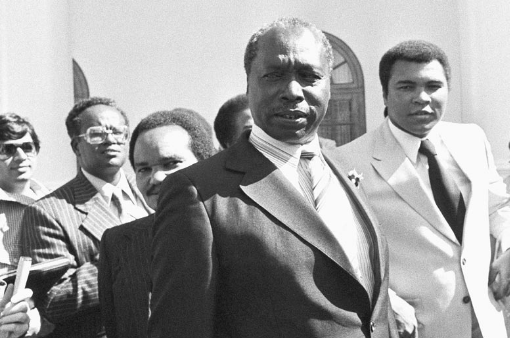
According to the book by David Musila, then President Moi refused to speak on phone to His Vice President Mwai Kibaki. The earlier narrative during the opening of the 1982 coup indicated that a tensed up President refused to sleep in Nyeri and appeared to trust Musila, a mere PC to his substantive assistant.

Fast forward to the post coup snap elections of 1983 and the subsequent purge on all politicians hitherto thought to have been close to Kibaki and Charles Njonjo and the emergence of the “Total Man” Nicholas Biwott, Professor George Saitoti and you see a choreographed political plot meant to tame political careers.

The coup, if Musila is to be believed, becomes the excuse to clip the political wings of established Central Kenya politicians.
Later in 1988, Moi used the Mlolongo rigged elections to humiliate Kibaki before demoting him to the Ministry of Health and appointing Professor Karanja as Kenya’s” Vice President.

David Musila: An MP refused to fund my studies

An MP from the then Kitui North refused to lend the family of David Musila Sh.2000 to able the former Senator pursue further studies in the US.
The narrative, published in his autobiography Seasons of Hope says that the MP took Musila round in circles, even suggesting that Musila was likely to become a scavenger in the US, or even become a beggar after dropping out of school.


The MP then a cabinet minister refered them to Kenya Commercial for assistance. Musila and his Dad, Nathan Muli got a shock of their lifetime when bank officials laughed off the joke. This was in May 1965.
With a dream shattered, a tearful Musila boarded the next available bus to Maingi.
Investigations by Uzalendo have established that the then Kitui North MP was the Late Ngala Mwendwa. He is now deceased and was also a cabinet Minister.

Uhuru takes notes from Africa’s biggest fish freezing factory visit

President Uhuru Kenyatta said African countries must take stronger steps to benefit from their immense marine resources.

He said many nations inlcuding Kenya gain almost nothing from their sea resources including fish.

The President said it was disappointing that foreign nations are benefiting more from the abundant fish in the territorial waters of many African countries.

He said African nations should work together and learn from the examples of countries like Namibia which has implemented progressive measures to develop its fisheries sector.

The Kenyan leader spoke when he toured Seaflower Pelagic Processing factory in Walvis Bay, Namibia, which has the distinction of being the biggest fish freezing factory in Africa.

The factory was set up recently at the cost of 40 million US dollars (about KSH 4 billion) through a partnership between the Namibian Government and a private investor.

The factory freezes 600 tonnes of fish on a daily basis and has created jobs for 700 people.

President Kenyatta instructed Agriculture Cabinet Secretary Mwangi Kiunjuri and Trade and Industry CS Peter Munya to immediately take steps to learn from the Namibian experience so that Kenya can have a similar factory.

Namibia’s Vice President Dr Nangolo Mbumba and Fisheries Minister Bernhardt Esau said the Government embarked on strengthening fishing in order to give Namibia a food security guarantee.

Vice President Mbumba said Namibia and Kenya are united by true freindship that started when Namibians were fighting for freedom.

“When SWAPO was fighting for freedom, the first vehicle it ever owned was bought by Kenya. We will also never forget the role played by the Kenyan contingent of UNTAG which remained behind at the cost of Kenya to protect Namibians until the country was stable,” said Vice President Mbumba.

President Kenyatta toured the fish factory after visiting the headquarters of Namibia port authority, Namport, also in Walvis Bay.

“We are here to learn from how Namibia is benefiting from its blue economy even as we continue to support and partner with them in various other fields,” said President Kenyatta.

The port of Mombasa and Walvis Bay are similar because they serve many nations in the interior of Africa.

The President was taken on a tour of the port and shown how the Government is reclaiming land from the sea to enable the port to handle ships with bigger capacity.

To enhance its efficiency in serving neighbouring landlocked countries, Namport has assigned dry ports to the different nations so that they can manage their own cargo.

President Kenyatta said Kenya will study the idea of dry ports for neighbouring countries that depend on the Port of Mombasa for their imports and exports.

“That kind of arrangement can let them manage their own cargo and our job will be to be efficient port owners,” said President Kenyatta.

He said the port of Mombasa and Namport will partner in the areas of efficiency enhancement, and the bridging of management and administration gaps that lead to corruption with the aim of improving service delivery.

The President said mismanagement and other malpractices at the ports create inefficiencies which in turn affect economies of many countries that depend on these ports as gateways into their countries.

The Namibian Government has already requested guidance from Kenya in the setting up of a single window system for processing and clearing transit cargo across many borders. The system allows importers to input data once which is then used by all countries through which the goods pass on their way to their destinations.

President Kenyatta said Africa will only succeed when all nations agree to collaborate to achieve progress.

“If Africa succeeds Namibia has succeeded and if Africa succeeds Kenya will also have succeeded,” said President Kenyatta.

President Kenyatta is on a State Visit to Namibia and was yesterday hosted at State House, Windhoek, where he held bilateral talks with President Hage Geingob.

On Thursday, President Kenyatta was the Chief Guest at the 29th Namibia Independence Day celebrations.

Why Kenya must take control of sand harvesting off its coast

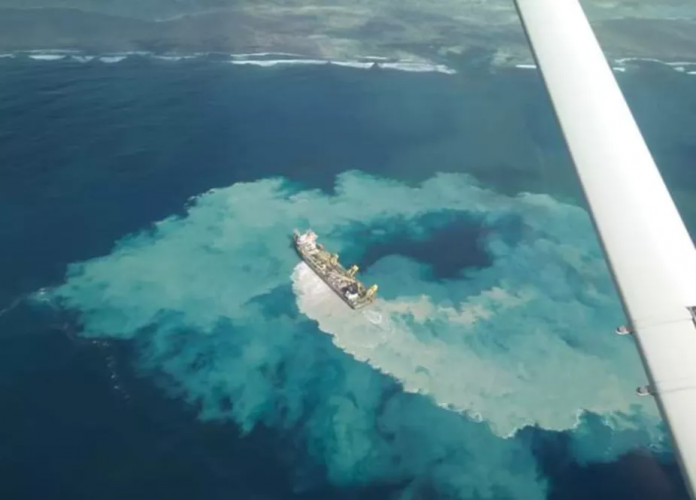
Dutch vessel, Willem van Oranje, harvests sand off Kenya’s coast. CORDIO David Obura, The University of Queensland

Kenyans have taken to social media to protest against what they claim is illegal sand harvesting off Diani beach, one of the country’s most popular coastal areas. The Conversation Africa’s Moina Spooner spoke to David Obura about why this is an issue.

Is sand harvesting a problem on the Kenyan coast?

The harvesting of sand from Kenya’s ocean beds has made headlines in recent years. It’s a growing problem. The most publicised case was in 2016 when the China Road and Bridge Corporation started to collect sand off the Waa reef for construction of the standard gauge railway in Mombasa. This was done without a suitable Environmental Impact Assessment and eventually the National Environment Tribunal revoked their license, putting a stop to it.

The main problem is that mega-infrastructure projects – like the country’s new standard gauge railway – are coming online and they need resources, like sand. Sand is crucial for construction and is used in the foundations of buildings, railways and port terminals. But the government has not identified where relevant sources are, the total anticipated demand, nor where sand should be extracted.

There needs to be a national strategic environmental assessment which focuses on sand for large scale construction. This would help inform where sand harvesting should be done and locations where conflict with other sectors, like tourism and fisheries, could be avoided.

For individual projects, where harvesting is allowed, there then needs to be an environmental impact assessment which would highlight what mitigation measures need to be put in place to minimise damage. What has been missing from all assessment reports so far is real-time monitoring of sediment plumes, how they are affected by the wind, waves and tides, and what would trigger harvesting activities to be postponed or altered to avoid damage to nearby sensitive reefs.

These environmental studies are good for all concerned, as the constraints would be transparent and useful for planning and long term investments.

Who is harvesting sand and why?

Sand harvesting is being carried out for construction of the second phase of the container terminal in Mombasa’s Port Reitz.

It is being harvested off the Waa coral reefs off Diani beach in Kwale County, on Kenya’s south coast. The harvesting is being carried out by the Dutch vessel Willem van Oranje, funded by the Japanese International Cooperation Agency.

After the sand is harvested it is then deposited at the terminal.

What impact can this have?

Sand harvesting can have a huge impact on coral reef and seagrass ecosystems.

The volumes of sand needed are immense. Removing this amount of sand will have a number of consequences. It will deepen the seafloor at the base of the coral reefs and the sand balance between undersea sediments and shorelines will change. In addition, popular beaches of the Diani area may become eroded.

Sand harvesting also creates large plumes of sediment, both on the seafloor and at the surface.

If carried to the reefs and seagrasses by tides, currents and wind, the sediments suffocate and kill corals.

The sediment plumes can also suffocate invertebrates, algae and fish, killing the reef.

This activity is being opposed because the Kenyan government hasn’t formally designated locations or guidelines for sand harvesting from the sea. Environmental impact assessment should have been prepared. In fact the current activity is based on reports and approvals that are over five years old.

A similar activity was stopped by the National Environment Tribunal in February 2016. At that time the environmental license was withdrawn on the grounds that the environmental impact assessment didn’t adequately address potential impact to the reef and people dependent on it.

Since that decision no new environmental impact assessment or consultation has been undertaken. If it had been done then the opposition by various stakeholders – like the tourism and fisheries sectors, coastal residents, marine scientists and hotel managers –- could have been taken on board and solutions found to avoid the current conflict.

How is the government addressing it?

So far the government has been completely silent. There are a couple of things it should do.

Kenya’s National Environment Management Authority should suspend the operations immediately. It must require that the 2014 environmental impact assessment be updated. The assessment must also specify relevant options for monitoring the adjacent reef and limiting sediment plume effects, and consult the relevant authorities in the county government.

And considering the regular and mega-infrastructure projects, the relevant government agencies should institute a strategic environmental assessment around the need for sand for construction. This should specify where large scale collection can or shouldn’t happen -– with individual environmental impact assessments conducted for each project.The Conversation

David Obura, Adjunct Fellow, The University of Queensland

This article is republished from The Conversation under a Creative Commons license. Read the original article.


Seasons of Hope: A glimpse of Kenyan politics through the eyes of David Musila

Former Kitui Senator David Musila is set to launch a tell-it-all book titled, Seasons of Hope.

Seasons of Hope launch will be graced by former Vice President Moody Awori.

The book takes synoptic look into the life of Musila, spanning over four Presidents namely Mzee Jomo Kenyatta, Daniel arap Moi, Mwai Kibaki and President Uhuru Muigai Kenyatta inspiring readers to stand up for the truth.

At the launch several government and former veterans in Kenyan politics will be expected at National Museum

Kenya plans to shelve more products in Namibia after direct flight plans kick-off

President Uhuru Kenyatta and his Namibian counterpart President Hage Geingob today held bilateral talks where they agreed to increase the people to people interaction between Kenya and Namibia in order to increase trade between the two countries.

The leaders said they will soon implement a five year visa plan for Kenyan business people interested in trading in Namibia. The plan is expected to eventually lead to a visa free regime between the two countries.

President Kenyatta, who is in Namibia for a State Visit, said Kenya is keen to export more products including its famous tea and coffee to the Southern Africa nation.

He said the sizeable Kenyan professional and business diaspora in Namibia has already created a foundation for stronger ties between the two nations.

President Kenyatta, who spoke at State House, Windhoek, said the bilateral relations between Kenya and Namibia are founded on shared values and common aspirations.

“We have an opportunity today to review the existing areas of cooperation and chart the way towards a status of strategic cooperation,” said President Kenyatta.

President Kenyatta and Namibian counterpart President Hage Geingob, who spoke at State House, Windhoek | PSCU

He said Kenya will continue supporting Namibia with expertise in various fields including health, engineering, architecture and governance. The President said Kenya will support Namibia in setting up of cooperatives to make the agricultural and fishing sectors more productive.

In reciprocation, Namibia will support Kenya in developing its fisheries sector so that the blue economy can contribute more to Kenya’s economy.

“We need closer cooperation with Namibia in the fishing sector. We need partnerships to exploit the Kenyan fisheries resources because currently we get almost nothing from our fish in the sea,” said President Kenyatta.

He said the two countries have already agreed to link the ports of Mombasa and Walvis Bay as Kenya embarks on programs to expand its ports.

The Kenyan leader said the country will continue strengthening its defence and security cooperation with Namibia.

President Kenyatta said Kenya and Namibia will work together to fast track the implementation of the Africa Continental Free Trade Area (AfCFTA) agreement

On his part, President Geingob said talks are at an advanced stage to start direct flights between Nairobi and Windhoek.

“We hope for direct flights from Nairobi to Windhoek and then we can do a lot more in trade and investment,” said President Geingob.

He said the free movement of people will contribute to increased trade and deepen the strong historical ties between the two nations.

President Kenyatta was accorded a 21 gun salute after which he inspected a parade by the Namibian Defence Force (NDF)

President Geingob said Namibia is keen to work more closely with Kenya in manufacturing and value addition especially in the minerals sector.

“Namibia is known for its beef, fish, diamonds and marble stones but we send the marble stones to foreign countries and we buy them back when they are polished,” said President Geingob.

He said Kenya is a leader in digital innovation and Namibia can learn a lot from the East African nation.

The two Presidents later witnessed the signing of an agreement on diplomatic services between Kenya and Namibia.

On arrival at State House in the morning President Kenyatta was received by his host and was accorded a 21 gun salute after which he inspected a parade by the Namibian Defence Force (NDF).

Con woman Charged For swindling Sh 2Million

A woman has been charged at the Milimani Law Courts for swindling Ksh. 2M from one Samuel Njuguna Ndirangu. 

The accused, Janet Wanjiru Ndirangu, approached Mr. samuel Njuguna, claiming that she can import a container load of second-hand clothes. Samuel, according to the prosecutor, agreed to pay 2 million shillings for the business.

Janet Wanjiru at the Milimani Law Courts for swindling Ksh. 2M

Appearing before Chief Magistrate,  Martha Mutuku,  she pleaded not guilty to the charge. She was released on a bond of Ksh. 500,000 or an alternative cash bail of Ksh. 300,000.
The case will be mentioned on 5th April, 2019 and later heard on 23rd April 2019.

Kenyans in Diaspora to get new generation Passports

President Uhuru Kenyatta last evening directed relevant Government agencies to come up with mechanisms of ensuring that Kenyans in the diaspora are issued with the new generation passports in the countries of their residence.

President Kenyatta said he saw no reason why Kenyans living outside the country should incur huge financial costs to travel back home to acquire the new passports.

The Head of State spoke at the Windhoek Country Club where he met Kenyans living in Namibia.

“Form a team that will go from country to country to register Kenyans in the diaspora. No Kenyan should be forced to spend money to travel to Kenya to get passports,” the President directed the relevant government agencies.

The President was responding to requests by Kenyans who spoke at the meeting and raised concerns over the difficulties those living outside the country undergo to acquire the new document.

Among the speakers at the forum were Prof Peter Nyarango, the Dean of the Medical School of the University of Namibia and businessman Peter Wamburi.

Prof Nyarango said Kenya’s education system should be geared towards empowering the youth to be employable in a changing world. He said Kenya is projected to have a population of 100 million by 2050 out of which 65 million will be youth aged below 25 years.

The Professor said the guiding factor in Kenya’s education system should be to capitalise on Kenya’s edge in innovation and research.

In his response President Kenyatta said, “My government has embarked on making changes on the curriculum to meet the emerging market needs”.

The Head of State added that even though there are challenges in the implementation of the new curriculum, his administration will not be deterred from its full implementation as it will equip Kenyan children with skills and knowledge that will shape their future better.

The business fraternity represented by Peter Wamburi acknowledged that Namibia treats Kenyan professionals, business people and the diaspora in general like brothers and sisters. They credited the good treatment to the excellent bilateral relations that exist between the two nations. Majority of the Kenyan diaspora migrated to Namibia following an MOU signed between the Kenyan and Namibian governments in 2002 through which many health professionals especially nurses secured employment in the Southern Africa country.

President Kenyatta assured the nurses who are returning to Kenya from Namibia after the end of their contracts that they will get their jobs back when they get back home.

Create a free account, or log in.

Gain access to read this content, plus limited free content.

Yes! I would like to receive new content and updates.

Sponsored Ad

Ad 1
Ad 2
Ad 3
Ad 4
Ad 5
Ad 6