Home Blog Page 6279

Selling sex: Wonder Woman and the ancient fantasy of hot lady warriors

When the film Wonder Woman released in early June, it will surely join the blockbuster ranks of other recent comic book-inspired film franchises, including Batman, Superman, Spiderman, and X-Men. But that’s not just because it features a sword-wielding Gal Gadot in knee-high boots and a metal bodice.

Wonder Woman has long been a bestselling creation, originally imagined in 1941 by the psychologist William Moulton Marston, and the film follows some of the main plot lines developed in the comic books.

Wonder Woman is a superheroine known as Diana, princess of the Amazons, who is trained to be an unconquerable warrior. When an American pilot, Steve Trevor, crashes on the shores of her sheltered island paradise and tells tales of a massive conflict raging elsewhere, Diana leaves her home, convinced she can stop the threat.

Though Wonder Woman was portrayed as a feminist icon in the 1940s, she is also a highly sexual character.

We can only wonder – no pun intended! – about the reasons for this imagined link between war and female sexuality. As a sexy but fierce lady warrior, Wonder Woman is hardly alone. Throughout history, cultures across the globe have envisioned and revered the femme fatale, from feline killers to sensual goddesses to sassy spelunkers.

The Sumerian “wonder woman”

In 3000 BC, in the ancient Sumerian city of Uruk in Mesopotamia, the first kings of human history ruled over the south of modern-day Iraq, protected by Ishtar, a great goddess of war and love often associated with lions.
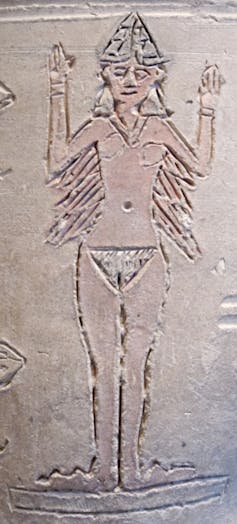
Ishtar, naked on a vase. Louvre/Wikimedia

Ishtar would reveal the kings’ enemies and accompany them to the battlefield. It was said that she fought like an unleashed lioness protecting her young – in this case, the Sumerian people. Like Wonder Woman, Ishtar’s sacred duty was to defend the world.

She could also be sensual. More than merely worship the goddess, the Kings of Uruk claimed to be Ishtar’s lovers, who, according to royal hymns of the era, would enter her bed and “plow the divine vulva”.

For the king, receiving sexual and military favours from a goddess served his political agenda, legitimised his reign and made him into an exceptional hero for his people. In the Wonder Woman film, this role is filled by the American pilot.

References to divine lovemaking are also found among ancient Palestinians, Babylonians, though scholars can’t confirm what was really going on in those temples.

Cat girls from Sekhmet
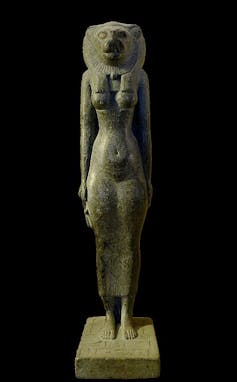
Bastet as a lion. Mbzt/Wikimedia, CC BY-ND
Lee Meriwether as Catwoman in the 1960s. Ebay/Wikimedia

What’s more sexy than a powerful woman? Taming her, of course.

In ancient Egypt, the most fearsome goddess was named Sekhmet. Like Ishtar, she had two sides – fierce beast and loving companion.

Sekhmet was often portrayed as a terrible lioness, the butcher of the Pharaoh’s enemies. At times, though, she would transform into an adorable cat named Bastet.

Today, the feline is still symbolic of female sexuality. Catwoman, another comic book heroine, was born a few months before Wonder Woman (not that a lady reveals her age) and is the most contemporary avatar of a feline woman.

With her curves and her bondage fetish, Catwoman has always been hypersexual, though some critics regret that her sexuality – not her intelligence – has become her greatest asset these days.

Amazons, the lonely sailors’ dreams

Warrior women with sexual natures are also found among the ancient Greeks.

Their myth of the Amazons tells of a Mediteranean kingdom in which it was women who fought and governed, while the men were relegated to domestic duties. Marston’s Wonder Woman comic invokes the Amazons’ city, Themiscyra, and the name of their queen, Hippolyta.

He embellished his ancient Amazonian setting with details from the legend of the women of Lemnos, in the Aegean Sea, adopting the isolated island idea as Wonder Woman’s home.

According to the Greek story, the women of Lemnos had revolted and massacred all the men on the island, young and old. Living in a forced sexual abstinence, the ladies were delighted when sailors unexpectedly landed on a local beach. They immediately set upon the Argonauts, a team of beautiful and famous mythological heroes that included Hercules and Theseus, compelling them into long orgiastic intercourse.

The sex-starved but unattached women theme is another favourite male fantasy, offering imaginary satisfaction of sexual scenarios that may be difficult to realise in real life.

Our modern Amazon. TombRaider Wikia

By the late 20th century, Lara Croft came along to update the idea of the Amazons and the ladies of Lemnos. Croft, an English archeologist-adventurer who started life as a character in the 1990s video game Tomb Raider, was the ultimate virtual-reality dream girl: she is an expert in martial arts, great with a gun and super smart.

Plus, she always leaves the guys wanting more. Reincarnated on the big screen in 2001 by actress Angelina Jolie, Croft often gave the cold shoulder to her male counterparts. Later sequels featuring Alicia Vikander continued to pitch Croft as a sex symbol while bolstering her feminist credentials.

Women and weapons, the ultimate fantasy?

The new Wonder Woman film seems to have made a careful choice of actress, looking beyond just a pretty face and a remarkable body. Gal Gadot has both of those, but she’s a lot like the heroine in other ways, too.

Voted Miss Israel in 2004, Gadot was also a sports coach in the Israeli army. In a August 2015 interview with Fashion magazine the actress, who was then 30, affirmed that her military experience prepared her well for a Hollywood career.

Gal Gadot in the Chinese film poster for Wonder Woman, to be released in China on June 2. Reddit

On screen and off, the ancient link between femininity, sexual attraction and the military, seems to still be going strong today. Everything from Wonder Woman and the Instagram account of Israeli soldier-cum-amateur model Maria Domark to the rise of a new sub-genre of lady warriors in Asian cinema and, of course, American weapons catalogues, confirms the old masculine fantasy associating pretty faces with guns.

The new Wonder Woman film channels all this history. Pop culture attempts to showcase the heroine as a feminist cannot counteract thousands of years of global sexual fantasy. But you can bet it’ll be a hit at the box office.The Conversation

Christian-Georges Schwentzel, Professeur d’histoire ancienne, Université de Lorraine

This article is republished from The Conversation under a Creative Commons license. Read the original article.

KeNHA Seeks Revocation of Work Permits for Chinese Contractors Involved in Assault

BY PRUDENCE WANZA –

The Kenya National Highways Authority (KeNHA) has announced steps to revoke the work permits of four Chinese nationals implicated in the assault of a KeNHA officer.

In a statement issued to newsrooms, the authority expressed concern over reports of the incident, which occurred last week. KeNHA confirmed that on May 21, 2019, it expelled the involved staff from the project site and has formally recommended the cancellation of their work permits.

“In addition, we have instructed that the four Chinese employees and one Kenyan staff member involved in the assault be replaced within 21 days,” the statement read.

The individuals in question—four Chinese contractors and one Kenyan—had been working on the Loichangamatak–Lodwar road project in Turkana County. They were arrested and charged in court following the physical assault of a KeNHA officer. However, the suspects were released on Tuesday after the charges were reportedly dropped.

KeNHA has also written to China Railway No. 5 Engineering Group, the company overseeing the project, citing the misconduct as a violation of contract terms.

“These measures are being taken without prejudice to any current or future criminal proceedings related to the actions of the staff involved,” the authority clarified.

6 CAK officials charged in court over allegations of procurement irregularities

BY PRUDENCE WANZA – Six Communications Authority of Kenya officials in court at Milimani Law Courts facing charges involving procurement irregularities.

The six are; Joyce Nyambache Osinde(Assistant Director and head of Procurement), Stanley K. Kobe(tender Committee meeting member), Leo Kibet Boruett(tender Committee Member), Jane Jeptanui Rotich (Tender Committee Member), and Philip Kiplangat

According to EACC there are allegations of procurement irregularities against the Assistant Director of Procurement at CAK.

Joyce Nyamba is alleged for having an upper hand during the evaluation of the tender for renovati of the Authorities Agriculturalist Society of Kenya show.

However three more suspects connected to the case are still at large. The three are Mutua Muthusi (former director CAK) periscope Nkonge and John Omo.

38 KRA Suspects to be released on Ksh 200,000 Bail

BY PRUDENCE WANZA – First 38 KRA suspects who were detained for 14 days will now be released on a cash bail of Sh.200, 000 and ordered to be reporting to the DCI every morning at 10.00am.

Justice Luka Kimaru rules pending the substancial ruling on Tuesday 22nd May, 2019.

The DCI had earlier sought to detain them for 21 days before Senior Resident Magistrate Paul Mayova who granted them 14 days.
The suspects how ever appealed the ruling before the high court.

Confession of One Suspect in Lawyer Willy Kimani’s Murder Will Now be Used as Evidence

BY PRUDENCE WANZA – Five suspects on trial for the murder of lawyer Willy Kimani suffered a huge blow on today after lady justice Jessie Lesiit ruled that confession of one of them will be used as evidence.

Police informer Peter Ngugi gave an extensive confession to the detectives on video during investigations and later sought to disown it.
He claimed to have been duped that he will receive Sh 30, 000 monthly, a safe house and a car in order to lend a hand in the investigations.

Ngugi through his lawyers disputed the use of the confessions as evidence claiming he did not understand what he said to investigators.
He claims to have been given forms written in English which he did not understand.

But Lesiit said the video and statements were taken within the provisions of the law therefore they will be admissible in court.
Kimani was killed in Mlolongo on June 23, 2016.

He was abducted after leaving Mavoko law courts together with his client Josephat Mwenda and taxi driver Joseph Muiruri. They were all killed.

Ngugi gave graphic details of implicating himself and his co accused persons in the murder of slain human rights lawyer who worked for the International Jurists Mission (IJM). 

Ngugi, and four AP officers Fredrick Leliman, Stephen Cheburet, Sylvia Wanjiku and Leonard Mwangi were charged with killing Kimani in court where they denied the charges.

Justice Lesiit said the use of the confession in the trial of the Ngugi and his accomplices is lawful.
She dismissed claims by the suspects’ claims that the case has delayed for long and that only seven witneses have testified since the start of the case more than two years ago.

“From the proceedings, I found that 37 witnesses have testified, 34 in 2017 and two in 2018. The case was adjourned seven times and most of those times the delays were caused by the defense.The prosecution sought only one adjournment which delayed the case by one day,” Lesiit said.

So far six witnesses have not testified. They include two officials from telephone services providers Airtel and Safaricom, three investigators and a witness who was stood down earlier.

The case will be heard between July 5 and 19.

Top 5 Hottest Transfers To Watch Out This Summer

5. Antoine Griezmann (Athletico Madrid)

Antoine Griezmann has told Atletico Madrid he will leave the club this summer, and it looks like Barcelona will finally get their man. Barcelona are willing to pay Antoine Griezmann’s £108m release clause

4. Philippe Coutinho (FC Barcelona)

The domino effect of a Griezmann arrival, plus the money spent on De Ligt, could prompt Coutinho’s departure from Barca. But this one is a tad more complicated, the Brazilian has failed to live up to his price tag, and Spanish publication Sport believe that if Barca were to sell him, they’d want to recoup over half of that initial price (£86m). Manchester United have been linked with the 26-year-old but would likely need to sell first

3. Eden Hazard (Chelsea)

According to Hazard himself, even with the Europa League final still to come. Real Madrid are confident of signing the Belgian, according to Sky sources, with just a year left to run on his Stamford Bridge deal. And if he’s told them he wants to go, will they fight to keep their best player with a transfer ban looming?

2. Gareth Bale (Real Madrid)

Bale has shown flashes of brilliance and single-handedly won them the Champions League last season, but as he approaches 30, his future may lie elsewhere. Bale is under contract until 2022, so won’t come cheap. Tottenham could take Bale in a £10m loan, according to The Sun

  1. Paul Pogba (Manchester United)

Less realistic than Hazard, but Real Madrid could be a destination for Paul Pogba this summer if he decides his time at Old Trafford is up, and particularly if United land Bale. However, L’Equipe reported this week Pogba’s wage demands do not fit in with Real Madrid’s wage structure, and Barca are unlikely to move for the World Cup winner.

Is Raila Losing his Popularity in his Back Yard after Muhoroni Heckling?

Former Prime Minister Raila Odinga has lost popularity by 80%. According to polls run by Ipsos Synovate, he is not only loosing popularity in his stronghold Nyanza, but also in other parts of the country. In the recent poll, Deputy President William Ruto leads the pack as Raila comes in a distant fourth

In a recent turn of events, Turkana governor Joseph Nanok, the ODM Deputy Chairman, is a high profile politician who is now taking sides with the Deputy President William Ruto. This move could potentially diminish Raila’s control of the Far North voting block.

The celebrated Handshake between Raila Odinga and his longtime political rival Uhuru Kenyatta, completely changed the Political Landscape. The two principals went on tour to urge the country to embrace the so called Building Bridges Initiative.

But despite cooling down the temperatures and instilling unkown peace in some parts of the country, Raila seems to have lost track of his most celebrated spirit. The fight against bad governance.

Since the Handshake, the government has been running without a watch dog. No one to call out the Jubilee Government in case they fall far from their promises. Perhaps this contributed to the loss of public appeal of the NASA principal.

Politics is about taking care of the interest of your people and this is something Raila being the party leader does not seem to understand. At some point politics, leadership and lies do change and what Kenyans want are goals which are oriented.

Kenyans want politics that will impact our lives in a positive way. And its high time Raila Odinga understands that . If not, let him pave way for the people who are willing to serve for the good of the people.

He should play his role in infrastructure in the African union which he was elected to do so. And leave those who were elected to represent Kenyans in the national government to do so.

But on another aspect with his likable attributes we can easily say that Raila has not completely lost his popularity as some may say and just maybe people were paid to heckle him at Muhoroni then again Raila is not only popular in Nyanza but all over Kenya.

DCI Nabs Suspects Packing Expired Rice in Kariobangi, Nairobi

BY PRUDENCE WANZA – The suspects found repackaging expired rice for sale will now be detained for 10 days at Parklands Police Station.

Detectives from the Directorate of Criminal Investigation Unit managed to arrest 2 suspects, John Mbugua Kariuki and Jeremiah Kuria Kimani, on 15th May, 2019 at Kariobangi South in Nairobi where they found repackaging several bags of assorted expired rice into bags of foreign brands with extended expiry date. 

The DCI made an application this morning seeking to hold the 2 suspects for 10 days to allow investigations as the matter touches on public interest and touches on the health of Kenyans. 

In the application the DCI cites that the investigations are being carried out in collaboration with the Public health team, KEBS, KRA and the office of the DPP and therefore the agencies will need more time for sampling and conducting analysis on the expired rice. 

The DCI adds that they also need more time to carry out investigations at the Port of Mombasa to authenticate the provided import documents and also visit representatives of foreign companies whose packaging bags were found being used by the suspects for statement recording. 

The DCI further wants a response from the registrar of companies to find out the directors of S.K NAFAKA STORES, the company involved in repackaging the rice and hold the directors to book. 

“Releasing the respondents at this stage may jeopardize investigations since intelligence indicate that most of the unwholesome rice and other foodstuffs are kept in several stores within Nairobi and other towns in the republic which the respondents are yet to lead investigators for recovery and may assist and facilitate removal from the stores and markets they had supplied if released, ” states DCI in the application. 

Court ruled that they be held for 10 days at Parklands Police Station  and be produced in court on 27th May, 2019.

Outgoing Kenya Revenue Authority Dir. General John Njiraini grilled by DCI officials over the ongoing graft investigations

Outgoing Kenya Revenue Authority Director General John Njiraini was on Wednesday grilled by DCI officials over the ongoing graft investigations at Times Tower. It is not clear what the detectives were enquiring about, but whatever it is he spend the better part of the deal at DCI Headquarters in Kiambu Road. It is not clear whether Njiraini was recalled from retirement to deal with a crisis orchestrated by the ongoing purge at Times Tower. But suffice is to say he may also be soaked in the graft probe.

The conspicuous absence of women in India’s labour force

India’s rapid economic growth has been accompanied by falling fertility rates and higher educational attainment among women. These advances often lead to an increase in women entering the labour force, but there has been a surprising decline on this front in India. Less than 30% of working-age women are currently in work compared to nearly 80% of men in India.

The conspicuous absence of women in India’s labour force is part of a wider issue the country is facing when it comes to jobs growth. But the fact that it is affecting women more than men is a worrying trend for India, which tends to rank poorly in UN rankings like the Gender Development Index and Gender Inequality Index, and has historically had low shares of women participating in the labour market. Plus, the number of women working has been gradually falling over the last 30 years.

There are a number of reasons for this, ranging from a lack of jobs growth in female-friendly sectors such as manufacturing, to more women staying in education for longer, and persisting stigma surrounding the idea of women working. As India grapples with boosting the number of jobs available to people – and young people especially – it must ensure it does not leave women behind in the process.


Check out our India Tomorrow podcast series, exploring major issues facing Indian society.


Global trends

It is useful to understand India’s experience against the global landscape. According to the latest estimates from the UN’s International Labour Organisation, the worldwide labour force participation rate in 2018 for women aged 15-64 was 53% while it was 80.6% for similarly aged men. Since 1990, participation rates for both groups have shown an overall decline around the world.

There are, however, variations in these global trends. The number of women working in high income countries went up between 1990 and 2018, largely due to policies like better parental leave, subsidised childcare, and flexibility in jobs. But in South Asia’s low and middle income countries, the number of women working has declined.

In India, female labour force participation fell from 35% in 1990 to 27% in 2018. India fares better than its neighbour Pakistan (where the rate increased from 14% to 25% over the same period). But it lags behind Bangladesh, Sri Lanka and Nepal, and other countries at similar stages of growth and development.

There are regional and demographic differences across the country. Rural women have higher participation rates than their urban counterparts. Married women, less educated women, and women from higher castes are less likely to participate in the labour market.

Reasons for the drop

Both economic and cultural reasons explain women falling out of India’s labour force. The latest evidence suggests that the number of jobs in India is on the decline. This is a significant structural problem for a country with a burgeoning young population. In particular, India has struggled to create labour-intensive manufacturing jobs, many of which favour women. This is in contrast to countries such as Bangladesh that experienced a booming export-led manufacturing sector that led to more employment opportunities for women.

The number of women staying in education in both urban and rural areas has increased, keeping them out of the workforce for longer. But, even when this is accounted for, the numbers of women working remains below India’s peers. For men, greater education leads to higher participation in the labour force.

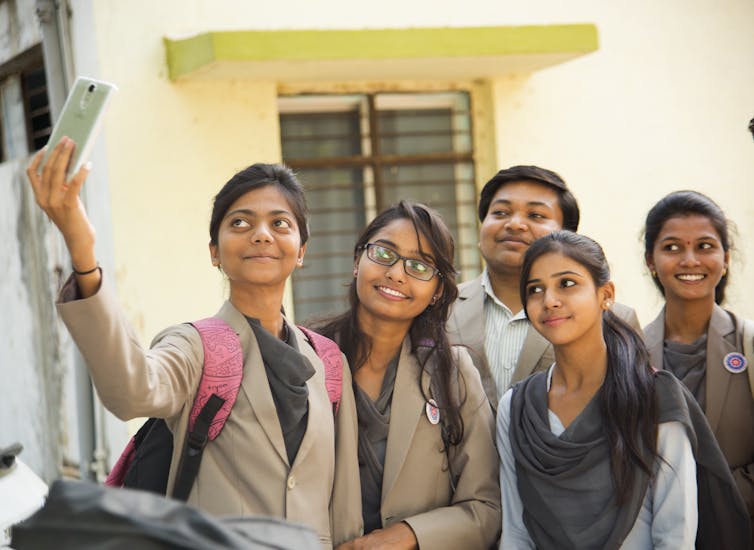
Women are staying in education longer but not going on to get jobs. CRS PHOTO / Shutterstock.com

Across India, there are cultural expectations that married women should not work and that they should prioritise housework and care work. A survey on social attitudes in 2016 found that around 40-60% of men and women believe married women should not work if the husband earns reasonably well.

Another factor keeping women out of the workforce is the wider problem of violence against women. New work finds that sexual violence and an unsafe environment for women also stops them seeking paid work outside their homes – this is especially the case for Muslim and lower-caste women.

Reversing the decline

Gender equality is an important development objective in and of itself. Research shows that when women work they have greater agency and voice and the poorer representation of women in paid work has negative consequences for their bargaining power within their households. Plus, increasing the number of women in work is important for any country’s economic growth, leading to better productivity and improving prospects for future generations.

There are a number of ways to boost the number of women working. Tackling the cultural reasons that result in women leaving the workforce could be one such way. Changing social norms about gender equity and women’s work is paramount, and this is where awareness programmes and affirmative action policies may help alleviate gender stereotypes. The 2017 Maternity Benefit Act, by increasing paid maternity leave, may also help to limit the drop-out of women from work after motherhood. Access to subsidised childcare may also free up time for women to engage in the labour force.

At a more structural level, the next government faces a tough task of reforming the economy to create more jobs. When it does so, it must take into account India’s growing gender employment gap and specifically think about jobs for women, if it wants to reduce this gap and help boost the country’s economy.The Conversation

Smriti Sharma, Lecturer in Economics, Newcastle University

This article is republished from The Conversation under a Creative Commons license. Read the original article.