Sponsored Ad

Ad 1
Ad 2
Ad 3
Ad 4
Ad 5
Ad 6
27.3 C
Kenya
Sunday, April 26, 2026
Home Blog Page 6086

Kenya to customise African Peer Review Mechanism (APRM) for County Governments

Kenya is set to become the first country in Africa to apply the methods used in the African Peer Review Mechanism to strengthen its devolved government system.

The African Peer Review Mechanism, that was pioneered by countries including Kenya, has seen African nations review each other on governance and economic policies leading to improvements in performance in participating countries.

Kenya was first peer reviewed in 2006 and has been the first to undergo a second review in 2017.

The report of the second peer review was launched today at a function held at State House, Nairobi, where the plan to apply the same mechanism to counties was announced.

President Uhuru Kenyatta, who gave the keynote address at the function, said he was pleased with the tremendous progress attained by Kenya through the APRM.


The President said that he is happy that Kenya will set the pace in cascading the peer review mechanism to strengthen the efficient delivery of services at the county government’s level.

“Kenya will be among the first countries to customise the APRM mechanism to the second tier of governance and I believe this will foster democratic dialogue between leaders and citizens in the delivery of services,” said President Kenyatta.

President Kenyatta said Kenya will continue subjecting itself to peer reviews and is ready for the third APRM.

The milestones mentioned in the second review include the promulgation of the constitution of Kenya in 2010 and the establishment of the devolved system of government (County Governments) which has progressively resolved issues of perceived marginalization.

Other milestones include the successful establishment of constitutional commissions and independent offices.


The establishment of various affirmative action funds notably Women Enterprise Fund, Youth Enterprise Development Fund and the Uwezo Fund; and the establishment of Huduma Centres, as one-stop shops for public service delivery, were also cited as key the milestones in the report.

President Kenyatta said the Government is committed to continue improving service delivery to Kenyans and is ready to deal with challenges identified in the APRM report.

Some of challenges identified in the report include the issue of gender equity in governance, insecurity largely attributed to terrorism; containing the overall cost of the devolved system; diversity management for national unity; corruption and the quest for transformative leadership; and poverty and inequality.

The Head of State said following the review, the government has developed a National Plan of Action (NPoA) which outlines the President’s commitment to the implementation of the recommendations made in the report.

President Kenyatta said he will continue spearheading efforts to unite all Kenyans adding that the aim of his call for a united country is not political.

“When we say we want to be committed to bringing Kenyans together this is not a political agenda. There is no political intention of hurting this person or fighting this person,” said the President.

He urged politicians not to politicise the efforts to unite Kenyans because there is no hidden political motive.

“Let us stop politicising everything. This is a challenge we have as a country and we can only deal with it together,” said the President.

President Kenyatta also called on Kenyans to be united in the war on corruption because the country has to deal with the vice in order to achieve progress.


National Treasury Cabinet Secretary Henry Rotich and Kakamega Governor Wycliffe Oparanya spoke at the event.

CS Rotich, whose ministry is the focal point for the APRM process in Kenya, called on all government agencies to support the peer review activities.

Governor Oparanya, who is the chairman of the Council of Governors, said county governments are ready to embrace the peer review mechanism once its modalities are established.

The Chief Executive Officer of APRM Pof  Al-Amin Abu-Manga reiterated Kenya’s willingness to continue being subjected to the peer review mechanism and the achievements it has recorded over the years.

Press Release : KBC Announces new Managing Director

” Pursuant to the provisions of Section 5 (1) of the Kenya Broadcasting Corporation Act, I’m Pleased to announce the appointment of Dr. Naim Bilal Yaseen as the Managing Director of the Kenya Broadcasting Corporation, a State Corporation charged with the public service broadcasting function in Kenya.

Dr. Bilal earned his appointment following a competitive recruitment process initiated by the Board of the Corporation in 2018 and conducted with the assistance of PriceWaterHouse Coopers. He emerged the best candidate in a field of over 35 candidates who applied for the position, leading to interviews of shortlisted applicants on January 24, 2019.

The new MD has a wealth of over 29 years’ experience in media and communication
management, gained in the private and public sectors in Kenya. Until his appointment, Dr.
Bilal was the Acting Director of Information in the Government, under the Ministry of
Information, Communications and Technology. Previously, he served as the Director of Public Affairs and Communication in the Judiciary.

In the private sector, Dr. Bilal worked for the Nation Media Group for 19 years, where he rose to the position of Managing Editor / News Manager in both the Print and Broadcasting Divisions of the Company. Before joining the Government in 2009, he served as the
Director of the House Live Broadcasting Project in the National Assembly, under the
Parliamentary Strengthening Project which was co-implemented by the State University of New York (SUNY Kenya).

Dr. Bilal holds a PhD in Communications Studies from Moi University and a Masters degree in Communications Policy from City University, United Kingdom. As the incoming Managing Director, Dr. Bilal will be expected, together with the
management team and the board, to develop a turn around strategy to wake up the sleeping giant that The Kenya Broadcasting Corporation is.

Specifically, the new Managing Director will be expected to ensure that the broadcaster
becomes the leading choice of information and news for all Kenyans, across its various
broadcast channels. On top of this, he has been tasked to ensure that KBC ramps up its
production capacity and work with local content producers to ensure we have quality Kenyan content is availed through its channels.

Being a signal distributor for free to air digital TV channel, Dr. Bilal will be expected to work with the industry to guarantee improved and efficient distribution of TV content that can be received across the country.
Pursuant to Section 11 of the Kenya Broadcasting Corporation Act, the Managing Director of KBC is vested with the control and executive management of the Corporation, and discharges these responsibilities subject to the directions of the Board.

The Government, through the parent Ministry, is committing to provide all the necessary support required to ensure that the national broadcaster regains its glory of days before.
I congratulate Dr Bilal on his appointment and pledge the Government, and the Board’s
support, as he takes up this challenging but exciting responsibility.

President Museveni becomes first Foreign president to ride on Madaraka Express

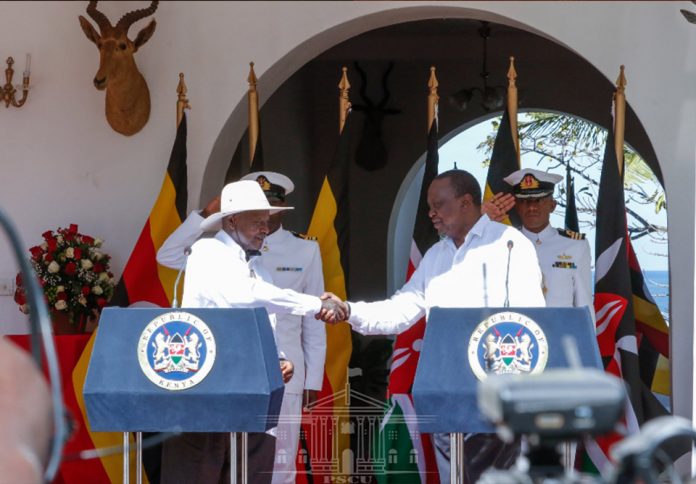
President Yoweri Kaguta Museveni of Uganda made a historic ride on Kenya’s Standard Gauge Railway (SGR) from Mombasa to Nairobi making him the first foreign  Head of State to use the service.

President Uhuru Kenyatta set the pace for the historic journey yesterday when he announced that President Museveni would travel from Mombasa to Nairobi on Kenya’s new modern railway line whose predecessor was christened by British colonialists as the “Lunatic Express”.

“Once again you are making history by being the first Head of State to come to Mombasa on the occasion of a State Visit,” said President Kenyatta when he hosted the visiting Ugandan President for a state banquet at State House Mombasa.

“Again, President Museveni will tomorrow be the first Head of State to travel on our SGR from Mombasa to Nairobi. You have once again made history and showed the remarkable partnership that exists between our two countries,” said President Kenyatta.

The old railway line from Mombasa to Kisumu and later to Kampala was built by British colonial government from 1896 to 1906 and was initially named the Uganda Railway after its ultimate destination.

SGR commuter train christened Madaraka Express | Kenya Railways


President Kenyatta launched the SGR commuter train christened Madaraka Express on Wednesday, 31st May 2017, 120 years after the British Government rolled out the first rail network in Kenya.

The SGR runs parallel to the old metre gauge railway line. Passenger trains run between Mombasa Terminus in Miritini and the Nairobi Terminus in Syokimau near the Jomo Kenyatta International Airport.

On arrival at the Nairobi SGR Terminus, President Museveni was received by his host President Uhuru Kenyatta who was accompanied by Deputy President William Ruto among other senior government officials.

During the four hour journey, President Museveni was accompanied by Cabinet Secretaries Monica Juma and James Macharia.

Uganda President Museveni impressed by Port of Mombasa Technology

President Uhuru Kenyatta and visiting President Yoweri Kaguta Museveni toured the Port of Mombasa where they were briefed on the operations and recent developments at the facility.

Transport Cabinet Secretary James Macharia briefed President Kenyatta and President Museveni on the enhanced Standard Guage Railway (SGR) cargo transportation services from the port to the Nairobi Inland Container Depot.

The Transport CS pointed out that over 3 million tonnes of cargo was moved via the SGR between January 2018 and January this year.

In his presentation to the two Heads of State, Kenya Ports Authority Managing Director Daniel Manduku highlighted the improved performance of the port and the ongoing expansion of the facility.


Kenya Revenue Authority (KRA) commissioner for customs and border Control Kevin Safari and Julius Rubagumya, the Uganda Revenue Authority Manager in Kenya, spoke on the achievements in cargo transportation between the two countries since the implementation of the Single Customs Territory (SCT).

“Our presentation focuses on the concept of the Single Customs Territory whereby we now have Kenya Revenue Authority working side by side with the Uganda Revenue Authority,” said Safari.

Safari said the implementation of the SCT has eliminated duplication of customs procedures in Kenya and Uganda leading to a reduction in cargo clearance time.

On his part, Rubagumya explained the benefits of the SCT saying it has enhanced cargo security through the Regional Electronic Cargo Tracking System in both Uganda and Kenya.

“Enhancing cargo security through the Electronic Cargo Tracking System is a huge relief to our governments but more so to the private sector. We used to have issues of escorts where police would escort cargo from here to Malaba and if you miss an escort on Friday evening maybe you are likely to get escort on Monday,” said Rubagumya.

“I am pleased to report that the physical escort is now history. We are using Electronic Cargo Tracking and we have monitoring centres both in Kampala and Nairobi such that as the trucks start the journey at the port, our officers on those centres are monitoring their movement,” he added.

Rubagumya said that along the roads there are also rapid response units that ensure no one diverts cargo or evades paying tax.

President Kenyatta and President Museveni were impressed by the operations at the port and the close collaboration between the Kenya Revenue Authority and the Uganda Revenue Authority that has improved efficiency at the port.

President Kenyatta inspected the ongoing construction of the modern Cruise Ship Terminal | PSCU


While at the port, President Kenyatta inspected the ongoing construction of the modern Cruise Ship Terminal that is currently 40 percent complete.

Briefing the President on the benefits of the cruise ship terminal, Tourism and Wildlife Cabinet Secretary Najib Balala said the modern facility will boost cruise ship tourism in the country.

East Africa should intervene to defuse Rwanda-Uganda war of words

Presidents Paul Kagame (right) and Yoweri Museveni observe a minute of silence during a genocide memorial. EPA/Ricky Gare Filip Reyntjens, University of Antwerp

The verbal exchanges between presidents Paul Kagame of Rwanda and Yoweri Museveni of Uganda, between their ministers and between their media have been escalating. In the aftermath, borders remain closed and trade and movement of people has been disrupted.

Historically the presidents of Rwanda and Uganda – and their countries – have been close allies. Kagame was among the “originals” of the National Resistance Movement that started a rebellion in 1981 . He and many other Rwandan fighters contributed significantly to Museveni’s seizure of power in 1986. In return, Uganda gave crucial support to the Rwandan Patriotic Front during the civil war in Rwanda. Without it, Kagame would probably not have taken power in 1994.

Again, during the first Congo war in 1997 the two were close allies in support of the rebellion that toppled Mobutu Sese Seko and brought Laurent Kabila to power in 1997.

At the end of the 1990s things changed, and the unthinkable happened. The two friends clashed on several occasions during the second Congo war. They fell out against the background of political differences on how to handle the war. But just as important was the competition between the countries over the exploitation of Congolese natural resources.

Hundreds of their soldiers were killed in 1999 and 2000. The entente cordiale never fully recovered.

A semblance of peace was restored in the early 2000s, but only after Clare Short, the then UK Secretary of State for International Cooperation, summoned the two to London in 2001 to avoid all-out war between Rwanda and Uganda.

A new round of hostilities erupted in 2017. These escalated considerably in early 2019. The Ugandan leadership alleges that there are external efforts to topple the regime. In response, the Rwandan Foreign Minister has claimed that hundreds of Rwandans were illegally deported from Uganda and that many have been arrested and tortured. In early March, Ugandan nationals and vehicles were denied entry at Gatuna border post.

Although a military confrontation remains implausible, today’s situation is reminiscent of the worst days between the two neighbours. Leaders of the region need to do more to avert a violent scenario.

Why relations went sour

In February 2017 a Rwandan news agency, Rushyashya, which was considered to be close to the intelligence services, claimed that a Uganda-backed rebel force was being set up at a training camp to the west of Kampala. It was said to be put in place by the exiled opposition movement Rwanda National Congress with the support of a Rwandan businessman who fell out with Kagame and set up a large tobacco development investment in northern Uganda.

Things came to a head at the end of October, when nine people were arrested and charged in Uganda with conspiracy in the kidnap and illegal deportation to Rwanda of an exiled former military officer six years ago. Lieutenant Joël Mutabazi was sentenced to life imprisonment in Rwanda on several counts related to subversion.

Then in mid-December, the Ugandan intelligence detained a high ranking Rwanda Patriotic Front official for “alleged espionage and activities which threaten national security”.

There have also been other bones of contention. These include air traffic rights, priorities on the construction of the new standard gauge railway, energy projects and French support for the training of Ugandan military units.

A number of incidents showed that relations continued to deteriorate throughout 2018. In early January, a former operative of Uganda’s intelligence agency wrote to Museveni to claim that he had been offered US$100,000 by Rwandan agents to assassinate him. And Ugandan nationals claimed they were being arbitrarily sacked in Rwandan media, schools and banks.

For its part, Kigali again accused Kampala of illegally detaining and torturing its citizens and of harbouring dissidents intent on destabilising Rwanda. Suspected Rwandan agents fled Kampala because of a crackdown by Ugandan security forces.

Distrust

Museveni and Kagame know each other very well. Nevertheless, the distrust between them is considerable. They both seem to genuinely believe that the other is bent on destabilising their respective regimes.

Earlier this month Kagame lashed out, claiming Uganda “had been undermining Rwanda since 1998”. He added that, faced with attempts to destabilise the country, “no one can bring me to my knees”. Museveni responded on the same day with a pointed warning:

Those who want to destabilise our country do not know our capacity. Once we mobilise, you can’t survive.

The Rwandan government has advised its citizens) not to travel to Uganda for safety reasons, and a week later effectively closed the border. This left hundreds of trucks stranded. Even ordinary Rwandans who used to go to Uganda for purchases, schools or medical care were prevented from crossing into Uganda. And to prevent them from using unofficial crossings, the Rwandan army destroyed makeshift bridges and arrested those attempting to pass.

Unconfirmed reports mentioned the deployment of Rwandan troops along the border. In mid-March, Ugandans started to shut down their businesses in Kigali because of a lack of supplies.

What next?

Where does this lead?

Both governments continue to trade accusations and take hostile unilateral actions. They aren’t even talking to one another directly to find solutions. In addition to impeding trade and the movement of people, the impasse is an obvious setback to cooperation and integration within the East African Community. Yet their neighbours Kenya and Tanzania remain silent.

Kenya’s president Uhuru Kenyatta met both Kagame and Museveni on the same day. But nothing concrete seems to have come from the bilateral talks. There’s been no follow-up. And no roadmap has emerged. Yet Kenyatta and Tanzanian President John Magufuli, as leaders of countries that control access to landlocked Uganda and Rwanda, have a powerful lever in their hands.

And if leaders of the East African Community prove unable to tackle this potentially destructive issue, then perhaps the African Union – which was chaired by Kagame until January – should take the lead.The Conversation

Filip Reyntjens, Emeritus Professor of Law and Politics Institute of Development Policy (IOB), University of Antwerp

This article is republished from The Conversation under a Creative Commons license. Read the original article.

First Lady: Stop imposing careers on the youth

First Lady Margaret Kenyatta has advised parents  to  stop imposing careers  on the youth and allow them the freedom to pursue  their talents especially in the creative arts.

She said time had come to change conventional thinking that certain disciplines such as law, engineering, medicine and teaching make great careers.

The First Lady said millennials (adolescents reaching adulthood in the early 21st century) should be allowed to earn their living through pursuits they are passionate about.

“Many times, we have imposed careers on our children; we have pushed them to consider becoming engineers, lawyers, doctors or teachers – anything that, to us, has spelt decent employment,” said the First Lady.

“Our youth want to earn a living quite differently. They want to pursue their passion and I urge us not to fight them,” she continued.

The First Lady spoke when she opened the inaugural Arts and Financing Conference at a Nairobi hotel. The conference brings together stakeholders in the arts industry covering writers, musicians, dancers, Disc Jockeys, sculptors and those in the finance industry including representatives from the Nairobi Securities Exchange (NSE).


“Art and sports as a viable and sustainable investment”, is the theme of the two-day conference.

The First Lady said, as an investment, art has the potential to become a major contributor to the country’s economic development especially in  providing  direct jobs to the youth.

“We are here to affirm the potential of the creative sector as an important source of development,” said the First Lady adding that time is long gone when parents used to be apprehensive about the viability of the creative arts as an economic pursuit.

The First Lady said art in its various forms, creative or expressive, is a commodity with the power to unite people in a shared journey of aesthetic appreciation and interpretation.

She said besides being powerful, creative arts can have real and lasting meaning beyond the money it earns.

The First Lady said art empowers communities by changing the way we view the world.

“Art is a mirror of reality; it beckons us to examine the world around us and to consider what our relationship with the environment is,” she said.

First Lady Margaret Kenyatta applauded the organisers of the conference for their boldness in investing in an initiative that will change people’s thinking of creative arts in the country.

“This forum has opened a new horizon of possibilities. It acknowledges the creative sector as a formidable source of revenue, a source of endless economic opportunity, and a source of jobs for our youth. It can be a profitable, permanent and satisfying career,” the First Lady said.

She applauded the NSE for considering the creative industry as a partner in raising capital to expand investment in the country and called for more such partnerships to create the needed convergence between creatives, collectors and investors.


“I encourage our robust private sector to invest in the creative sector, to invest in our youth to help them build robust and sustainable business cases,” she said.

The First Lady congratulated the Ministry of Sports and Heritage, represented at the conference by CS Amina Mohammed, for supporting the new initiative.

She said the initiative also resonates well with Kenya’s Vision 2030 and Sustainable Development Goals.

Others who addressed the conference included Amb Amina, the Principal Secretary for Culture and Heritage Ms Josephta Mukobe and the Art and Work Founder and Chief Executive Roy Gitahi.

Presidents Kenyatta and Museveni commit to push for more regional integration


President Uhuru Kenyatta and his visiting Ugandan counterpart Yoweri Museveni re-emphasized their commitment to regional and continental integration.

President Kenyatta endorsed President Museveni’s long standing commitment to continental and regional integration saying it is the path to transforming African countries from being developing to truly developed economies.

“I want to assure you that is a commitment that we share. That is a belief that we not only strongly endorse but it is a belief that will move us from developing countries to a truly developed region and continent,” said President Kenyatta

The President spoke at State House, Mombasa last night when he hosted the visiting Ugandan leader at a state banquet.


On trade between the two countries, President Kenyatta said that movement of cargo from the Port of Mombasa to Kampala that previously took 21 days has drastically reduced to 7 days since he took over as President.

President Kenyatta said by August this year, the SGR will have reached Naivasha adding that his government will avail land in the town for Uganda to develop a dry port for its cargo.

“I have confirmed to President Museveni that with that development in Naivasha and then moving the SGR to Malaba, goods will be able to move from Mombasa to Malaba in just two days,” President Kenyatta said.


He said, as the Kenyan government implements the long-term plan to move all cargo from the road to the SGR, his administration is working on the complete elimination of barriers that slow down movement of cargo such as multiple roadblocks and unnecessary weigh bridges.

“But more importantly, it (SGR) will reduce the cost of transport for Ugandan investors and Uganda itself. It will improve efficiency of Mombasa Port to the benefit of our people,” said President Kenyatta.

On the transportation of petroleum products, President Kenyatta said his government was finalizing the construction of the Kisumu petroleum jetty.

“For the first time since colonial days, we are utilizing Lake Victoria for transportation thereby reducing the cost of moving fuel (petroleum) to Uganda and increasing potential for trade between the two countries,” he said.

President Museveni said African countries must embrace economic and political integration in order to spur prosperity and ensure strategic security for their citizens.

He praised the founding fathers of African states such as Julius Nyerere, Jomo Kenyatta, Kwameh Nkrumah, Sekou Toure and other Pan Africanists for championing continental and regional economic and political integration.

The Ugandan leader hailed the revival of the East African Community, joining of COMESA by East African states and signing of the Continental Free Trade Area (CFTA) saying those were progressive steps  towards the political integration of the continent.

“Economic integration if it is implemented properly will result in the modernization of African countries. They will be stimulated to produce more,” said President Museveni.

He called for fast tracking of the political integration of East African states saying the region can easily form a political confederation because her people have much in common unlike other economic blocks which lack a unifying factor beyond economic integration.

“Above all, East Africa and eastern Congo speak Kiswahili. Therefore, the infrastructure for a political integration in East Africa is very strong,” said President Museveni.


Government commits to keep improving the business environment

President Uhuru Kenyatta reaffirmed the government’s commitment to create a conducive environment for private businesses to thrive.

President Kenyatta pointed out that the move is aimed at attracting investments and promoting job creation in the country.

The President said past experience has shown that private sector enterprises succeed more when well supported by the government.

“I say so because the private sector is the engine of growth. Government certainly plays a central role, and equally certainly won’t relinquish it, but the fact of the matter is that the wide prosperity we all want is the product of men and women, not government, turning their labour and capital to productive work,” President Kenyatta said.

The President was speaking in Mombasa today during the Kenya-Uganda Business Forum that was also addressed by Ugandan President Yoweri Kaguta Museveni.


The forum whose theme was ‘Strengthening Economic and Trade Partnerships’ was attended by Deputy President William Ruto.

President Kenyatta said the forum provided an opportunity to boost business, trade and investment between Kenya and Uganda.

“This forum provides an opportunity for Uganda and Kenya to be trailblazers in the region in terms of trade ties,” President Kenyatta said.

He added that the forum underscored the important role played by trade and investment as drivers of international relations.

“It is also a good opportunity to create new business links; to strengthen existing partnerships; and to promote new investments, in capital and shared expertise alike,” he said.

President Kenyatta noted that Kenya and Uganda enjoy thriving economic and trade relations.


Kenya’s value of total exports to Uganda stood at Kshs 61.8 billion in 2017 while the total bilateral trade was Kshs 103.8 billion, a demonstration of the strong commercial ties between the two countries.

“We therefore need to put together the necessary measures to enhance this partnership for the benefit of our people,” the President said.

President Kenyatta said Kenya and Uganda have resolved to partner in developing first class infrastructure under the framework of the Northern Corridor Integration Projects (NCIP) with the aim of increasing connectivity between the two nations and the rest of the continent.

President Museveni said it was clear that the private sector was the vehicle that would create wealth for the two countries.

“It is this wealth which will create the much needed jobs in our two countries,” President Museveni said.

He said for the private sector to operate successfully it needs a stable local and international markets adding that the most important enabler for the both is good infrastructure.

While assuring the private sector of cheaper electricity in Uganda following his government’s investment in power generation, President Museveni once again commended President Kenyatta for giving priority to infrastructure development in Kenya.

Other speakers included Kenya’s CS for Industry, Trade and Cooperatives Peter Munya, East African Business Council Chairman Nicholas Nesbitt and Kenya National Chamber of Commerce and Industry Chairman Kiprono Kittony.

First Lady commends women for transformative innovations

First Lady Margaret Kenyatta commended innovative Kenyan women for coming up with ideas that continue to transform lives in Kenya and the world.

The First Lady said innovations that bring change are key to removing of structural barriers that have in the past hindered women and girls from realising their full potential.

She said it is through innovations that the country will be able to address gender inequalities that slow down the achievement of national development goals.

“Innovation unlocks opportunities by placing people at the heart of development and programs that empower their lives,” said First Lady Margaret Kenyatta.

The First Lady spoke to Kenyan women at the Kenya School of Government in Kabete, Nairobi during celebrations to mark International Women’s Day. Today’s date was specifically set aside to mark the celebrations locally. The annual  event is normally celebrated globally on 8th March.


The theme for this year’s International Women’s Day is, ‘Think Equal, Build Smart and Innovate for Change.’

The theme places innovation at the centre of development especially the role played by women innovators and the impact of their innovations on gender equality and women empowerment.

The First Lady cited various innovations that have transformed households and communities in Kenya such as M-Pesa and the Kenya Women’s Finance Trust’s mobile banking solutions.

She said these innovations have unlocked opportunities for millions of women in the rural areas across the country.

“Tele-medicine has saved many lives of mothers and children in hard to reach remote areas,” said the First Lady.

She applauded Kenyan women and girls who have embraced innovation saying their new ideas in technology and science have helped in coming up with helpful interventions using the internet, mobile telephony and other emerging technologies.


“We celebrate our Kenyan women who are not only consumers of innovation, but also influencers in the innovation space – for providing real solutions using limited resources to improve women and girls access to infrastructure and public service,” the First Lady said.

“I especially want to recognise the school girls who came up with sensors for explosive devices; girls who produced mobile apps to fight Female Genital Mutilation; and girls who developed sensors to alert and avert human wildlife conflict, amongst others. You have made us proud,” said added.

During the function, First Lady Margaret Kenyatta launched the first edition of a book titled, “Pioneers & Transformers: The Journey of Women Trailblazers in Kenya.”

The book celebrates the achievements and the journeys of women as mothers, wives, entrepreneurs, teachers, doctors, activist, conservationists and politicians.

The First Lady also launched a curriculum on women leadership, which will be used to train women interested in politics.


She challenged eminent women in the country to embrace this year’s theme and start mentoring young women to take up science subjects in schools and colleges and also encourage them to enrol in Technical and Industrial Vocational courses to enable them fully participate in the country’s development.

Public Service, Youth and Gender Affairs CS Margaret Kobia said her ministry would continue to strengthen the policy framework to advance gender equality and women’s empowerment.

She said her ministry has   put in place measures to eradicate all forms of discrimination against women and men.

“I am happy to report that since the last International Women’s Day, the country’s endeavour to realize the right to equal opportunities in all spheres for men and women, girls and boys has been remarkable and remains on course,” said CS Kobia.

Spouse to former Prime Minister Ida Odinga condemned the Court of Appeal judges proposal to lower the age of girls consent to sex  from 18 years  to 16 years saying it is unconstitutional and urged women to reject such a proposal.

Mrs Odinga said at age 16, a girl has not matured enough to make independent decisions on such weighty matters.

Other speakers included ICT Cabinet Secretary Joe Mucheru, Kitui Governor Charity Ngilu and Canada’s High Commissioner to Kenya Lisa Stadelbauer.

Man charged in court for failing to supply snake venom

BY PRUDENCE WANZA – There was drama in at Milimani court when a man appeared before court, charged for failing to supply snake venom valued at 881,000.

Emmanuel Mwini Musili was charged of obtaining money falsely by pretending that he would supply snake venom to one Anita Mueni Mbithi.
The accused, Emmanuel, obtained a total of Ksh. 881,000 from Anita and never supplied the snake venom as they had agreed. 
He pleaded not guilty before the Chief Magistrate, Francis Andayi at the Milimani Law Courts. 


He will be released upon payment of a bond of Ksh. 400,000 and an alternative cash bail of Ksh. 300,000.
The hearing of the case has been set on 9th May, 2019.

Create a free account, or log in.

Gain access to read this content, plus limited free content.

Yes! I would like to receive new content and updates.

Sponsored Ad

Ad 1
Ad 2
Ad 3
Ad 4
Ad 5
Ad 6