Sponsored Ad

Ad 1
Ad 2
Ad 3
Ad 4
Ad 5
Ad 6
30.5 C
Kenya
Saturday, May 9, 2026
Home Blog Page 6131

African economies will largely be transformed by ICTs, President Kenyatta says

President Uhuru Kenyatta has called on African countries to prioritize the integration of Information and Communication Technologies (ICTs) in their development plans because they hold immense economic transformation potential. 

The President spoke when he unveiled Kenya’s digital economy blueprint to investors and Heads of State attending the Transform Africa Summit 2019 of the Smart Africa Initiative in Kigali, Rwanda. 

The Heads of State present at the unveiling included President Paul Kagame of Rwanda and Boubakar Keita of Mali. The Rwandan President is the current chairman of the Smart Africa Initiative, a continental body that aims at creating a single digital market.

Kenya’s  digital economy strategy themed “powering Kenya’s transformation” was unveiled in the presence of over 4,000 participants  among them government bureaucrats, policymakers, innovators and technology investors who are meeting to discuss how ICT resources can be harnessed to boost African economies. 

Through the blueprint, the government aims at enhancing the contribution of ICTs to the economy through digital governance solutions, digitizing business processes, facilitating infrastructure delivery, innovation driven entrepreneurship and promotion of digital skills and values. 

As a champion of the digital economy on the continent, President Kenyatta told a summit panel discussion that Kenya has invested heavily in its digital network and is partnering with various organizations to ensure efficient connectivity for all.

“Our vision is that in the next five years, every part of the country will be connected, thus allowing all citizens partake in the digital movement,” said President Kenyatta. 

The President also spoke about the central role of the youth in the digital economy in Africa saying Kenya had fashioned a special intervention targeted at empowering her young people with practical ICT skills. 

“We are encouraging the youth to be proactive and tap into the digital market through our Ajira programme that has seen many get online jobs,” he added. 

Earlier, President Kenyatta toured various exhibition stands at the summit including that of Kenya where various products that enhance efficiency and use of technology in various sectors of the economy including agriculture were showcased. 

In his address, President Kenyatta said Kenya will be at the forefront in driving Africa’s digital economy adding that the country’s globally acknowledged and revolutionary innovations such as MPESA mobile money ecosystem are a demonstration of the continent’s limitless ICTs potential. 

He said Africa stands on the brink of a major transformation, not only as a new frontier for investment but as a continent driven by a young, vibrant and aggressively innovative population, brimming with immense potential.

“We are the new frontier for trade and investment with estimates indicating that by 2025, business opportunities in Africa will be about US$ 5.6 trillion.  More importantly we have evolved platforms for driving this collective destiny of our prosperity,” said President Kenyatta.

President Kenyatta underscored the importance of technology as a fundamental element of Africa’s economic journey to prosperity saying he looked forward the roll out of a Pan-African digital economy strategy. 

The Head of State said Kenya’s proactive digital economy strategy gives prominence to five pillars among them an infrastructure that is available affordable, resilient and reliable.

“Achieving ubiquitous, fast, and inexpensive internet connectivity for African businesses and households is critical to unlocking the potential of the digital economy.  Connectivity needs to reach a certain threshold in order for users to access digital service,” said President Kenyatta.

Besides infrastructure, the Head of State said the availability and use of digital services and platforms to enable public service delivery is of immense importance. 

“Currently, the Kenya Government has over 200 digitized services offered through Huduma Centres countrywide as well as an online self-service platform, E-Citizen,” he told the summit. 

The President said Kenya had taken a bold move to digitize core government services such as filing of tax returns where the Kenya Revenue Authority (KRA) provides services  through the iTax system that is linked to the Intergrated Finnacial Management Information System (IFMIS) and the Central Bank.

“This digital system has helped to speed up assessment and service delivery of the country’s tax administration,” he said.

On electronic commerce, President Kenyatta noted that it would be very difficult to conduct business across Africa without the ability to pay remotely through digital channels.

“Indeed, 39% of private enterprises in Kenya are engaged in e-commerce and 70% of all e-commerce payments in Kenya are settled through various mobile money payment platforms,” he said.

President Kenyatta said that the future of African economies will largely depend on innovation-driven entrepreneurship and called for policies that support local innovations. 

“The presence of an ecosystem that supports home-grown firms to generate world class products and services has greatly helped in widening and deepening of digital and economic transformation. Kenya boasts of a robust innovation ecosystem,” the President said. 

The Kenyan leader however cautioned against the growing misuse of technology saying social vices propagated, especially by young people, threaten to widen divisions based on African narratives of ethnicity, social class, religion and race.

The President is accompanied by ICTs Cabinet Secretary Joseph Mucheru among other senior government officials. 

Another Dusit D2 Terror Attack Suspect Arraigned in Court

BY PRUDENCE WANZA – One more person has been charged in court for facilitating the commission of the Dusit D2 terror attack by sending money. 
The accused, Mohammed Abdi Ali, on diverse dates is alleged to have send Ksh. 907,400 to Ali Saline Gichunge alias Eric Kinyanjui Munyi who was the main suspect and was killed during the attack. 
The prosecution made an application in court for the accused person not to be released on bond or bail as this is a matter of national security and safety of the country and the offense committed is a serious one. 

According to the prosecution led by Harrison Kiarie, the accused was arrested on the 19th of May at the Kenya-Somalia boarder by Anti-Terror Police Unit Officers in Mandera where he was working as a money exchanger. 
He is alleged to have used his two mobile numbers, 0720776*** and 0723049*** to send money to Ali Salim Gichunge which was used to fund the Dusit D2 terror attack on the 15th and 16th of January, 2019.
Further, sometimes back in 2018, between 31st January and 13th February he is alleged to have sent money to an accused person facing terror charges in court. The prosecution also raised questions on why the accused person only stopped sending money to Salim Gichunge 3 days before the attack. 

According to his lawyer Mr. Chacha, the prosecution did not bring out compelling reasons in the affidavit to deny the accused person bail. He further added that the accused person at the time of arrest was a money exchanger at Mandera. “Seriousness of the crime is not a stand alone ground to deny someone bail but a fact that can be used in putting strong bond term, ” he said. 
The accused person appeared before Senior Resident Magistrate, Paul Mayova at the Milimani Law Courts. 
So far over 120 arrests have been made in the course of investigations in relation to the Dusit D2 terror attack and 16 people have been charged in court pending trial.

Ruling on whether he will be made tomorrow on 14th May, 2019.

Bulgarian national to detained pending determination of a case relating to gold scam syndicate

BY PRUDENCE WANZA – A Bulgarian national has been detained pending the determination of a criminal case against him relating to the gold scam syndicate. Yulian Stankov Pentrov alias Vikta Rosta was detained after the prosecution opposed his release on bail.
The prosecution argued that Rashi is a foreigner and has no fixed residence in the country and therefore is at flight risk.During the time of arrest the accused also did not have any identification documents. 
Pentrov is charged alongside a Kenyan businessman, Mohammed Akabar Rashi   Amit Gathi, with obtaining USD 30,850 equivalent to Ksh. 3.8 from Laxmin Narian Jindal by falsely pretending they were in position to sell him10KG of gold.
They are alleged to have committed the offence on diverse dates between 27th February and 27th April 2019 jointly with others not before court 

Rashi was released on a cash bail of Sh 100,000.
Pentrov is also charged with being unlawfully present in Kenya.
The accused persons were before Senior Resident Magistrate, Muthoni Nzibe at the Milimani Law Courts. 

15 people Arrested with Suspected Fake Gold to be held for 7 days

Court has allowed the DCI to continue holding 15 people arrested with suspected fake gold for 7 days  as opposed to the 14 days requested by DCI. 
The suspects were presented before Senior Resident Magistrate, Paul Mayova at the Milimani Law Courts where the DCI sought orders to detain them for 14 days to complete investigations.

Those arrested are Abouma Tamoua, Salim Ali Abubakar, Albert Likole Lokunda, Philip Nahashon Naulu, Maxwell Oyuga Oduor, Tom Okoth, Peter Omondi Onyach, Jalang’o Abdalla Okoth, Annangton Modishia , William Otieno Onyango, Gochi Otieno Paul, Michael Ochieng, Cynthia Githinji, Joyce Akinyi and Faith Nzisa Nyamai

In the affidavit, the investigators want time to have the metal bars recovered in the suspects’ office examined by a geologist to establish whether they are genuine. 
The police also want time to retrieve and analyse data from their mobile phones, laptops and computers.
The court heard that the suspects were arrested on 13th May at house No. 12 at Kaputei Gardens within Kileleshwa, Nairobi, following a tip from members of the accused person.

Upon search, police recovered 23 different mobile phones, 28 steel metal boxes ten of them packed and sealed, several sledge hammer heads, seven desk top computers, two laptops and gold coated iron bars.
Further, it is alleged that the 1,2,3 suspects are foreigners and did not produce any identification therefore need time to verify from the immigration department whether they are in Kenya legally.
According to the investigators, the fifteen could not explain what they were doing at the said office upon interrogation.

Eight motor vehicles were also recovered from the compound among them Subaru KCQ 830W, Land Cruiser Prado KCS 888D, Mercedes Benz KBV 916Q, Toyota Axio KCM 808U, Mercedes Benz KCR 648V, Toyota Corolla KCS 904Q, Toyota Crown KCD 680M and Honda KCM 770B whose registration is yet to be established at NTSA.
The police also claim intelligent reports indicate that the suspects are engaging in cyber related crimes within and outside the country putting the country at risk.

However, their lawyers among them Makori, Ayuo, Omingo, Kinuthia and Kangahi objected the days sought saying that they were unnecessary.
Makori told the court that his clients who are foreigners have their passports and are ready to avail them.He further submitted that the said vehicles were recovered from a car wash and could have been there to be cleaned. It was his submission that the police can still get the information on the vehicles from NTSA without detaining them.

Ayuo submitted that there no reason to detain the suspects for 14 days urging the court to detain them for two days if it deems it necessary to detain them.
Omingo further stated that there was nothing complex in the affidavit to warrant custodial orders.
He said that his clients 8-10 suspects are just collateral damage as they were bystander minding their own business when they were arrested. He requested the court to grant them cash bail.
Kangahi and Ms Kinuthia who represent the 11-15 suspects told the court that their clients are cooks, receptionists and cleaners.
The court has ruled that the suspects be detained at Kilimani Police Station for the 7 days. 
The matter will be mentioned on 21st May, 2019.

Sidelines: Harambee Stars Will Have to get Creative with their Official Jerseys

It was a moment of glory for Kenya when it eventually qualified for the coveted AFCON 2019 competitions, after a successful run in the qualifiers.

Mignes boys seem to have finally found a coach who brought out the best in the Harambee stars squad.

But, something seems amiss from the perfect squad. So much has been mentioned on Social media and football enthusiasts. The Jerseys.

Earlier this week The Football Kenya Federation announced that the new Harambee Stars kit will be on sale from May 20 in preparation for the kick off on June 20 in Egypt.

Kenyans have expressed concern over the new kits, citing that they lack creativity and they don’t display much of the “stars” that the National Team is.

“…They are crisscrossed in national flags that make it look like those uniformed worn by area chiefs” Said one Njagi, a staunch football supporter, “There are very talented designers in Kenya who can do a better job designing uniforms that kenyans will be proud to wear even in their daily activities away from the pitch” He added.

CONCEPT Harambee Stars Kit, Designed By Arnold Lakita

The Kenya Football Federation should consider awarding a public design competition to source for better Jerseys for our Harambee Stars, in an effort to boost their confidence in matches and those of the Patriotic Kenyan supporters.

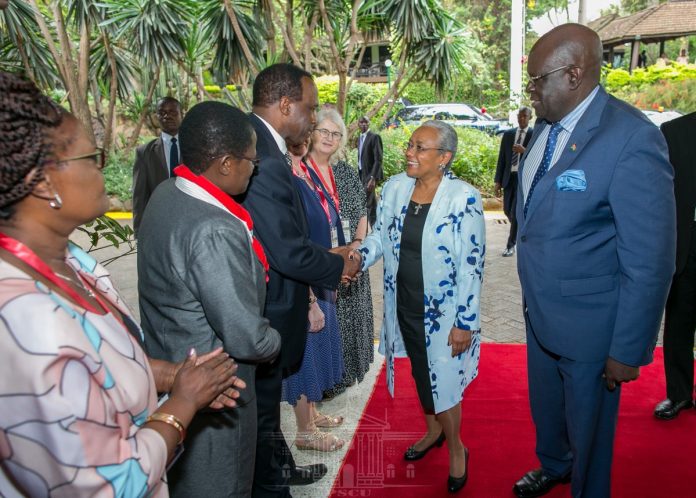
First Lady Margaret Kenyatta calls on Governments to invest more in nursing services


First Lady Margaret Kenyatta has challenged governments to invest more resources in public health nursing so as to achieve aspirations of high quality healthcare provision for all.

She said public health nursing is central to the functioning of any health system and should therefore be adequately resourced in terms of manpower, equipment and continuous capacity building.

“It will certainly benefit all our healthcare systems if we invest in building a strong cadre of public health nurses, through rigorous training, specialization and practice to enhance their skills, ” the First Lady said.

The First Lady who spoke when she presided over the official opening of the 5th Global Network for Public Health Nursing (GNPHN) Conference at a Nairobi hotel expressed gratitude that the country has intensified the training, development and deployment of public nurses.

“In my work and visits to health centres across Kenya, I have witnessed the role of nurses and community health workers as key influencers in the health and wellbeing of patients, communities and the populations they serve,” she said.

The public nursing conference whose theme is “Public health nurses achieving sustainable development goals (SDG) 3-Good health and wellbeing,” is being held in Africa for the first time.

First Lady Margaret Kenyatta called on the conference participants, who are drawn from across the world, to work together on finding solutions to not only the identified challenges facing the public nursing profession but the entire public health sector.

“The evolving role of public health nursing will be a conversation that you will be considering over the next three days, because we have to avert preventable diseases, provide better care and improve the quality of life of our people, by focusing on community health promotion and prevention,” she said.

She noted that a strong health system requires a competent and caring workforce pointing out that globally, nurses provide over 80% of healthcare services.

“I have seen your hard work, your combined talents and dedication. You are the first point of contact with the community – sometimes braving very challenging conditions,” she added.

While commending the First Lady for being a role model in public health provision through her Beyond Zero Initiative, Education CS Prof George Magoha said he will continue working closely with his health counterpart to ensure the country grows its nursing workforce to meet internationally set standards.

The cabinet secretary further said the government will ensure the highly trained Kenyan nurses are retained in the country by taming the emigration of local nurses into other countries.

“We need to train more nurses, employ them, retain them and empower them,” Prof Magoha said.

Health Cabinet Secretary Sicily Kariuki said Kenya’s efforts to achieve Universal Health Coverage (UHC) can only be realized through skilled and motivated medical staff.

She pointed out that global health challenges require global partnerships and expressed optimism that the three-day conference will come up with resolutions that will help resolve some of the challenges facing the public health sector especially nursing services.

Other speakers included University of Nairobi Vice Chancellor Prof Peter Mbithi and the Chairman of the Global Network for Public Health Nursing Prof Linda Smith among others.

How African countries are doing in ballooning digital music revenues

Last year was a good one for the music recording industry. After years of decline 2018 marked the fourth consecutive year of growth in music industry revenues. According to the International Federation of the Phonographic Industry, this was driven by a significant rise in “digital” revenues which accounted for nearly 60% of the total.

The federation also points out that the music industry is now more “global” than ever thanks to the successes of Korean and Latin American artists, among others. But one very important music market is missing from the federation’s report: the African continent.

This is especially problematic given the remarkable developments in digital music distribution through mobile devices that have emerged in many African countries. Although the rise of digital media technologies has created new forms of intermediation and interdependence worldwide, the changes in African music sectors don’t simply mirror what’s happened in the West.

Our research provides a window into what’s happened on the continent. It sheds light on how mobile telecommunications and technology firms have transformed business practices and revenue flows in the music sectors of Kenya and Ghana. Our data relate to just two countries. But we believe that our insights are relevant to music industries across Africa.

Our work suggests that while new modes of distribution using mobile telecommunications networks offer real alternatives to piracy, African musicians continue to struggle to reap significant benefits.

Digital distribution in Africa

There are vast differences in both music styles and market economies across the continent’s 54 countries. But there are some features that are common across most. These include a combination of weak recorded music distribution networks, relatively unregulated digital markets, a legacy of unlicensed music distribution (including “piracy”), tensions between cultural rights and copyright, and widespread disruptive effects of digital innovations.

The rapid and pervasive uptake of smartphones and mobile internet has driven African music sectors along a different path of digitalisation than in the west. This has meant that power has been placed in the hands of different sorts of firms. In Kenya, for example, digital music distribution relies on two kinds of firms: “mobile service providers” (telecom networks) and “digital content firms”.

The digital content firms provide customised ringtones, ringback tones (where the caller hears a song paid for by the callee), music downloads and music streaming.

Firms of both types have become key players in Kenya’s music industry over the past decade. They have expanded their activities beyond distribution, into audio and video production, talent management and award shows. This has solidified their hold over the industry. The CEOs of a mobile service provider or the principle of a digital content firm are the Kenyan music moguls of the 21st century.

This new reality poses new challenges for African music economies and, especially, African musicians.

Mutual interests

Recorded music distribution has always been tied up with the technology firms that have sold playback devices. Radios, record players, CD players and digital music players only appeal to consumers if they facilitate music playback and give access to a large catalogue of music. This has historically helped to align the interests of companies selling music playback devices and companies selling recorded music – often, companies have sold both. Apple’s foray into media distribution is no exception to this.

Across Africa, however, there is one key difference: internet access is widespread, but “unlimited” broadband access via cable is rare. Instead, most internet access is mobile. And “unlimited” internet access is very rare. Mobile service providers sell “data bundles”. But demand for data relies on customers having a need for data. This is where music comes in.

Musicians need access to paying customers in the absence of reliable distribution mechanisms. Mobile service providers need to sell data to compete in cutthroat telecom markets. And mobile hardware manufacturers require connectivity and “content” to make their multimedia devices attractive.

Given the strong reliance of Africans on mobile, these companies need each other. As they developed economies of scale in a huge market, musicians (or, to be more precise, music rights holders) are not necessarily getting their fair share of the proceeds.

Benefits

In 2016 Kenyan gospel singer Eunice Njeri, one of the most popular artists on Liberty Afrika’s music distribution platform, lamented:

I got to see the accounts and how much my songs, which were signed to Liberty Afrika, make and I am not happy … I was told my song made Sh1 million in a six-month period, when in fact it had made about Sh24 million.

This anecdote suggests that mutual interests and the promise of revenues have enticed musicians to collaborate with mobile service providers, digital content firms and mobile hardware manufacturers. But ultimately, musicians have a limited bargaining position that leaves them as vulnerable to exploitation as they have always been.

The problem is that the political economy of music distribution goes unchecked. Despite the promise of better opportunities, music sectors remain a market constrained by distribution bottlenecks. In technical terms, music markets are oligonomic in character. This means that intermediaries (labels, distributors, promoters, media outlets) continue to act act as an oligopoly – when a few sellers control a particular market – towards audiences and as an oligopsony – a market with many sellers, but few buyers – towards musicians.

In the best of cases, fierce competition between mobile service providers gives the most popular musicians some leverage over whom they sign brand marketing deals with. But most musicians have little or no leverage when it comes to being paid a fair share of revenues from digital music services.

Digital rising

The global rise of digital music distribution is undeniable. But who reaps the profits when digital disruption occurs? And how can we make sure music distribution through mobile networks across Africa is reflected in global industry data?

Currently, the International Federation of the Phonographic Industry is not paying enough attention to the nature of music economies on the African continent. This needs to change.The Conversation

Christiaan De Beukelaer, Lecturer in Cultural Policy, University of Melbourne and Andrew J. Eisenberg, Assistant Professor of Music, New York University Abu Dhabi

This article is republished from The Conversation under a Creative Commons license. Read the original article.

President Uhuru mourns the Family of the Late Jeremiah Kiereini, the Former Head of Public Service

President Uhuru Kenyatta has sent a message of condolence and encouragement to the family, friends and relatives of former Head of Public Service and Secretary to the Cabinet Jeremiah Gitau Kiereini who died late last evening.

In his message, the President described the late Kiereini as a towering reform minded public servant and patriotic Kenyan who served his country with distinction.

President Kenyatta said the late Kiereini remains an important part of Kenya’s public service history because of his many achievements key among them being the role he played in the modernization of the Kenyan military when he served as Permanent Secretary in the Ministry of Defence.

“Mr. Kereini was a polished patriot and loyal Kenyan who served this country with dedication as a public servant for over 30 years rising through the ranks to the position of Head of Public Service and Secretary to the Cabinet,” said the President.

The President pointed out that the many reforms the late Kiereini initiated while at the helm of the civil service as the Head of the Public Service and Secretary to the Cabinet forms the foundation upon which current successes in the sector are being realised.

“Indeed his sterling performance at the helm of the public service gave us the foundation upon which the successes we are witnessing in the sector today are anchored,” the President said.

After retirement from the public service, Mr Kiereini transitioned into the private sector by being appointed Chairman of the Kenya Breweries Board (KBL) in 1988, a company he later transformed into the East African Breweries Limited.

The late Kiereini served on the boards of several companies including Unga Group Limited, CMC Holdings, CFC Stanbic, Heritage Insurance and CFC Life among others.

The President prayed to God to give the family the comfort and fortitude at this difficult period of mourning.

Police Officer arraigned in Court for the Attempted Murder of a Woman

BY PRUDENCE WANZA – A Police officer was yesterday arraigned in court for attempting to kill one Maureen Adoyo by shooting her with a firearm.

He is alleged to have committed the crime on the 10th of May 2019 at capital hill police canteen in upperhill area in Nairobi.

The accused, Charles Kiwerwa pleaded not guilty before Chief Magistrate Martha Mutuku at Milimani Law Courts.

He was released on a bond of Sh. 500,000 or an alternative cashbail of Sh. 500,000.

The case will be heard on 11th June, 2019 and the mention on 27th May, 2019.

Women Suffering In Disasters should Be A Thing Of The Past– And Here’s Why

Hundreds of Mozambicans were killed and thousands made homeless recently by Cyclones Idai and Kenneth. Almost immediately, there were reports of a sadly familiar story: women being forced to trade sex for food by local community leaders distributing aid.

Globally, international organisations appear to be grappling with the issue more seriously than before. Yet reports about sexual exploitation keep coming. How does the aid community strategise to protect women’s safety in disaster situations?

Over the past 15 years, I have done research on sexual exploitation of displaced women in Uganda and Colombia. I have also worked with a variety of humanitarian organisations on accountability and legalisation. Through this, I have identified the factors necessary to bring justice to the victims of predatory aid workers.

Sexual exploitation must be recognised as a real and widespread problem. There must be staff and management accountability. Transgressions must be sanctioned through disciplinary or penal measures. But there are also major dilemmas that need to be understood and tackled by governments, agencies and, most importantly, local communities.

Sexual exploitation in aid

The sexual exploitation of disaster and conflict victims is a global – and longstanding – phenomenon. Over the last 25 years, there have been radical changes in the standards of global public morality around the conduct of personnel working for international organisations and NGOs when vulnerable adults and children are involved.

Nevertheless, the willingness to see sexual exploitation as an inherent feature of the international community’s intervention to bring development, humanitarian aid or peace has been much slower to evolve.

It was only 24 years ago that UNHCR issued guidelines on sexual violence and refugees that expressly mentioned international refugee workers as being implicated in sexual violence against refugees.

The sexual abuse of vulnerable women and girls in several African countries by international aid workers was recently described as “endemic”. It was also noted that perpetrators easily moved around the sector undetected.

Several recent cases have been reported from Cote d’ivore, to the Democratic Republic of the Congo, Namibia, Liberia, Sierra Leone, South Sudan and the Central African Republic.

These have involved aid workers and peacekeepers, as well as local aid workers and government employees.

In my research on refugees, accusations concerning “sex for resettlement” registration surface regularly. I found these to be frequent while working on refugee resettlement in Kampala 15 years ago. Despite the UNHCR’s promise to reform, similar accusations keep resurfacing, most recently in Kenya. The time has come for the international community to seriously debate the power mechanisms embedded in the resettlement process that enable sexual exploitation to fester.

What will fix the problem?

The first step is to organise accountability.

Humanitarian accountability first emerged as a concern in the 1980s. It was institutionalised in the 1994 Code of Conduct for the International Red Cross and Red Crescent Movement and NGOs in Disaster Relief . The 1996 Joint Evaluation of Emergency Assistance to Rwanda was a defining moment.

That report resulted in several sector-wide initiatives. Five years ago efforts were made to streamline these in the revised Core Humanitarian Standards.

Throughout this period, sexual exploitation has been considered the worst possible behaviour humanitarian workers can be guilty of. But it has not been clear what constitutes exploitation and in which relationships it takes place. The lack of a definition, the unwillingness to articulate and enforce robust norms for professional behaviour and the absence of effective complaint mechanisms and protections for whistle-blowers have contributed to a culture of impunity for predatory behaviour against aid recipients.

Early policy responses to sexual exploitation were concerned with reputational issues. But over the past 15 years the humanitarian sector has seen a flurry of institutional initiatives to grapple with this specific issue. The effort to prevent sexual exploitation and abuse is led by the Inter-Agency Standing Committee.

The aid sector is now engaging in “safeguarding exercises”. These emerged after the Oxfam scandal in Haiti. The organisation was seen as failing to act on sexual misconduct by staff in the aftermath of the 2010 earthquake, and then to have attempted a cover-up.

Safeguarding includes all actions by aid actors to protect staff from harm (abuse, sexual harassment and violence) and to ensure staff do not harm beneficiaries.

This broad definition represents both a welcome recognition of the scope of the problem and an opportunity for a comprehensive approach. But it also creates some new challenges. Three are particularly worth noting.

The challenges

Who gets a voice: There has been vocal concern about the lack of inclusiveness in how safeguarding is practised. Critics have noted that a safeguarding industry was hatched with little attention to local and national context or participation. There is a view that safeguarding is yet another Western-centric practice. I think this critique is true. But it also creates a dilemma: should global norms about sexual exploitation in international aid be up for local negotiation?

Regulation and criminalisation. In recent years, there have been calls to regulate foreign aid actors more robustly. This is understandable. Aid actors have operated with a great deal of license and even impunity under the humanitarian banner. But drawing up new laws also creates problems. This is particularly true in a context where African civil society generally is under pressure from new restrictive laws that curtail their activities.

Responding to the call to “do something”, the international community has embraced criminalisation and criminal prosecutions to promote and strengthen the fight against impunity. But opting for criminal law and the courtroom rests on a deeply simplistic framing of structural power imbalances in aid. Legal strategies are costly and slow. The focus on sexual violence in disasters and conflicts also risks crowding out concern for other aspects of women’s lives.

Localisation: Since 2016 there has been a significant focus on the localisation of aid. The Charter for Change focuses on contracting, resource allocation, transparency and communication. It highlights the importance of not undermining local capacity. The process is generally painfully slow and a shockingly small percentage of international aid funding is actually allocated to local actors.

At the same time, there is a persistent call for international actors to do, control and know more about what goes on locally to limit corruption, incompetence and abuse. This call comes partly from media in donor states addressing taxpayers, but also from watchdogs within the sector.

This is also the case for sexual exploitation. In its report, Human Rights Watch demands that “international partners, particularly the UN, should ensure greater oversight of the conduct of local officials during the distribution of humanitarian aid”. This will not come for free.

The question is how a balance can be found between control and localisation – and who gets to determine what this balance should be.The Conversation

Kristin Bergtora Sandvik, Research Professor in Humanitarian Studies and Professor of Sociology of Law, Department of Criminology and Sociology of Law, University of Oslo, Peace Research Institute Oslo (PRIO)

This article is republished from The Conversation under a Creative Commons license. Read the original article.

Create a free account, or log in.

Gain access to read this content, plus limited free content.

Yes! I would like to receive new content and updates.

Sponsored Ad

Ad 1
Ad 2
Ad 3
Ad 4
Ad 5
Ad 6